How do I support without taking over?
5 min read
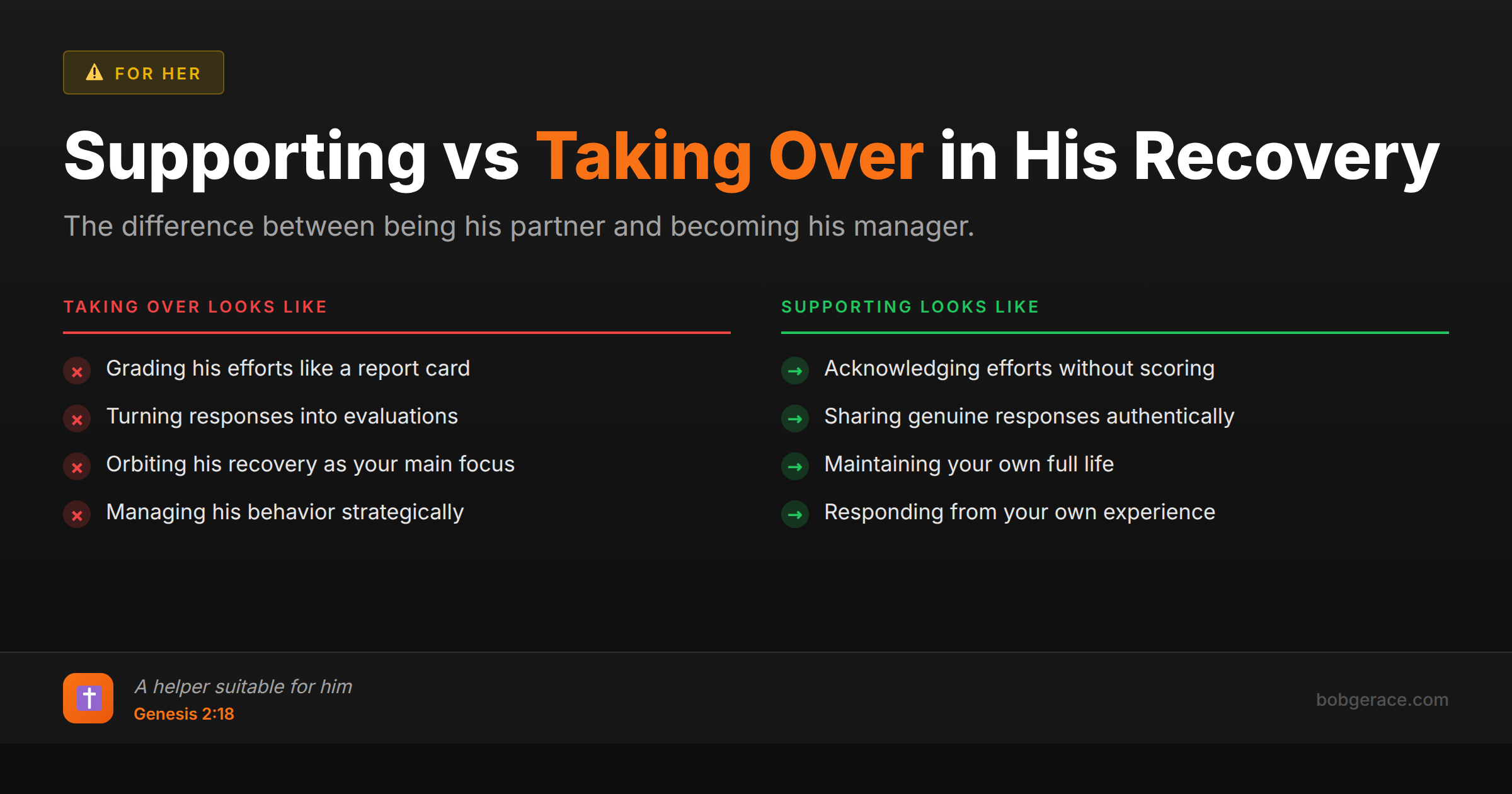
Supporting without taking over means staying emotionally present while letting him carry his own weight. It's the difference between being his partner and being his manager. Practically, this looks like: acknowledging his efforts without grading them, sharing your genuine responses without turning them into evaluations, and maintaining your own life rather than orbiting his recovery. You can express appreciation when you notice positive changes without turning into a cheerleader. You can share honestly when something concerns you without delivering lectures or ultimatums. You can ask about his experience without interrogating his progress. The key distinction is motivation: are you responding authentically from your own experience, or are you strategically managing his behavior? One connects; the other controls. Supporting means you're alongside him in the process. Taking over means you've made yourself responsible for his outcomes. The former is sustainable and healthy; the latter will exhaust you and undermine his growth. He needs to develop his own internal motivation and accountability—which only happens when you create space for it.
The Full Picture
The line between support and takeover can feel impossibly thin when you've spent years compensating for his gaps. You've likely become skilled at anticipating problems, managing situations, and holding things together—skills developed out of necessity, not desire. Now you're being asked to step back, and everything in you resists. What if he fails? What if stepping back means things fall apart?
Here's the hard truth: if his transformation only works because you're managing it, it's not really transformation. It's performance. And performance always eventually collapses under real pressure. For him to develop genuine change, he needs to own it completely—including the struggle, the stumbles, and the recovery. Your over-involvement, however well-intentioned, can actually prevent this.
So what does healthy support look like?
Be honest about your experience without making it his assignment. If something he did hurt you, you can say that—you should say that. But you're sharing your reality, not handing him a task list. 'That really hurt' is different from 'You need to apologize and here's how.' One is authentic expression; the other is management.
Acknowledge what you notice without grading it. When you see genuine effort, you can name it: 'I noticed you handled that differently.' That's very different from keeping score: 'That's twice this week you've done better, but you still failed three times.' One encourages; the other monitors.
Stay curious rather than interrogative. 'How's it going with your coaching?' opens conversation. 'What did you work on today? What did you learn? Are you doing your assignments?' is an audit. He has a coach for accountability. You're his wife.
Maintain your own life. Your wellbeing cannot be contingent on his progress. You need your own support systems, your own growth work, your own sources of stability. If you're entirely focused on his transformation, you'll become anxious, controlling, and eventually resentful—none of which help him or you.
Hold your boundaries. Boundaries aren't about controlling him; they're about protecting yourself. 'I'm not okay with being spoken to that way, and I'm going to step away from this conversation' is a boundary. 'You need to speak to me differently or else' is an ultimatum designed to change his behavior. One takes care of you; the other tries to manage him.
Let natural consequences happen. If his choices have negative results, resist the urge to soften or prevent them. Consequences are powerful teachers. Your protection may feel loving, but it often delays the very growth you want to see.
Clinical Insight
Attachment theory illuminates why stepping back feels so threatening. In anxious attachment patterns—often developed when you've had to be hypervigilant to manage relational instability—any reduction in monitoring feels like abandonment of your own safety. Your nervous system interprets 'letting go of //blog.bobgerace.com/electromagnetic-marriage-physics-control-field/:control' as 'accepting danger.' Recognizing this helps: the anxiety you feel when stepping back isn't necessarily accurate signal that something is wrong. It may be your attachment system reacting to unfamiliar territory.
Psychological research on motivation distinguishes between extrinsic and intrinsic motivation. Extrinsic motivation comes from external rewards or consequences—performing to avoid your disapproval or gain your praise. Intrinsic motivation comes from internal values and genuine desire. Only intrinsic motivation produces lasting change. When you provide constant external feedback, you may accidentally keep him in extrinsic mode, preventing the development of internal drivers.
The concept of differentiation in marriage therapy describes the capacity to maintain your own sense of self while remaining emotionally connected to your partner. Healthy support requires differentiation: you can be present to his experience without losing yourself in it. You can care about his progress without your identity depending on it. This is harder than it sounds, especially after years of enmeshment or survival-mode functioning.
Research on enabling behaviors shows that actions intended as support can inadvertently reinforce the patterns you want to change. Rescuing him from consequences, managing logistics to prevent his failure, providing emotional labor he should handle himself—these feel supportive but often perpetuate dysfunction. True support sometimes looks like stepping back and allowing difficulty.
Biblical Framework
Genesis 2:18 describes woman's creation as 'a helper suitable for him.' The Hebrew word ezer, translated 'helper,' is the same word used for God helping Israel—it implies strength offered in alliance, not subservience or management. A helper comes alongside, providing strength the other lacks, without taking over their fundamental responsibilities. This is the biblical picture of support: powerful presence without control.
Galatians 6:2-5 contains an apparent paradox: 'Carry each other's burdens' (verse 2) followed by 'each one should carry their own load' (verse 5). Different Greek words are used: 'burden' (baros) refers to crushing weights too heavy for one person; 'load' (phortion) refers to a soldier's pack, the responsibility each must carry themselves. Your job is helping with crushing weights when genuinely needed—not carrying his daily pack for him.
Proverbs 14:1 states: 'The wise woman builds her house, but with her own hands the foolish one tears hers down.' Building a house is different from building your husband. You contribute to your household's health through your wisdom, your character, your faithfulness—not through managing your husband's transformation. That's not your house to build; it's his.
Consider also Jesus' approach to His disciples. He taught them, walked with them, challenged them—but He didn't do their faith development for them. When Peter needed to learn hard lessons, Jesus let him fail, then restored him. The pattern is engagement without takeover, presence without control. Christ's disciples had to own their own transformation, even as He remained faithfully present.
Action Steps
-
1
Before speaking, ask yourself: am I sharing my experience or trying to manage his behavior?
-
2
Practice observation without commentary—notice changes without immediately processing them aloud.
-
3
Invest in your own support system: friends, counselor, community, so you're not dependent on his progress.
-
4
When tempted to rescue or manage, pause and ask what he might learn if you step back.
-
5
Hold your boundaries clearly while releasing attempts to control his responses to them.
-
6
Celebrate progress internally before deciding whether to verbalize it—not every observation needs expression.
Related Questions
- What's my role in his transformation?
- What should I expect during this process?
- How do I take care of myself through this?
- How long does real change actually take?
- What if I can't get past it?
- Do I need my own support?
- How do I know if he's really changing?
- What are the markers of genuine behavior change?
- What does healthy coping look like?
- How do I set boundaries without controlling?
Also find Bob on
Subscribe for weekly videos on Christian marriage.
Think This Could Help Your Husband?
If you believe your husband could benefit from the structured transformation process we offer, share this with him. Real change is possible when men commit to the work.
Learn About the Program →