What is 'bearing one another's burdens'?
6 min read
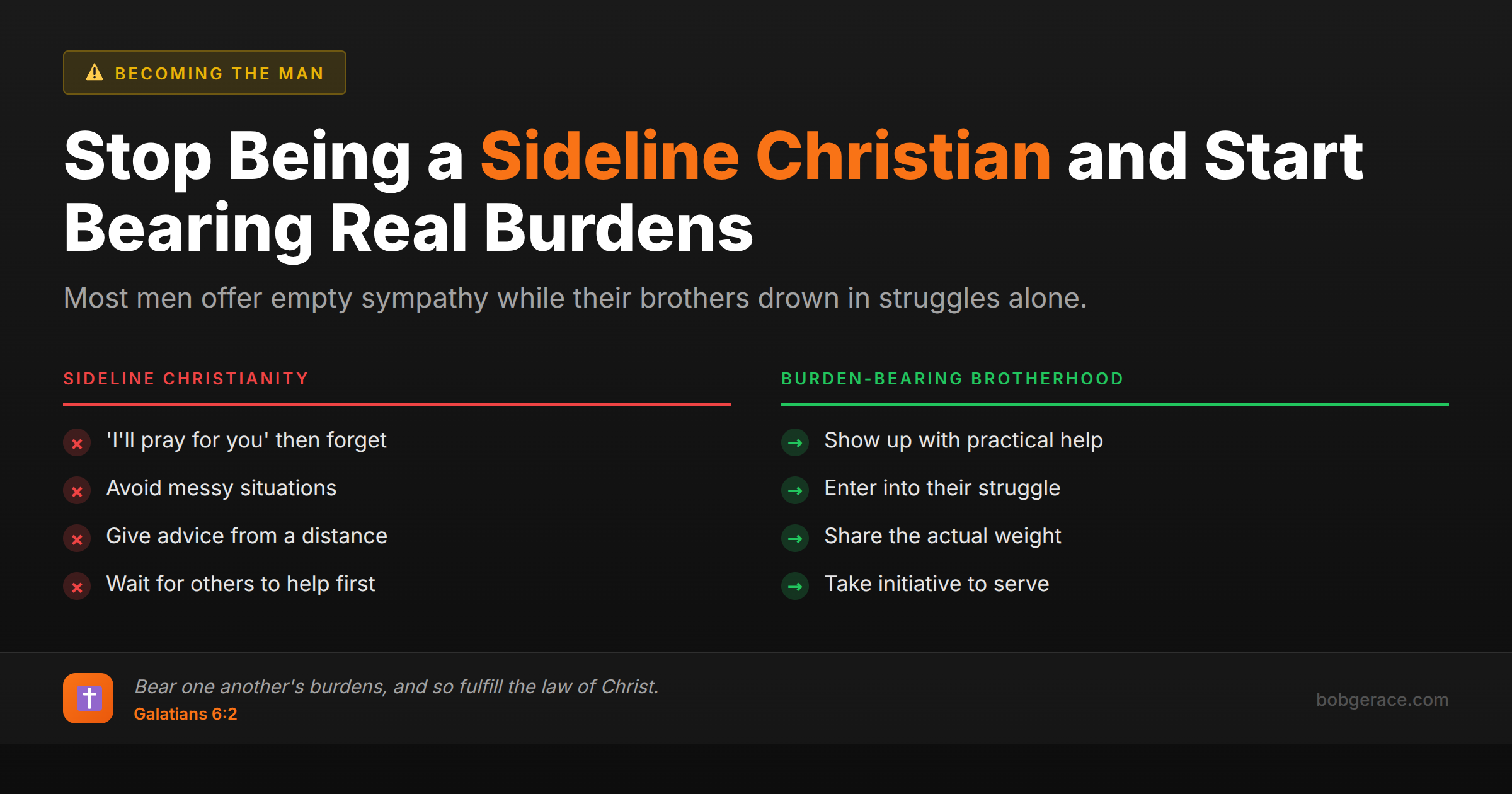
Bearing one another's burdens, from Galatians 6:2, means actively sharing in and helping carry the struggles, challenges, and difficulties that your brothers face. It's not just offering sympathy or saying 'I'll pray for you' – it's rolling up your sleeves and getting involved in practical, meaningful ways. This could mean financial help during job loss, emotional support during marriage struggles, or physical assistance during illness. The Greek word 'baros' refers to a heavy load that would crush someone if carried alone. As Christian men, we're called to step into each other's battles, not stand on the sidelines. This principle transforms marriages because when husbands learn to bear burdens with other men, they become better equipped to share their wives' burdens rather than avoiding or minimizing them.
The Full Picture
Most Christian men have completely misunderstood what it means to bear one another's burdens. We've turned it into a nice sentiment instead of a radical call to action. The apostle Paul wasn't suggesting we be supportive cheerleaders – he was commanding us to literally share the crushing weight of life's hardest moments.
The word 'burden' in Galatians 6:2 is the Greek word 'baros,' which refers to something so heavy it would overwhelm or destroy a person if carried alone. Think of a load that would break your back. Paul is saying that when your brother is facing something that could break him – whether it's financial ruin, marriage crisis, health issues, or spiritual warfare – you don't just offer to pray. You get under that load with him.
This is where most Christian men fail miserably. We've been conditioned to handle everything alone, to never appear weak, to solve our own problems. But biblical manhood is the exact opposite. It's about creating a brotherhood where no man faces his giants alone.
In marriage, this principle is game-changing. When husbands learn to authentically share burdens with other men, they develop the emotional muscles needed to truly carry their wives' burdens. They stop trying to fix everything and start sharing the weight. They stop minimizing their wives' struggles and start entering into them fully.
The result? Wives feel truly partnered with instead of managed. They experience their husbands as allies in their battles rather than judges of their struggles. This is what transforms marriages from functional partnerships into covenant relationships where both spouses feel deeply known and supported.
What's Really Happening
From a therapeutic standpoint, burden-bearing creates what we call 'distributed coping' – the psychological phenomenon where shared stress becomes manageable stress. When men isolate with their problems, cortisol levels remain elevated, decision-making becomes impaired, and depression/anxiety increase significantly.
But here's what I see consistently: men who practice authentic burden-bearing with other men develop higher emotional intelligence, better stress regulation, and significantly improved marital satisfaction. They learn to co-regulate emotionally, which is a critical skill for healthy marriages.
The neurological impact is profound. When we share burdens authentically, it activates the brain's attachment system and releases oxytocin, which reduces stress hormones and increases feelings of connection and trust. This is why isolated men often struggle with depression, anger, and relational disconnection.
In marriage therapy, I consistently see that husbands who have strong burden-bearing relationships with other men are far better at emotional attunement with their wives. They've practiced sitting with difficult emotions without trying to immediately fix or escape. They've learned that sometimes the greatest gift is simply sharing the weight.
Conversely, men who try to bear all burdens alone often become either controlling (trying to manage everyone else's problems) or withdrawn (overwhelmed by the weight). Neither pattern serves marriages well. The most emotionally healthy husbands I work with have learned to both give and receive support from other men, which translates directly into healthier marriage dynamics.
What Scripture Says
Scripture is crystal clear about our call to mutual burden-bearing, and it's far more radical than most churches teach:
Galatians 6:2 - *"Bear one another's burdens, and so fulfill the law of Christ."* This isn't a suggestion – it's how we literally fulfill Christ's law of love. The word 'bear' means to take up, carry, and endure together.
Ecclesiastes 4:12 - *"Though one may be overpowered, two can defend themselves. A cord of three strands is not quickly broken."* God designed us for mutual support. The battles that would destroy us individually become winnable when fought together.
1 Thessalonians 5:14 - *"And we urge you, brothers and sisters, warn those who are idle and disruptive, encourage the disheartened, help the weak, be patient with everyone."* Notice the active verbs: warn, encourage, help. This is hands-on involvement, not passive sympathy.
Romans 15:1 - *"We who are strong ought to bear with the failings of the weak and not to please ourselves."* The strong carry the weak – not judge them, not lecture them, not abandon them.
James 5:16 - *"Therefore confess your sins to each other and pray for each other so that you may be healed."* Healing happens in community, through confession and mutual prayer.
1 Corinthians 12:26 - *"If one part suffers, every part suffers with it; if one part is honored, every part rejoices with it."* We're designed as a body where individual pain becomes collective responsibility.
This isn't about creating codependent relationships – it's about creating the kind of brotherhood that makes men dangerous to the enemy and irresistible to their wives.
What To Do Right Now
-
1
Identify one man in your life who's carrying a heavy burden right now and reach out to him today with specific, practical help
-
2
Confess to a trusted brother one burden you've been carrying alone and ask for his support and prayer
-
3
Create a regular check-in rhythm with 2-3 men where you share real struggles, not just surface-level updates
-
4
Practice burden-bearing with your wife by asking 'How can I share this weight with you?' instead of trying to fix her problems
-
5
Join or start a men's group that prioritizes authentic sharing over Bible study performance or casual fellowship
-
6
Make a commitment to never again say 'I'll pray for you' without also offering tangible, practical support
Related Questions
Ready to Build Real Brotherhood?
Stop carrying your burdens alone. Let me help you develop the kind of authentic relationships that will transform both your marriage and your walk with God.
Get Support →