What should I expect during this process?
5 min read
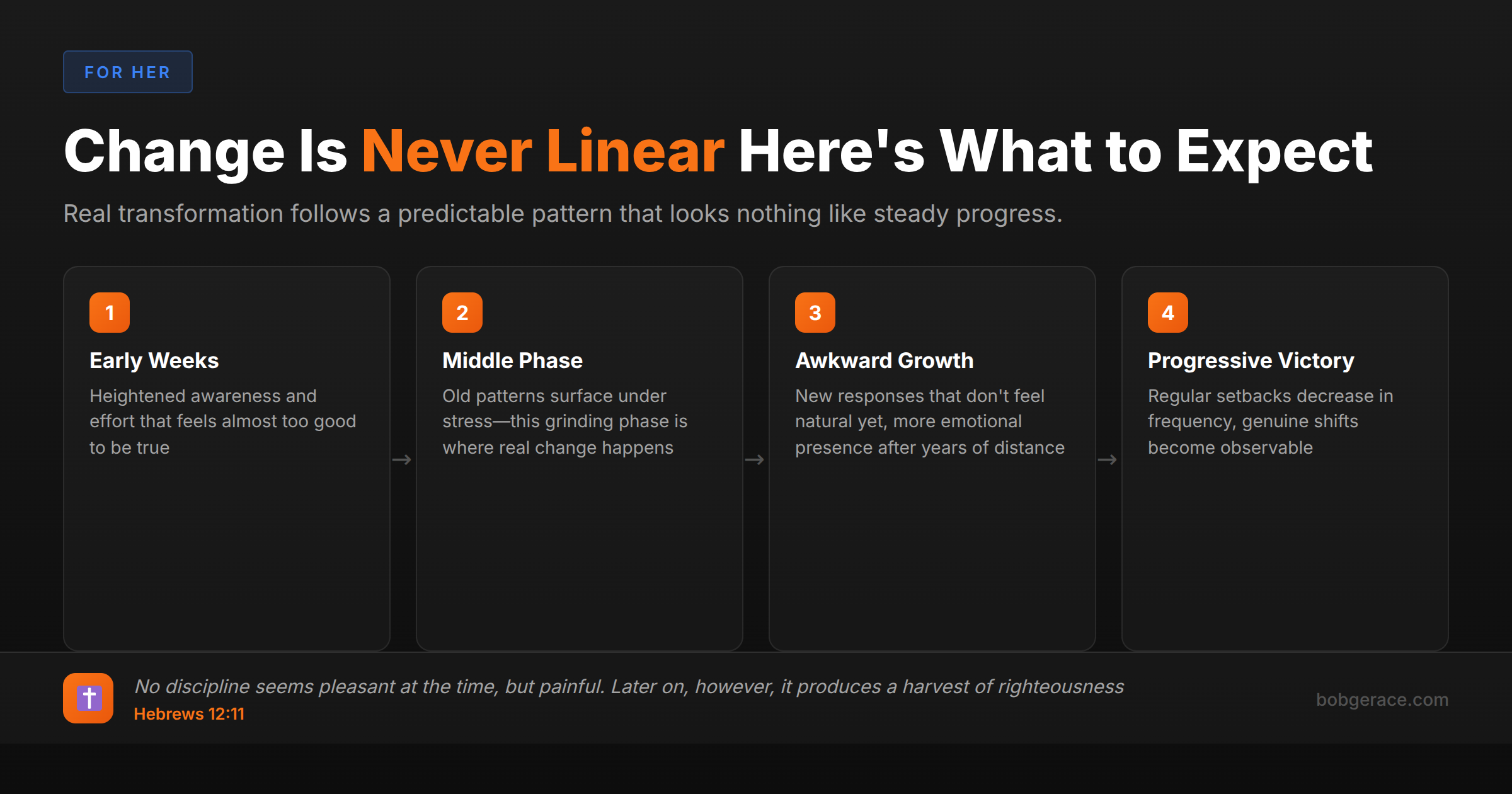
You should expect a process that's genuinely nonlinear—progress will not be smooth or constant, and that's actually a sign it's real. In the early weeks, you may see heightened awareness and effort that feels almost too good to be true. This often gives way to a harder middle phase where old patterns surface under stress and the work feels like grinding. This isn't failure; it's where real change actually happens. Expect him to be more reflective and possibly more emotionally present—which can feel unfamiliar after years of distance. Expect some awkwardness as he tries new responses that don't yet feel natural. You may also expect moments where you wonder if anything is actually different, followed by moments where you notice something has genuinely shifted. The process includes regular setbacks that decrease in frequency and intensity over time. What you shouldn't expect is perfection, overnight transformation, or a straight line from broken to whole. What you can expect is observable evidence of genuine effort, increasing self-awareness, and progressive improvement in how he handles the moments that used to go badly.
The Full Picture
Understanding what lies ahead helps you interpret what you're seeing accurately—distinguishing between normal process and genuine red flags. Here's a realistic map of the terrain.
The first few weeks often bring noticeable effort. He may be more attentive, more communicative, more careful with his words and responses. This can feel hopeful, but it can also feel suspicious—you've seen this before, and it didn't last. That skepticism is earned. The difference this time is what's happening beneath the surface: he's not just trying harder, he's learning why previous efforts collapsed and building different foundations.
Weeks three through six typically bring the first real test. Initial motivation fades. Old patterns reassert themselves, especially under stress. You may see him slip back into familiar reactions—then catch himself, apologize, and try again. This stumbling phase is actually critical. It's where the gap between knowing what's right and automatically doing what's right gets bridged. His response to his own failures matters more than whether failures occur.
The middle phase—roughly weeks six through ten—is often the grittiest. The novelty has worn off. The work feels tedious. Old habits feel easier. This is where many previous attempts died. The daily accountability and brotherhood support exist specifically for this valley. Watch for whether he's still engaging even when it's hard, still showing up even when he doesn't feel like it.
As you approach and pass the 90-day mark, you should see new responses becoming more automatic. The changes that required conscious effort start feeling more natural. He handles triggering situations differently without having to think through each step. The trajectory, while still imperfect, clearly points upward.
Throughout this process, expect increased emotional expression. Men in this work often access feelings they've suppressed for years. This might mean more vulnerability but also potentially more processing out loud. Expect some conversations to feel unfamiliar—deeper than your usual exchanges.
Expect him to reference new language and frameworks—the Four Theaters, Core 4 domains, pattern recognition. This isn't jargon for jargon's sake; it's a shared vocabulary that helps him understand and articulate what's happening internally.
Also expect that your own responses will be challenged. As he changes, the relational dynamic shifts. Patterns you've both settled into get disrupted. This is ultimately good, but it can feel destabilizing in the moment. Growth in one partner always affects the other.
Clinical Insight
Research on behavior change reveals a pattern called the 'extinction burst'—when someone begins eliminating a habitual behavior, the behavior often temporarily intensifies before it fades. This counterintuitive phenomenon explains why things sometimes seem worse before they get better. The brain, facing threat to established patterns, throws more resources at maintaining them. If you see old behaviors flare temporarily, this may actually indicate the change process is working, not failing.
Psychologist Albert Bandura's work on self-efficacy demonstrates that sustainable change requires not just new behaviors but new beliefs about one's capacity to perform those behaviors. This internal shift happens through mastery experiences—small successes that build confidence. Early in the process, these wins may be invisible to you but significant to him. Over time, they compound.
The Kübler-Ross change curve, adapted from grief research, maps how people move through transitions: shock, denial, frustration, depression, experimentation, decision, and integration. Your husband may move through these stages—and they're not linear. He may cycle //blog.bobgerace.com/soul-restoration-marriage-leading-her-back/:back through frustration multiple times before reaching stable integration. Understanding this prevents misinterpreting normal process as failure.
Research also shows that social support during change is one of the strongest predictors of success. The brotherhood component provides accountability he can't manufacture alone. Your support, while not the same as professional accountability, also matters—though it's important you don't carry responsibility for his success. You're his wife, not his coach or his conscience.
Expect variability. Human change is messy. Statistical improvement looks like decreasing frequency and intensity of problems over time, not immediate elimination. The trend line matters more than any single data point.
Biblical Framework
Scripture prepares us for the reality that growth includes struggle. Hebrews 12:11 states: 'No discipline seems pleasant at the time, but painful. Later on, however, it produces a harvest of righteousness and peace for those who have been trained by it.' The verse acknowledges present pain while pointing toward future fruit. The training process is uncomfortable by design—not because God is harsh, but because transformation requires it.
Peter's journey illustrates what this process looks like. He declared absolute loyalty to Jesus at the Last Supper, then denied knowing Him three times before dawn. After the resurrection, Jesus didn't reject Peter for his failure—He restored him and commissioned him. Peter went on to become a pillar of the early church. His transformation wasn't instant or linear. It included catastrophic failure, grief, restoration, and eventually, genuine change.
Proverbs 24:16 observes: 'For though the righteous fall seven times, they rise again.' Notice: the righteous fall. Not the wicked—the righteous. Falling isn't what distinguishes the categories; rising is. As you watch your husband's process, look for the rising more than you count the falling.
James compares the testing of faith to refining precious metals—a process requiring sustained heat and repeated purification. The impurities don't release all at once. Each heating cycle removes more. The result is something genuinely pure, but the process is neither quick nor pleasant.
What God is doing in your husband may look messy from the outside. Growth often does. But Scripture consistently presents that messiness as part of authentic transformation rather than evidence against it.
Action Steps
-
1
Keep a private note of changes you observe—both encouraging and concerning—to track trajectory over time.
-
2
Prepare yourself emotionally for nonlinear progress rather than expecting steady improvement.
-
3
Distinguish between concerning patterns and normal stumbles in the learning process.
-
4
Give yourself permission to feel uncertain—you don't have to decide immediately whether it's 'working.'
-
5
Notice how he responds to his own mistakes: defensiveness versus ownership indicates more than the mistakes themselves.
-
6
Communicate observations when helpful without monitoring or scorekeeping his every move.
Related Questions
- How long does real change actually take?
- What is this program actually teaching him?
- What's my role in his transformation?
- How do I support without taking over?
- What if I see effort but not results yet?
- How will I know if it's actually working?
- What does real transformation look like?
- How long does recovery take?
- What are the 'stages of change'?
Also find Bob on
Subscribe for weekly videos on Christian marriage.
Think This Could Help Your Husband?
If you believe your husband could benefit from the structured transformation process we offer, share this with him. Real change is possible when men commit to the work.
Learn About the Program →