What's my role in his transformation?
5 min read
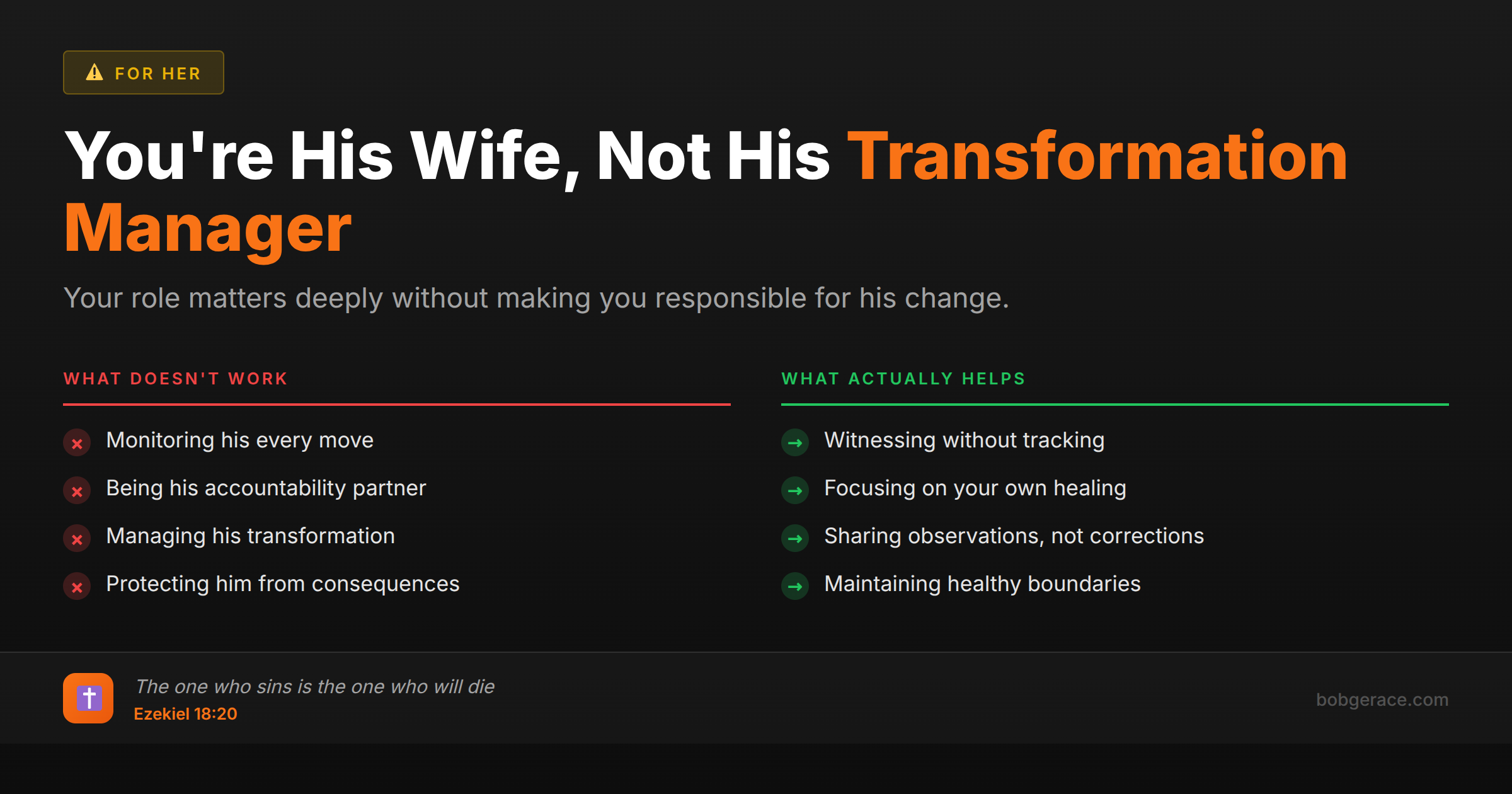
Your role is significant but bounded—you matter deeply to his transformation without being responsible for it. You are his wife, not his coach, accountability partner, or rehabilitation program. That distinction protects both of you. Your presence in his life provides context and motivation for change. The marriage you might rebuild together is part of what he's fighting for. But the daily work of transformation—the internal battles, the pattern recognition, the accountability—that's his to do with his coach and brotherhood. What you bring to this process is irreplaceable: you're the person who will live with the man he becomes. Your observations matter. Your needs and boundaries matter. Your responses to his changes matter. But you cannot do his work for him, and trying to will exhaust you while preventing him from developing the internal strength he needs. Think of yourself as a witness to his transformation rather than its architect. You'll see things his coach won't see—how he handles daily life, stress, conflict. Your perspective is valuable. But witnessing is different from managing.
The Full Picture
You've likely spent years trying to manage, fix, or improve your husband through sheer force of will, clear communication, pleading, ultimatums, or carefully managed consequences. None of it produced lasting change—not because you did it wrong, but because transformation doesn't work that way. One person cannot change another person from the outside. Change happens inside-out, and only the person changing can do that internal work.
This reality isn't meant to diminish your importance—it's meant to free you from an impossible job you never should have been assigned. You are not his rehabilitation specialist. You're his wife. Those are fundamentally different roles with different responsibilities.
So what is your role? You are a witness to his process—someone who sees him in daily life, outside the coaching context. You notice things: Is he handling stress differently? Does he catch himself before reacting? Is he more present, more engaged, more aware? Your observations are valuable data, both for you in assessing whether this is working and potentially for him in understanding his blind spots.
You are also a person with your own needs, boundaries, and responses. Part of his work is learning to attend to you differently—but he can only do that if you're actually present with your real feelings rather than managing or suppressing them to avoid rocking the boat. Your authentic responses teach him things his coach cannot.
You are the potential future he's working toward. Healthy men don't transform in a vacuum—they have something to build toward. The possibility of a restored marriage, of genuine partnership, of the intimacy you both wanted but couldn't create—that vision matters. You don't have to promise anything or guarantee outcomes. Simply being in process yourself, watching and evaluating, is enough.
You are not his accountability partner. He has a coach and a brotherhood for that. When you take on the accountability role, you become something other than his wife—and that never ends well. Wives who monitor their husbands' progress become exhausted enforcers rather than partners. His accountability belongs to men who can hold him without the relational stakes you carry.
You are not responsible for his success or failure. If he does the work and transforms, that's his victory. If he resists the work and fails, that's his failure. You will be affected by either outcome, but you didn't cause either one. Releasing this false responsibility is essential for your own wellbeing.
Clinical Insight
Family systems theory identifies roles that develop in dysfunctional relationship patterns: the overfunctioner and the underfunctioner. When one partner takes excessive responsibility for the relationship's health—managing, monitoring, compensating—the other partner often takes correspondingly less responsibility. This dynamic is self-reinforcing: the more you do, the less he needs to, which means you need to do more, which means he does even less.
Breaking this cycle requires both partners to change their positioning. For you, this means stepping back from responsibilities that rightfully belong to him. This feels counterintuitive when you've been holding things together for years. It may even feel like abandonment or giving up. It's actually the opposite—it's creating space for him to step into his own responsibility.
Codependency research reveals that attempts to //blog.bobgerace.com/romans-7-marriage-crisis-scripture-control/:control or change a partner, however well-intentioned, often produce paradoxical effects. The more you push, the more he resists. The more you monitor, the less internal motivation he develops. The more you rescue him from consequences, the less he learns from them. Your job isn't to step away from the marriage—it's to step out of the change-agent role you were never designed to fill.
Psychologist Harriet Lerner's work on relationship patterns emphasizes that real change in a system often requires one person to change their own behavior without demanding reciprocal change. This isn't about accepting poor treatment—it's about focusing on what you actually control. You control your responses, your boundaries, your engagement. You don't control his transformation.
The daily accountability structures in his program exist precisely so you don't have to provide them. The brotherhood exists so other men carry the confrontation weight. Your job is simpler and harder: be his wife, stay present to your own experience, and let him do his work.
Biblical Framework
Ezekiel 18:20 declares: 'The one who sins is the one who will die. The child will not share the guilt of the parent, nor will the parent share the guilt of the child.' This principle of individual moral responsibility runs throughout Scripture. Each person stands accountable for their own choices, their own repentance, their own transformation. You cannot do his spiritual work for him any more than he could do yours for you.
First Corinthians 3:6-7 describes different roles in growth: 'I planted the seed, Apollos watered it, but God made it grow. So neither the one who plants nor the one who waters is anything, but only God, who makes things grow.' You may plant seeds—through your presence, your words, your responses. His coach may water. But the growth itself is between him and God. You are not the one who makes things grow.
Peter's first letter addresses wives in difficult marriages directly: 'Wives, in the same way submit yourselves to your own husbands so that, if any of them do not believe the word, they may be won over without words by the behavior of their wives, when they see the purity and reverence of your lives' (1 Peter 3:1-2). Note what this passage doesn't say: it doesn't say to manage, fix, correct, monitor, or control. It describes a posture of living authentically while entrusting outcomes to God.
This doesn't mean passivity or acceptance of mistreatment. It means your primary work is your own walk with God, your own integrity, your own wholeness. His transformation is his work and God's work. Yours is to steward your own soul while remaining present to the process.
Action Steps
-
1
Release the monitoring role—notice what he's doing without tracking, scoring, or managing it.
-
2
Focus energy on your own wellbeing rather than fixing him—you have your own restoration work.
-
3
Share observations when genuinely helpful rather than as tests or corrections.
-
4
Maintain your own boundaries—these are about what you need, not about controlling his behavior.
-
5
Allow natural consequences rather than protecting him from the results of his choices.
-
6
Remember that being his wife is enough—you don't have to be his coach, mother, or conscience.
Related Questions
- How do I support without taking over?
- What should I expect during this process?
- How long does real change actually take?
- What is this program actually teaching him?
- How will I know if it's actually working?
- Should we be doing couples work too?
- What does real transformation look like?
- How do I know if he's really changing?
- What are markers of genuine remorse vs. guilt?
- What does rebuilding trust require from her?
Also find Bob on
Subscribe for weekly videos on Christian marriage.
Think This Could Help Your Husband?
If you believe your husband could benefit from the structured transformation process we offer, share this with him. Real change is possible when men commit to the work.
Learn About the Program →