What is 'white-knuckling' vs. internalized change?
6 min read
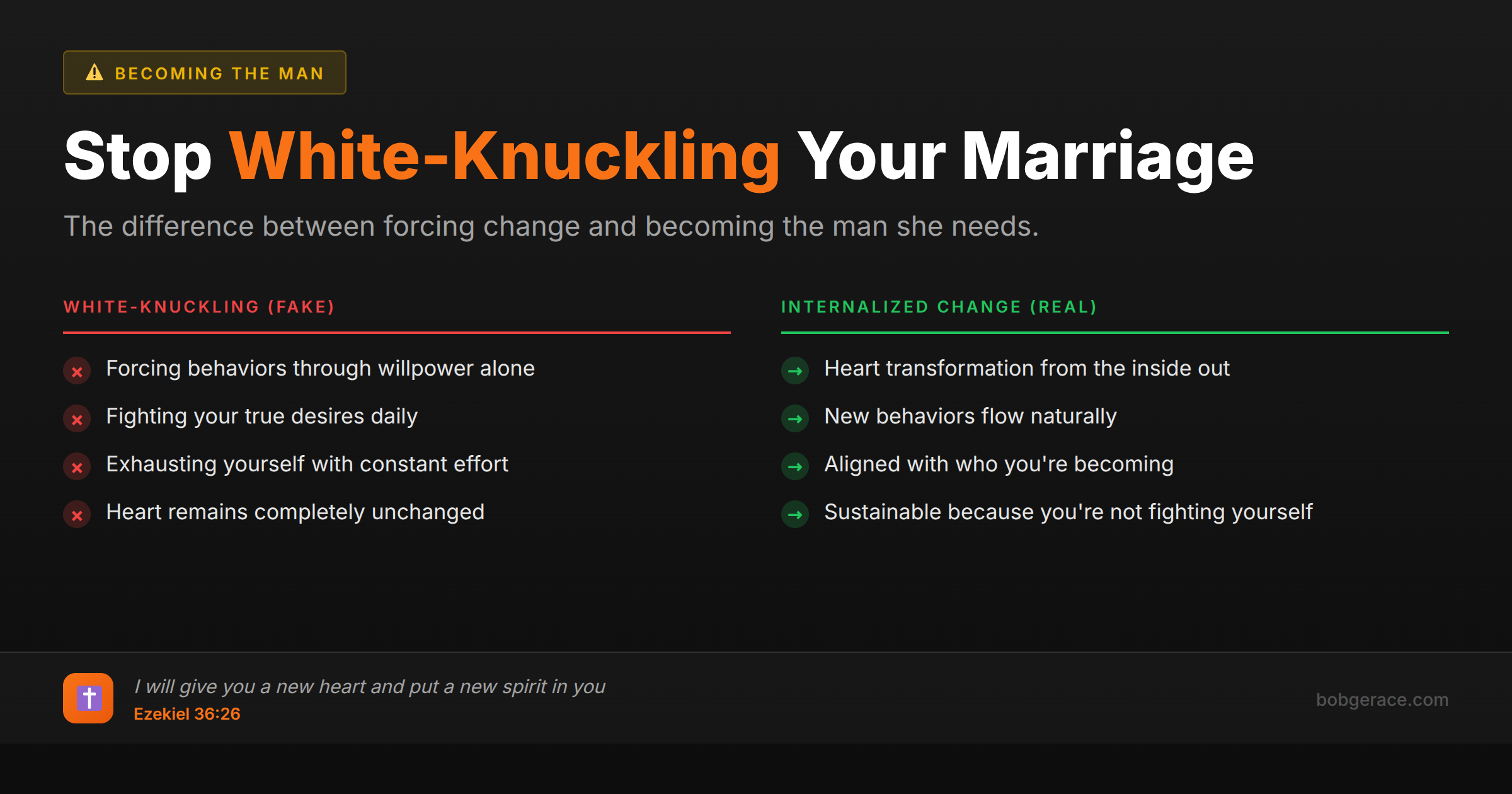
White-knuckling is forcing yourself to behave differently through sheer willpower while your heart remains unchanged. It's like gripping something so tightly your knuckles turn white - you're holding on by force alone. This approach is exhausting and ultimately unsustainable because you're fighting against your true desires and motivations. Internalized change, on the other hand, is genuine transformation from the inside out. Your heart, mind, and motivations actually shift, making new behaviors flow naturally from who you're becoming rather than what you're forcing yourself to do. This creates lasting change because you're not constantly battling yourself - you're aligned internally with the person you want to be.
The Full Picture
Think about the difference between holding your breath underwater and learning to swim. White-knuckling is like holding your breath - you can do it for a while, but eventually you'll gasp for air and surface. Internalized change is like becoming a swimmer - you've developed the skills and capacity to naturally navigate the water.
White-knuckling looks like: - Forcing yourself to be kind while seething with resentment inside - Staying faithful through gritted teeth while fantasizing about alternatives - Saying the right words while your heart harbors bitterness - Following rules and behaviors without understanding or embracing the why - Constantly fighting urges and impulses that feel overwhelming - Feeling exhausted from the constant internal battle
Internalized change looks like: - Kindness flowing from genuine care and understanding - Faithfulness rooted in deep love and commitment - Words that reflect actual heart transformation - Behaviors that align with your values and identity - Natural responses that don't require constant self-monitoring - Energy and peace because you're not fighting yourself
The problem with white-knuckling is that it's built on willpower alone, and willpower is a finite resource. You can maintain it for days, weeks, maybe even months, but eventually you'll hit a wall. When you're stressed, tired, or facing unexpected challenges, that forced control often crumbles. This is why people can seem to be doing well in recovery or growth, then suddenly have a dramatic setback - they were white-knuckling instead of truly changing.
Internalized change takes longer to develop, but it's sustainable because it's not dependent on constant effort. It's become part of who you are.
What's Really Happening
From a clinical perspective, white-knuckling activates our sympathetic nervous system - the fight-or-flight response. You're literally in a state of chronic stress, using cortisol and adrenaline to maintain control. This is why white-knuckling feels so exhausting and why people eventually 'snap' or relapse.
Internalized change, however, engages neuroplasticity - your brain's ability to form new neural pathways. When someone truly internalizes change, we see different brain regions becoming active. The prefrontal cortex strengthens its connection to emotional regulation centers, and new thought patterns become automatic rather than forced.
This is why trauma work is so crucial in marriage recovery. If someone is white-knuckling their way through behavioral changes while underlying trauma, shame, or core wounds remain unaddressed, the change won't stick. The wounded parts of their psyche will eventually reassert control.
I often tell clients to pay attention to their internal dialogue. White-knuckling sounds like: 'I have to... I must... I can't let myself...' Internalized change sounds like: 'I want to... This matters to me because... I choose this because...' The motivation shifts from external pressure to internal conviction.
True internalized change requires processing emotions, addressing root causes, and developing new coping mechanisms. It's not just about behavior modification - it's about identity transformation. This is why effective therapy addresses not just what someone is doing, but who they believe themselves to be and what they truly value.
What Scripture Says
Scripture is crystal clear about the difference between external compliance and heart transformation. God has always been more interested in our hearts than our behavior, because He knows that genuine heart change produces lasting fruit.
Ezekiel 36:26 promises: *"I will give you a new heart and put a new spirit in you; I will remove from you your heart of stone and give you a heart of flesh."* This is internalized change - God transforms us from the inside out, not just managing our behavior.
2 Corinthians 3:18 describes the process: *"And we all, who with unveiled faces contemplate the Lord's glory, are being transformed into his image with ever-increasing glory, which comes from the Lord, who is the Spirit."* Real transformation is gradual, ongoing, and comes from spiritual connection, not willpower.
Jesus addressed white-knuckling directly in Matthew 23:25-26: *"Woe to you, teachers of the law and Pharisees, you hypocrites! You clean the outside of the cup and dish, but inside they are full of greed and self-indulgence. Blind Pharisee! First clean the inside of the cup and dish, and then the outside also will be clean."*
Romans 12:2 gives us the pathway to internalized change: *"Do not conform to the pattern of this world, but be transformed by the renewing of your mind."* Transformation happens through mind renewal, not behavior management.
Philippians 2:13 reveals the supernatural element: *"For it is God who works in you to will and to act in order to fulfill his good purpose."* When God works in us, He changes our desires (will) and our actions naturally follow.
The difference is clear: white-knuckling is human effort trying to produce godly results. Internalized change is allowing God to transform our hearts so that godly behavior flows naturally from who we're becoming in Christ.
What To Do Right Now
-
1
Honestly assess your current approach - are you forcing behaviors or experiencing heart change?
-
2
Identify areas where you're white-knuckling and acknowledge the exhaustion this creates
-
3
Begin asking 'why' questions - why do I want to change, why does this matter to me personally?
-
4
Address underlying issues like trauma, shame, or core wounds that drive destructive patterns
-
5
Develop spiritual practices that invite God's transformative work in your heart
-
6
Seek professional help to process root causes rather than just managing symptoms
Related Questions
- What does real transformation look like?
- What's the difference between fixing and transforming?
- How do I change from the inside out?
- Why do behavior changes alone not work?
- What is 'identity-based change'?
- What makes change sustainable vs. temporary?
- How do I know if he's really changing?
- What are the markers of genuine behavior change?
- What is 'white-knuckling' vs. real transformation?
- How long until new behaviors become automatic?
Also find Bob on
Subscribe for weekly videos on Christian marriage.
You Can't White-Knuckle Your Way Through This
A coach sees where you're forcing it and where the change hasn't landed yet. Bob works with you on what's actually happening in your marriage, not just the behavior checklist.
Talk to Bob →