What's the antidote to defensiveness?
6 min read
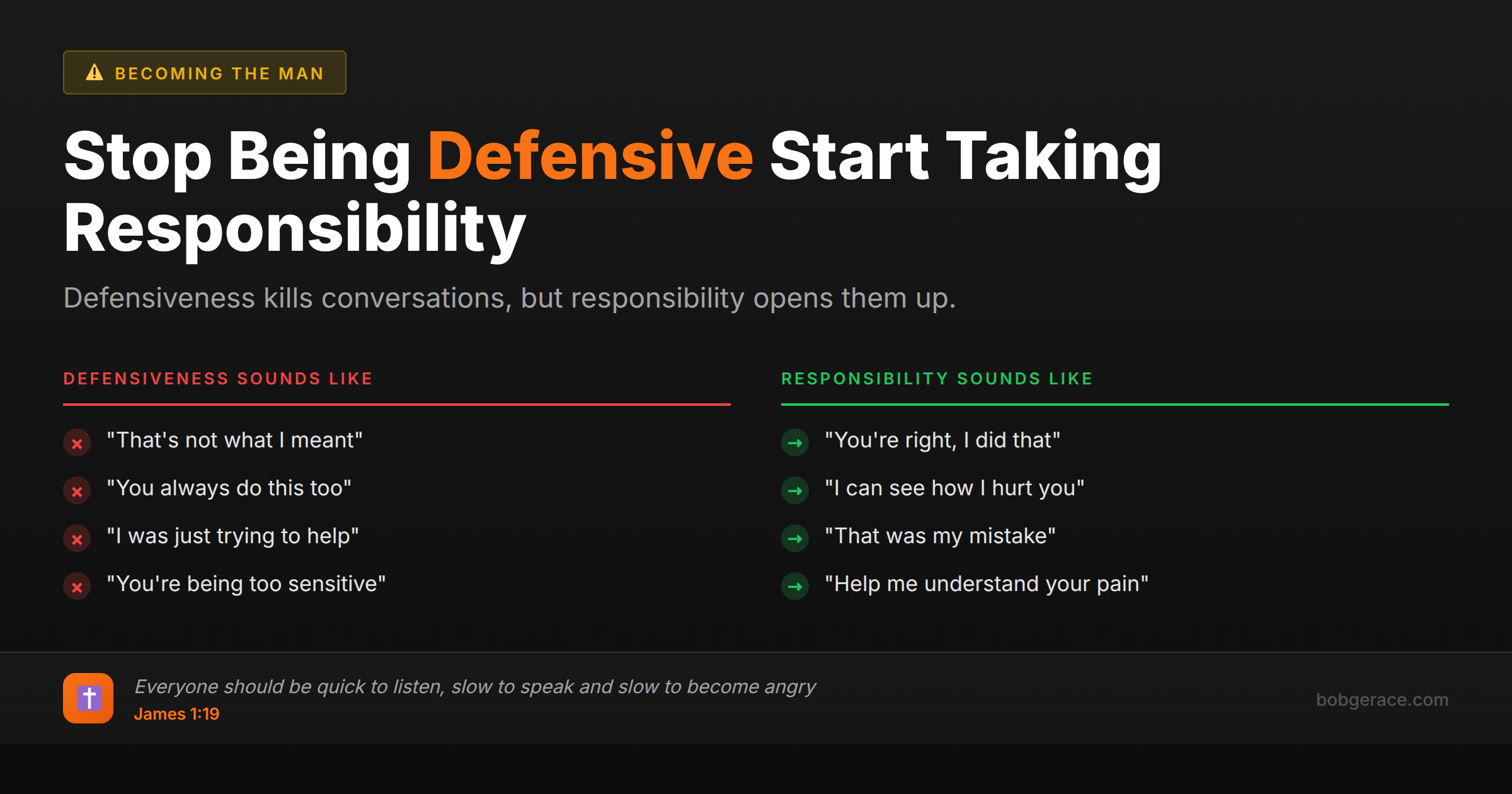
The antidote to defensiveness is taking responsibility - specifically, owning your part without deflecting, justifying, or counter-attacking. When your spouse brings up an issue, instead of explaining why you did what you did or pointing out their flaws, you say something like "You're right, I did that and I can see how it hurt you." This isn't about taking blame for everything or becoming a doormat. It's about having the courage to acknowledge your actual contribution to the problem. Most conflicts involve two people, and when you own your piece first, it creates safety for your spouse to eventually own theirs. Defensiveness kills conversations; responsibility opens them up.
The Full Picture
Here's what most people don't understand about defensiveness: it's not actually protecting you from anything real. You think you're defending yourself from attack, but what you're really doing is defending yourself from growth, intimacy, and the possibility of actually solving the problem.
Defensiveness shows up in predictable ways. You explain why you had to do what you did. You point out that your spouse does the same thing. You minimize the impact ("it wasn't that big a deal"). You question their motives or timing ("why are you bringing this up now?"). Every single one of these responses, no matter how "reasonable" they seem to you, communicates the same message to your spouse: "Your feelings don't matter, and I'm not safe to talk to."
The antidote isn't complicated, but it requires something most of us struggle with: the willingness to be wrong. Not wrong about everything, not wrong as a person, but wrong about this specific thing your spouse is bringing up. When you can say "You know what, you're right about that" or "I can see how my actions hurt you," something miraculous happens. The argument stops escalating.
Your spouse isn't looking for perfection. They're looking for acknowledgment. They want to know that their experience matters to you and that you're willing to take responsibility for your part in their pain. This doesn't mean you have to agree with everything they say or take blame for their reactions. It means you focus on what you actually did contribute instead of focusing on what you didn't do or what they did wrong.
The beautiful thing about taking responsibility first is that it often creates space for your spouse to do the same. Not always immediately, and you can't do it just to manipulate that outcome. But when people feel heard and validated, they're much more likely to examine their own behavior.
What's Really Happening
From a clinical perspective, defensiveness is a trauma response - your nervous system perceiving threat and activating fight-or-flight. When your spouse brings up a concern, your brain interprets it as an attack on your character, competence, or worth. The defensive response is your attempt to restore safety, but it actually creates more danger in the relationship.
Taking responsibility works because it down-regulates both nervous systems. When you acknowledge your partner's experience without defending, you're essentially saying "I'm not a threat to you, and you're not a threat to me." This moves both of you out of survival mode and into connection mode, where actual problem-solving becomes possible.
The neurological shift is measurable. Defensive responses trigger cortisol and adrenaline - stress hormones that make complex thinking nearly impossible. Responsibility responses trigger oxytocin and vasopressin - bonding hormones that increase empathy and cooperation. You're literally changing the brain chemistry of your interaction.
What makes this challenging is that taking responsibility requires distress tolerance - the ability to sit with uncomfortable feelings without immediately trying to fix or escape them. Most people defend because they can't tolerate feeling "wrong" or "bad," even temporarily. But learning to sit with that discomfort is what allows you to respond thoughtfully instead of reactively.
The clinical evidence is clear: couples who can take responsibility for their contributions to problems have significantly better outcomes in therapy and report higher relationship satisfaction. It's not about being perfect; it's about being accountable.
What Scripture Says
Scripture is crystal clear about the power of taking responsibility and the danger of defensiveness. James 1:19 tells us, "Everyone should be quick to listen, slow to speak and slow to become angry." This is the exact opposite of defensiveness, which is quick to speak and quick to anger.
Proverbs 28:13 says, "Whoever conceals their sins does not prosper, but the one who confesses and renounces them finds mercy." Defensiveness is concealment - hiding our faults behind explanations and excuses. Taking responsibility is confession that leads to mercy and restoration.
Jesus modeled this perfectly. Even though He was sinless, Philippians 2:6-8 tells us He "did not consider equality with God something to be used to his own advantage; rather, he made himself nothing by taking the very nature of a servant... he humbled himself." If Jesus could humble Himself when He had every right to defend Himself, how much more should we?
Matthew 7:3-5 addresses our tendency to focus on our spouse's faults while ignoring our own: "Why do you look at the speck of sawdust in your brother's eye and pay no attention to the plank in your own eye?" Defensiveness is speck-hunting - constantly pointing out what your spouse is doing wrong to avoid dealing with your own contributions.
Ephesians 4:15 calls us to "speak the truth in love," and sometimes the truth we need to speak is "I was wrong." 1 John 1:9 promises that "if we confess our sins, he is faithful and just and will forgive us our sins." This principle works in marriage too - confession leads to forgiveness and restoration.
What To Do Right Now
-
1
Notice your defensive triggers. Pay attention to what phrases or tones make you want to explain, justify, or counter-attack.
-
2
Practice the pause. When you feel defensiveness rising, take three deep breaths before responding. Ask yourself: "What part of this is actually true?"
-
3
Own your actual contribution. Focus only on what you did or didn't do, not your intentions or your spouse's behavior.
-
4
Use responsibility phrases. "You're right about that," "I can see how I hurt you," "That was my mistake," "I should have handled that differently."
-
5
Validate their experience. Even if you disagree with their interpretation, you can acknowledge that their feelings are real and understandable.
-
6
Ask for forgiveness specifically. Don't just say "I'm sorry" - say "I'm sorry for [specific action]. Will you forgive me?" Then wait for their answer.
Related Questions
- What is defensiveness in Gottman's Four Horsemen?
- What does 'taking responsibility' actually look like?
- How do I receive feedback without counter-attacking?
- What does a non-defensive response sound like?
- Why does feedback feel like attack?
- How do I separate behavior criticism from identity attack?
- What is 'felt understanding' and how do I give it?
- How do I not lose my mind right now?
Also find Bob on
Subscribe for weekly videos on Christian marriage.
Your Marriage Has Its Own Patterns
A coach who knows your story can see what triggers your defensiveness and help you interrupt it in real time. You don't have to figure out your specific version of this alone.
Talk to Bob →