What are the behavioral markers of defensiveness?
6 min read
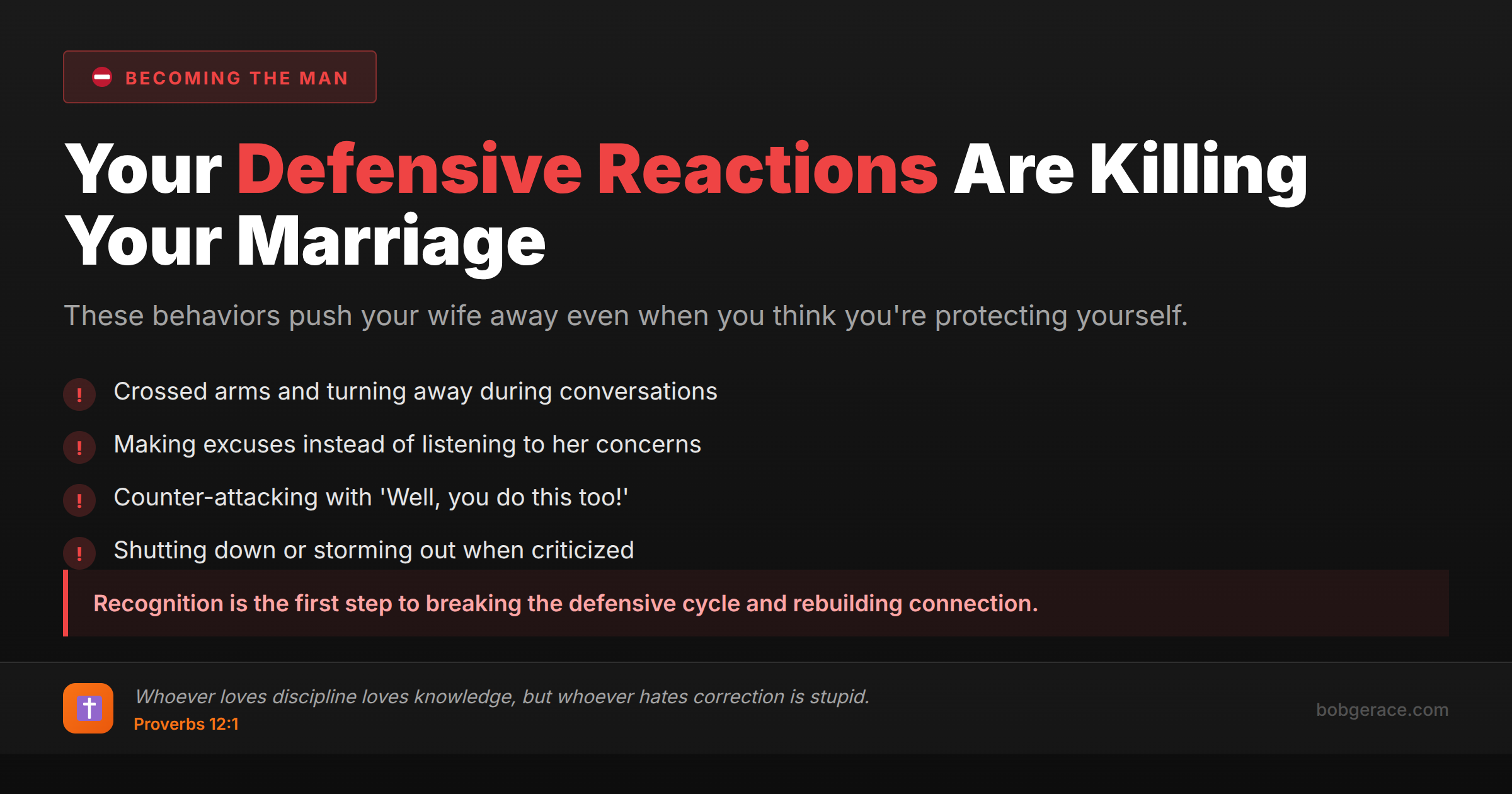
Defensiveness shows up through specific, observable behaviors that signal someone feels attacked or criticized. The most common markers include body language changes (crossed arms, turning away, eye-rolling), verbal patterns (making excuses, counter-attacking, deflecting blame), and emotional responses (raised voice, shutting down, storming out). These behaviors typically emerge when someone perceives threat to their character or competence, even when none was intended. Understanding these markers helps you recognize when defensiveness is hijacking your conversations and damaging your connection with your spouse.
The Full Picture
Defensiveness is like an alarm system that goes off when we feel criticized, blamed, or attacked. But here's the problem: this alarm system is often faulty, triggering even when there's no real threat. When defensiveness kicks in, it shows up in predictable ways that actually make things worse, not better.
Physical markers are often the first signs. Watch for crossed arms, turning the body away, rolling eyes, or creating physical distance. The person might lean back, cross their legs away from you, or literally put objects between you. Their facial expression often shifts to a scowl, raised eyebrows, or a look of disgust.
Verbal patterns become equally telling. Defensive people make excuses ("I was tired"), counter-attack ("Well, you do it too"), play victim ("You're always picking on me"), or deflect responsibility ("That's not what I meant"). They might bring up past grievances, use absolute language like "always" or "never," or completely deny what just happened.
Emotional responses escalate quickly. Voice pitch rises, speaking becomes rapid-fire, or the person might go completely silent and shut down. Some people storm out, slam doors, or give you the cold shoulder treatment. Others become overly emotional, crying or expressing hurt to avoid addressing the actual issue.
The key insight? These behaviors all serve the same purpose: protecting the person's sense of being right and avoiding responsibility. But they destroy intimacy and prevent real resolution. When you can spot these markers early, you can choose a different path forward.
What's Really Happening
From a clinical perspective, defensiveness is fundamentally a self-protection mechanism rooted in threat perception. When someone perceives criticism or blame, their nervous system activates a fight-or-flight response, even in seemingly minor conversations.
The behavioral markers we observe are neurobiological responses. The crossed arms and turning away represent the body literally creating barriers. Eye-rolling and facial expressions of contempt trigger mirror neurons in the observer, escalating conflict. These aren't conscious choices—they're automatic responses designed to protect self-esteem and maintain a positive self-image.
Verbally, defensive responses follow predictable patterns because they serve specific psychological functions. Counter-attacking shifts focus away from personal responsibility. Making excuses preserves the narrative that "I'm not a bad person." Bringing up past grievances attempts to level the playing field and reduce shame.
The emotional escalation occurs because defensiveness activates the limbic system while reducing prefrontal cortex activity—essentially, emotion overrides logic. This is why defensive people often can't "hear" what their partner is actually saying and instead respond to what they think is being said.
Understanding this helps couples recognize that defensiveness isn't malicious—it's protective. The goal isn't to eliminate the protection instinct but to create enough safety that the nervous system doesn't perceive threat in normal relationship conversations. This requires both partners to understand their roles: the defensive partner must learn to recognize their patterns, while the other must learn to approach sensitive topics in ways that don't trigger the defensive response.
What Scripture Says
Scripture addresses the heart issues behind defensive behavior with remarkable clarity. Proverbs 12:1 states, "Whoever loves discipline loves knowledge, but whoever hates correction is stupid." This isn't harsh judgment—it's honest assessment. When we become defensive, we're essentially rejecting wisdom and growth.
Proverbs 27:5-6 teaches us, "Better is open rebuke than hidden love. Wounds from a friend can be trusted, but an enemy multiplies kisses." Defensiveness prevents us from receiving the "wounds from a friend"—the honest feedback that could actually help us grow. Instead, we prefer the "kisses" of people who won't challenge us.
The Apostle Paul models non-defensive response in 1 Corinthians 4:3-4: "I care very little if I am judged by you or by any human court; indeed, I do not even judge myself. My conscience is clear, but that does not make me innocent. It is the Lord who judges me." Paul found security in God's opinion, not human approval, which freed him from defensive reactions.
James 1:19 provides the antidote to defensiveness: "My dear brothers and sisters, take note of this: Everyone should be quick to listen, slow to speak and slow to become angry." Defensive people do the opposite—they're slow to listen, quick to speak, and quick to anger.
Perhaps most importantly, 1 John 1:8-9 reminds us, "If we claim to be without sin, we deceive ourselves and the truth is not in us. If we confess our sins, he is faithful and just and will forgive us our sins." Defensiveness often stems from the inability to acknowledge our failures, but God's grace actually makes honesty safe.
The biblical path forward isn't self-protection—it's humble acknowledgment of our need for growth, trusting that God's love remains constant regardless of our failures.
What To Do Right Now
-
1
Record yourself during a disagreement (with your spouse's permission) and identify your specific defensive markers—this builds self-awareness
-
2
Create a "pause signal" with your spouse that either person can use when defensiveness appears, agreeing to take a 10-minute break
-
3
Practice the "partial ownership" technique—find one small thing you can acknowledge responsibility for, even when feeling defensive
-
4
Develop a pre-conversation prayer or breathing routine before discussing sensitive topics to calm your nervous system
-
5
Write down your top three defensive responses and prepare alternative responses in advance—practice these when you're calm
-
6
Schedule weekly "feedback sessions" where you practice giving and receiving input in a structured, safe environment
Related Questions
Ready to Break the Defensive Cycle?
Defensiveness doesn't have to control your conversations or damage your marriage. Let's work together to develop healthier communication patterns.
Get Help Now →