How do I be warm without being a doormat?
6 min read
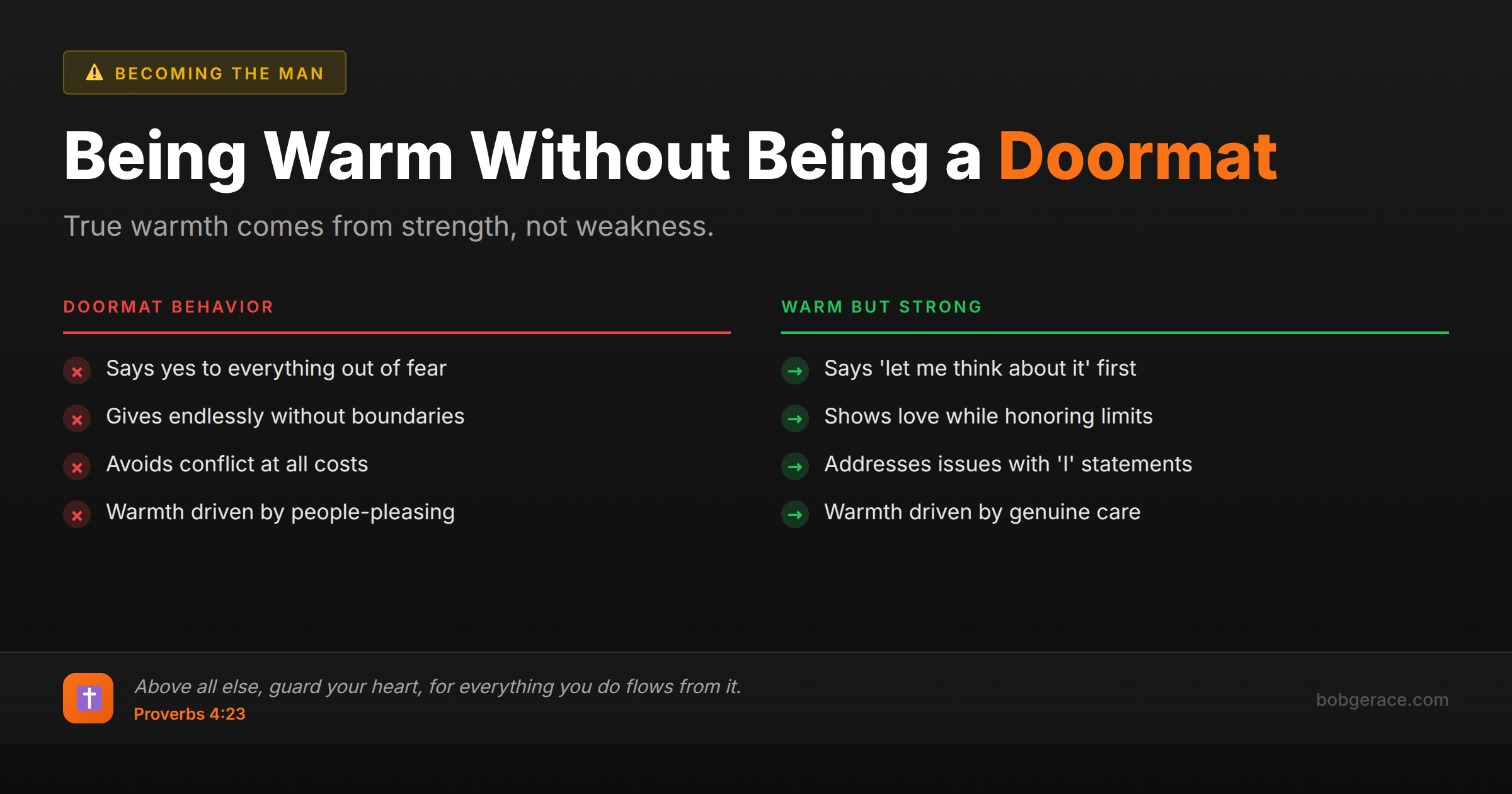
Being warm without being a doormat means maintaining your kindness and love while clearly communicating your limits and expectations. True warmth isn't about saying yes to everything - it's about being genuine, caring, and present while still honoring your own needs and values. The key is understanding that boundaries actually enhance intimacy rather than diminish it. When you're clear about what you will and won't accept, your warmth becomes more authentic because it's not driven by fear or people-pleasing. You can love deeply while still requiring respect and reciprocity in your relationship.
The Full Picture
Many women struggle with this balance because we've been taught that being loving means being accommodating. But there's a massive difference between healthy warmth and doormat behavior.
Healthy warmth comes from a secure place - you're kind because you choose to be, not because you're afraid of conflict or abandonment. Doormat behavior, on the other hand, stems from fear and often includes:
- Saying yes when you want to say no - Avoiding difficult conversations to keep the peace - Accepting disrespectful treatment to maintain connection - Prioritizing everyone else's comfort over your own well-being
The irony is that doormat behavior actually damages relationships over time. When you don't communicate your needs or enforce your boundaries, resentment builds. Your partner may lose respect for you, and you'll lose respect for yourself.
True warmth requires authenticity. It means:
- Being genuinely caring while maintaining your standards - Expressing your needs clearly and kindly - Showing affection without compromising your values - Creating safety for both yourself and your partner through consistent boundaries
This balance is especially crucial when dealing with marital challenges. You can be understanding and supportive while still requiring honesty, respect, and commitment to change. Your warmth becomes a gift you choose to give, not a desperate attempt to earn love or avoid conflict.
Remember: Boundaries aren't walls - they're gates. They help you determine who gets access to your heart and under what conditions. This actually makes your warmth more precious and meaningful.
What's Really Happening
From a psychological perspective, the doormat pattern often develops from attachment wounds and learned behaviors. Many women who struggle with this balance grew up in environments where their worth was tied to how well they met others' needs.
What we see clinically is that secure attachment allows for both warmth and boundaries. People with secure attachment styles can maintain emotional connection while advocating for themselves. They don't see boundaries as threats to the relationship - they see them as necessary for relationship health.
The doormat pattern is often driven by anxious attachment - the fear that setting boundaries will result in abandonment. This creates a cycle where the person gives more and more of themselves, hoping to earn security, but actually creates less respect and intimacy in the relationship.
Neurologically, when we operate from fear (fear of conflict, abandonment, or disappointing others), our prefrontal cortex - responsible for rational decision-making - becomes less active. We react from our emotional brain rather than responding from our wise, integrated self.
Healthy boundaries actually regulate the nervous system. When you know your limits and communicate them clearly, both you and your partner can relax into the relationship. There's clarity about expectations and safety in the structure you've created.
The goal isn't to become cold or defensive - it's to develop what we call differentiated warmth. This means you can be emotionally available and loving while maintaining your separate sense of self. You're not enmeshed or codependent, but you're also not disconnected or defensive.
What Scripture Says
God's design for relationships includes both love and wisdom, both grace and truth. Jesus himself modeled this perfectly - he was incredibly loving and compassionate, yet he never compromised his mission or allowed others to manipulate him.
"Above all else, guard your heart, for everything you do flows from it." - Proverbs 4:23. Guarding your heart doesn't mean building walls - it means being wise about who and what you allow to influence you.
"Instead, speaking the truth in love, we will grow to become in every respect the mature body of him who is the head, that is, Christ." - Ephesians 4:15. Truth and love aren't opposites - they work together to create healthy relationships.
"Be as shrewd as snakes and as innocent as doves." - Matthew 10:16. Jesus instructed his followers to be both wise and pure-hearted. You can be loving while also being discerning and protective of yourself.
"Let your 'Yes' be 'Yes,' and your 'No,' 'No.'" - Matthew 5:37. Clear communication and boundaries are actually biblical principles. When you mean what you say and say what you mean, you create trust and safety.
"Each of you should give what you have decided in your heart to give, not reluctantly or under compulsion." - 2 Corinthians 9:7. Even in giving and serving, God values our freedom to choose. Love that's given under pressure or fear isn't the kind of love God desires.
God himself sets boundaries - he's infinitely loving, yet he doesn't tolerate sin or compromise his holiness. His love is secure and consistent, but it comes with clear expectations and consequences.
What To Do Right Now
-
1
Identify one area where you've been giving too much or accepting too little - start with something small and specific
-
2
Practice saying 'Let me think about that and get back to you' instead of automatically saying yes to requests
-
3
Have one honest conversation about a boundary you need - use 'I' statements and focus on your needs, not their behavior
-
4
Show warmth through quality attention and genuine interest, not through constant accommodation or people-pleasing
-
5
Set one small, clear expectation and kindly but consistently enforce it - this builds your confidence in boundary-setting
-
6
Celebrate moments when you're both warm AND authentic - notice how it feels to be genuinely yourself while still being loving
Related Questions
- What boundaries should I set?
- What's the difference between boundary and ultimatum?
- How do I set boundaries without controlling?
- What does 'holding space' while 'holding boundary' look like?
- How do I stay connected while enforcing boundaries?
- What does 'detach with love' actually mean?
- Should I give her space or fight for her?
- What's the difference between pursuing and chasing?
- How do I pursue without pressuring?
- How do I honor her autonomy while fighting for us?
Also find Bob on
Subscribe for weekly videos on Christian marriage.
You Don't Have to Figure This Out Alone
Calibrating warmth and boundaries in your specific marriage takes a coach who knows your story. Bob works with you on what's actually happening in your relationship—not generic advice.
Talk to Bob →