What does 'detach with love' actually mean?
6 min read
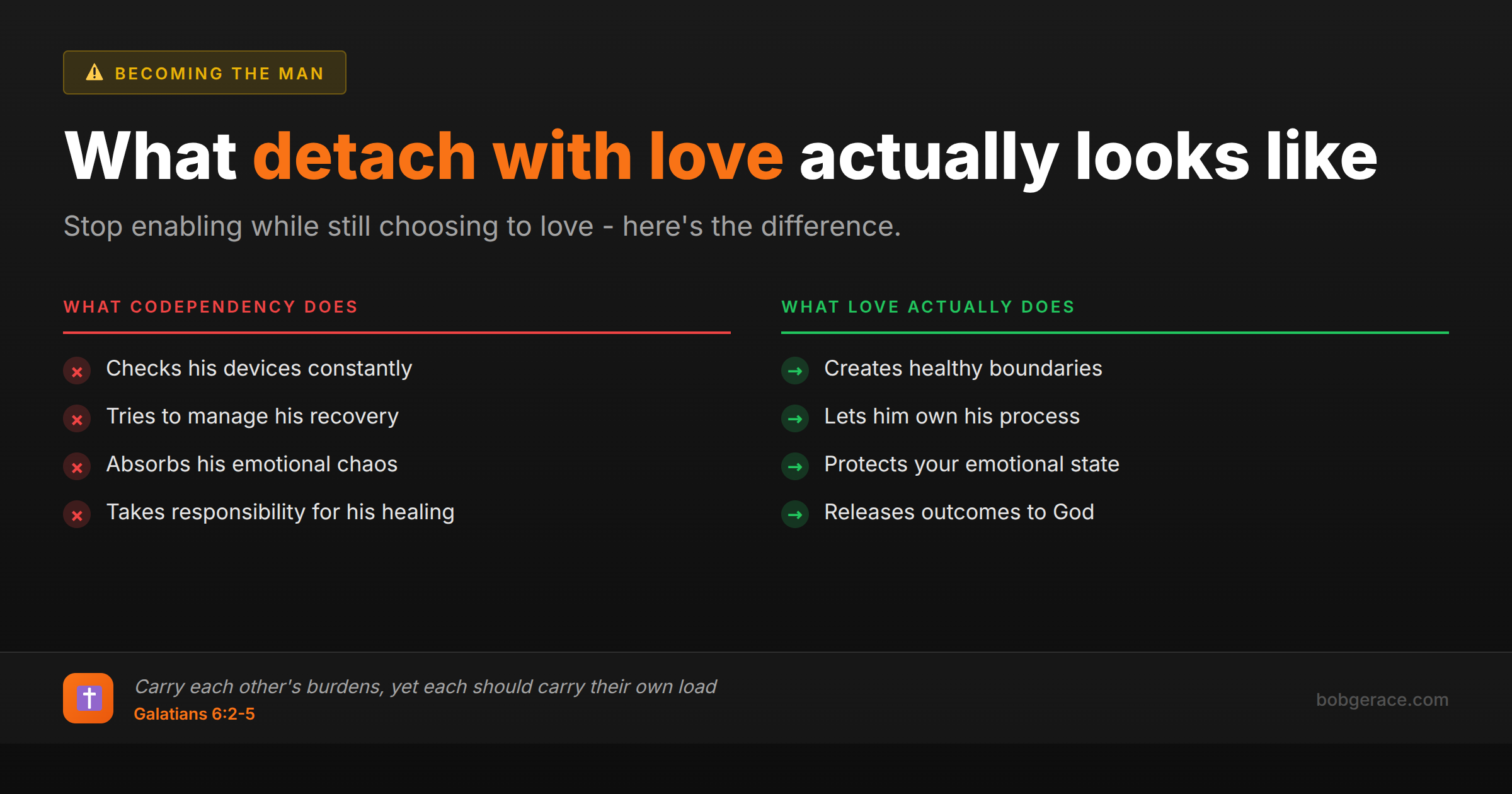
Detaching with love means creating emotional and sometimes physical distance from your spouse's harmful behaviors while still maintaining your commitment to love them as a person. It's not about becoming cold or indifferent - it's about protecting your heart and mind from the chaos of their choices while refusing to enable or control their actions. This means you stop trying to fix, rescue, or manage their recovery process. You release the outcome of their healing to God while setting clear boundaries about what you will and won't accept. You can love someone deeply while choosing not to absorb their emotional turmoil or allow their poor decisions to dictate your emotional state.
The Full Picture
Detaching with love is one of the most misunderstood concepts in marriage recovery. Many wives think it means becoming emotionally numb or giving up on their marriage entirely. Others fear it's unloving or goes against their wedding vows. The truth is, healthy detachment is actually one of the most loving things you can do - both for yourself and your husband.
Here's what detachment with love looks like in practice: You stop checking his phone obsessively. You don't interrogate him about his whereabouts every moment. You refuse to be his accountability partner or recovery manager. You create space for yourself to heal and process without constantly monitoring his progress or lack thereof.
But here's the crucial part - you do this from a place of love, not punishment. You're not withholding affection to manipulate him into better behavior. You're not becoming vindictive or cruel. Instead, you're recognizing that your obsessive focus on his recovery has become unhealthy for both of you.
This process requires incredible strength and intentionality. It means grieving the loss of control you thought you had over the situation. It means accepting that you cannot love someone into wholeness - they have to choose it for themselves. And it means trusting that God can work in your husband's heart more effectively when you step back and stop interfering.
Detachment with love also protects your own recovery process. When you're constantly enmeshed in his emotional state, you can't properly process your own trauma and healing. You need space to figure out who you are apart from this crisis and what you actually want moving forward.
What's Really Happening
From a clinical perspective, detachment with love addresses a common pattern I see in couples dealing with infidelity: trauma bonding and codependent behaviors that actually hinder recovery for both partners.
When betrayal occurs, the betrayed spouse often develops hypervigilant behaviors - constantly monitoring, checking, and trying to control their partner's recovery process. While this feels protective, it actually creates an anxious attachment cycle that prevents authentic healing and genuine behavior change.
Detachment with love interrupts this cycle by allowing each partner to take responsibility for their own healing journey. For the betrayed spouse, it means developing what we call 'differentiation' - the ability to maintain your sense of self while remaining emotionally connected to your partner.
Neurologically, constant hypervigilance keeps your nervous system in a state of chronic activation. Detachment practices help regulate your nervous system, moving you out of fight-or-flight mode and into a space where actual processing and healing can occur.
For the unfaithful partner, healthy detachment removes the enabling dynamic that often keeps them stuck in immature patterns. When you stop managing their recovery, they're forced to develop internal motivation and accountability - which are essential for lasting change.
This doesn't mean becoming emotionally unavailable. Instead, it's about creating secure attachment through healthy boundaries rather than anxious attachment through control and monitoring.
What Scripture Says
Scripture provides a clear framework for loving someone while maintaining healthy boundaries. Galatians 6:2-5 tells us to 'carry each other's burdens' but also that 'each one should carry their own load.' This distinction is crucial - we support one another without taking on responsibilities that belong to them.
Proverbs 27:14 warns us that even well-intentioned actions can become harmful when taken to extremes: 'Whoever blesses their neighbor with a loud voice early in the morning will have it counted as a curse.' Sometimes our attempts to help actually become harmful when they cross into control or enabling.
Matthew 7:6 instructs us not to 'throw your pearls to pigs.' This isn't about viewing your spouse as a pig - it's about recognizing when your emotional investment isn't being honored or protected, and having wisdom about when to pull back.
Ephesians 4:15 calls us to 'speak the truth in love' - which includes the truth that you cannot heal for someone else. Love sometimes means allowing natural consequences to do their work rather than constantly rescuing someone from the results of their choices.
1 Corinthians 13:4-7 describes love as patient and kind, but also notice what it doesn't say - it doesn't say love is enabling or controlling. True love 'does not insist on its own way' - which includes insisting that someone heal on your timeline or in your preferred manner.
Ecclesiastes 3:1-8 reminds us there is 'a time for every purpose under heaven' - including a time to embrace and a time to refrain from embracing, a time to speak and a time to be silent.
What To Do Right Now
-
1
Stop checking his devices - Delete tracking apps, stop going through his phone, and resist the urge to monitor his online activity
-
2
Create your own daily routine - Establish activities and commitments that have nothing to do with his recovery or your marriage
-
3
Practice the 24-hour rule - When you want to confront or question him, wait 24 hours and ask yourself if it's truly necessary
-
4
Set communication boundaries - Limit conversations about his recovery to specific times rather than making it the constant focus
-
5
Develop your own support system - Invest in friendships and activities that nourish you independent of your marriage situation
-
6
Practice self-compassion - Remind yourself daily that detaching doesn't make you unloving - it makes you wise and healthy
Related Questions
- What is the '180' approach and does it work?
- How do I stay connected while enforcing boundaries?
- How do I not pursue while also not abandoning?
- How do I be warm without being a doormat?
- What's the difference between acceptance and approval?
- What does healthy self-respect look like right now?
- Should I give her space or fight for her?
- What's the difference between pursuing and chasing?
- What does it mean to love without grasping?
- How do I honor her autonomy while fighting for us?
Also find Bob on
Subscribe for weekly videos on Christian marriage.
Detaching in Your Marriage Is Different
Your specific situation—what she's doing, how long this has been going on, what you've already tried—changes how you detach without abandoning. A coach who knows your story helps you calibrate boundaries that actually fit your marriage.
Talk to Bob →