What's the role of emotional availability during affair?
6 min read
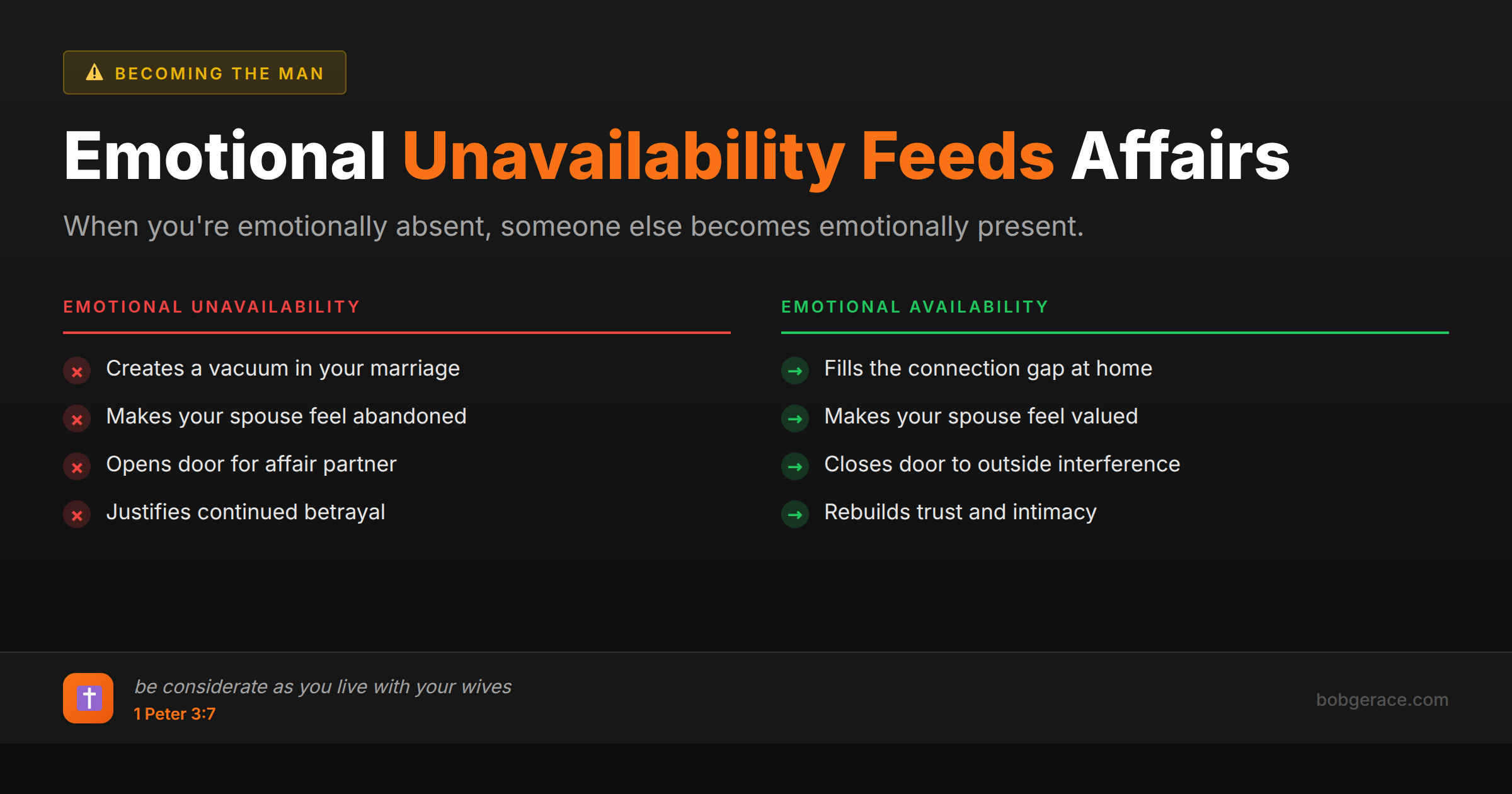
Emotional availability plays a crucial role in both the development of affairs and the recovery process afterward. When spouses become emotionally unavailable to each other, it creates a vacuum that makes the marriage vulnerable to outside interference. The affair partner often fills this emotional void, providing the connection, understanding, and presence that's missing at home. During an active affair, the unfaithful spouse typically becomes even less emotionally available to their marriage, channeling their emotional energy toward the affair partner instead. This creates a devastating cycle where the betrayed spouse feels increasingly isolated and abandoned, while the unfaithful spouse justifies their behavior by pointing to the emotional distance in the marriage. Recovery requires both spouses to understand this dynamic and work intentionally to rebuild emotional availability and connection.
The Full Picture
Emotional availability is the foundation of marital intimacy, and its absence creates the perfect storm for infidelity. When couples stop being emotionally present for each other - really listening, sharing vulnerably, and prioritizing their connection - they're essentially leaving the front door of their marriage wide open.
Here's what typically happens: One or both spouses gradually withdraw emotionally. Maybe it's due to work stress, parenting demands, unresolved conflicts, or just the slow drift that happens when couples stop being intentional. This emotional distance doesn't happen overnight - it's usually a slow fade that neither spouse fully recognizes until damage is done.
The unfaithful spouse then encounters someone who *is* emotionally available - someone who listens, shows interest, provides emotional support, and makes them feel valued and understood. This emotional connection often precedes any physical involvement and is frequently what makes the affair feel so compelling and "right" to the unfaithful spouse.
Meanwhile, the betrayed spouse often senses something is wrong but can't pinpoint what. They may try harder to connect, only to be met with further withdrawal, criticism, or emotional unavailability from their spouse who is now emotionally invested elsewhere. This creates a devastating cycle where the very attempts to reconnect are rebuffed, leading to more distance and pain.
The tragedy is that both spouses usually contributed to the emotional disconnection, even though only one chose to have an affair. Understanding this doesn't excuse the betrayal, but it's essential for genuine healing and preventing future affairs. Recovery requires both partners to learn what emotional availability actually looks like and commit to practicing it consistently.
What's Really Happening
From an attachment perspective, emotional availability is how we signal safety and security to our spouse. When this availability is withdrawn or inconsistent, it triggers profound attachment anxiety and can lead to what I call 'emotional seeking behaviors' - where one or both partners begin looking outside the marriage for emotional regulation and connection.
The affair often represents an attempt to meet legitimate emotional needs through illegitimate means. The unfaithful spouse isn't necessarily seeking sex - they're seeking emotional attunement, validation, and the feeling of being truly known and valued. The affair partner provides what attachment theorists call 'felt security' - the sense that someone is truly present with them emotionally.
What makes this particularly devastating is the neurological impact. When we're emotionally available to someone, we're literally co-regulating their nervous system through our presence, attention, and attunement. The unfaithful spouse begins experiencing this co-regulation with their affair partner while simultaneously dysregulating their spouse through emotional withdrawal and deception.
During recovery, we often see that the unfaithful spouse struggles to be emotionally available to their betrayed partner because they're grieving the loss of the affair relationship - including the emotional connection they felt there. This creates a secondary trauma for the betrayed spouse who desperately needs their partner's emotional presence to heal from the betrayal.
Successful recovery requires the unfaithful spouse to gradually rebuild their capacity for emotional availability within the marriage, while the betrayed spouse learns to recognize and communicate their emotional needs clearly. This process takes time and often requires professional support to navigate safely.
What Scripture Says
Scripture places emotional availability at the very heart of marriage. Ephesians 5:29 tells us that 'no one ever hated their own body, but they feed and care for it, just as Christ does the church.' This feeding and caring extends far beyond physical needs - it encompasses the emotional nourishment that spouses are called to provide each other.
1 Peter 3:7 specifically addresses emotional availability: 'Husbands, in the same way be considerate as you live with your wives, and treat them with respect as the weaker partner and as heirs with you of the gracious gift of life, so that nothing will hinder your prayers.' Being 'considerate' means being emotionally present and attuned to your spouse's needs and experiences.
The biblical concept of 'knowing' goes far beyond intellectual knowledge. Genesis 4:1 says 'Adam knew his wife Eve' - this Hebrew word 'yada' implies intimate, experiential knowledge that can only come through emotional presence and availability. Marriage is designed to be a place where spouses truly know and are known.
Proverbs 27:6 reminds us that 'wounds from a friend can be trusted, but an enemy multiplies kisses.' When spouses aren't emotionally available to each other, they miss opportunities for honest, loving confrontation that could address problems before they become crises. Instead, they may find themselves vulnerable to the 'multiplied kisses' of someone outside the marriage who seems more emotionally present.
Ecclesiastes 4:12 speaks to the power of togetherness: 'Though one may be overpowered, two can defend themselves. A cord of three strands is not quickly broken.' Emotional availability creates this strong cord - but when spouses become emotionally unavailable, they leave each other vulnerable to attacks on their marriage.
The ultimate model is Christ's emotional availability to us, as described in Matthew 11:28: 'Come to me, all you who are weary and burdened, and I will give you rest.' This is the heart of emotional availability - creating a safe space where your spouse can bring their burdens and find rest in your presence.
What To Do Right Now
-
1
Assess your current emotional availability honestly - When did you last have a meaningful conversation with your spouse about their inner world?
-
2
Eliminate obvious barriers to connection - Put away devices, create phone-free times, and establish regular check-ins with each other
-
3
Practice the 'daily download' - Spend 15-20 minutes each day sharing what's really happening in your hearts and minds
-
4
Learn your spouse's emotional language - How do they best receive emotional connection? Through words, touch, quality time, or acts of service?
-
5
Address underlying issues that create emotional distance - Unresolved conflicts, stress, depression, or other problems that interfere with availability
-
6
Seek professional help if needed - If emotional availability feels impossible due to the depth of betrayal or other issues, get qualified support
Related Questions
- What is the '180' approach and does it work?
- How do I stay connected while enforcing boundaries?
- How do I not pursue while also not abandoning?
- What does 'detach with love' actually mean?
- How do I be warm without being a doormat?
- How do I show her what she's losing without manipulation?
- Should I give her space or fight for her?
- What does 'space' actually mean to her?
- How do I fight without pushing her away?
- What's the difference between pursuing and chasing?
Also find Bob on
Subscribe for weekly videos on Christian marriage.
Your Marriage Can't Wait 30 Days
If she's in an affair right now, you need a coach who knows your specific story and can calibrate to where you actually are today. Talk to Bob.
Get a Coach →