Do I show emotion or stay calm?
6 min read
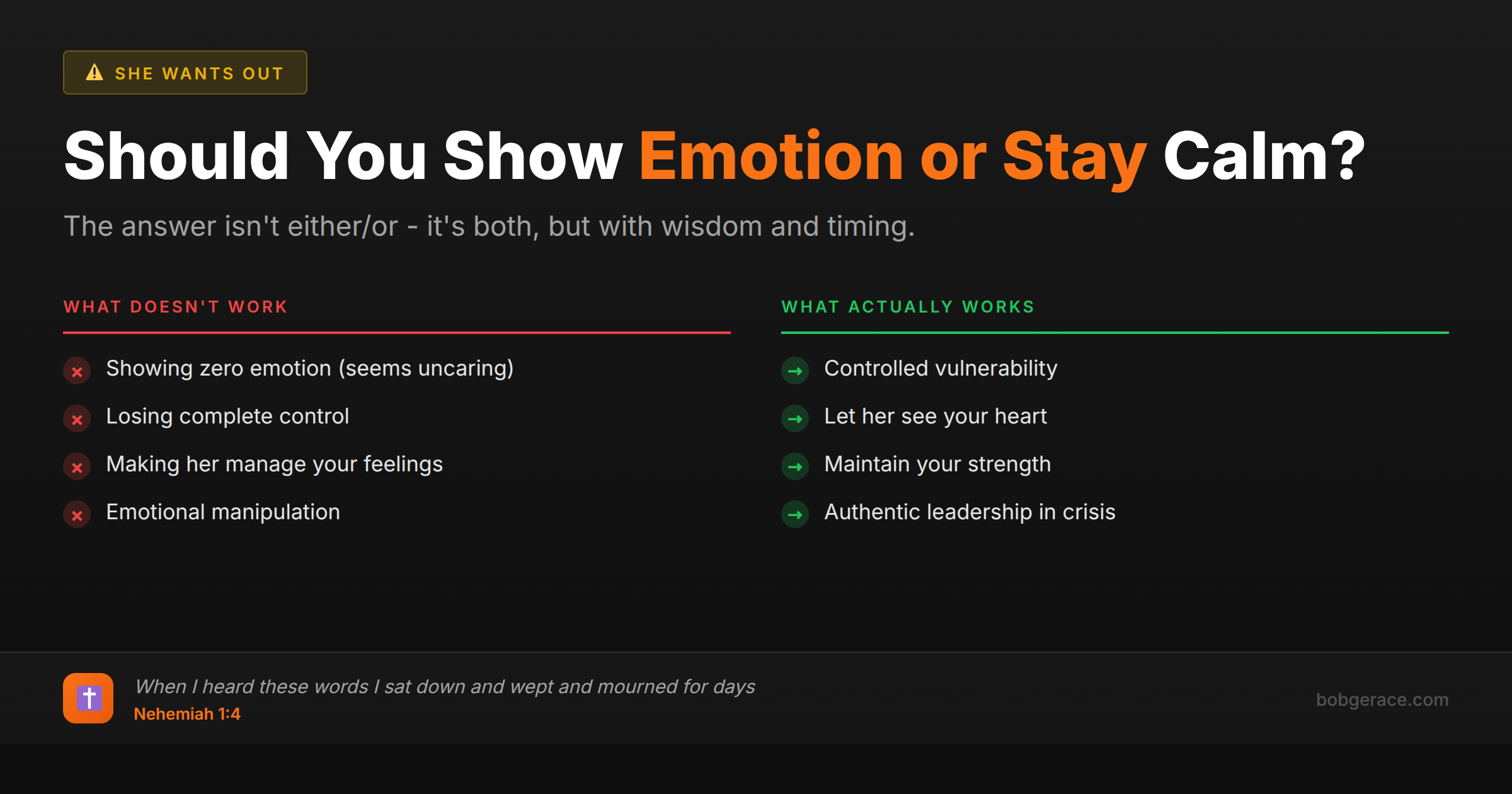
The answer isn't either/or - it's both, but with wisdom and timing. Your wife needs to see that you're human and that this matters to you, but she also needs to feel safe and see that you can handle hard things without falling apart completely. Showing zero emotion makes you seem disconnected or uncaring. But losing complete control makes her feel like she has to manage your feelings on top of everything else she's already carrying. The key is controlled vulnerability - letting her see your heart while maintaining your strength as a man. This isn't about manipulation; it's about authentic leadership in a crisis moment.
The Full Picture
When your marriage is in crisis, your emotional response becomes a critical factor in what happens next. Most men default to one of two extremes: they either shut down completely (thinking they're being "strong") or they break down entirely (thinking they're being "vulnerable"). Both approaches backfire.
The shutdown approach fails because: • Your wife interprets your calmness as indifference • She feels like you don't actually care about losing her • It reinforces her belief that you're emotionally unavailable • She sees it as proof that she was right to want out
The breakdown approach fails because: • She feels responsible for managing your emotions • It adds pressure when she's already overwhelmed • She questions your ability to lead through difficulty • It can feel manipulative, even if that's not your intent
What works is calibrated authenticity - showing genuine emotion while maintaining your capacity to think clearly and act wisely. This means you might have tears in your eyes while speaking calmly. You might say "This is breaking my heart" while still being able to listen and respond thoughtfully.
Your wife is watching to see how you handle this crisis. She's asking herself: "Can this man handle hard things? Can he feel deeply while still being someone I can lean on?" Your emotional response in these moments is answering that question.
The goal isn't to convince her to stay through your emotions. The goal is to show her who you really are - a man who cares deeply but doesn't crumble under pressure.
What's Really Happening
From a therapeutic standpoint, emotional regulation during relationship crises is crucial for several reasons. Research in attachment theory shows that partners are constantly assessing each other's capacity for co-regulation - the ability to help stabilize each other's emotional states.
When a marriage reaches crisis point, the pursuing partner (often the wife) is in a state of chronic hypervigilance. She's unconsciously evaluating whether her partner can provide emotional safety. Complete emotional shutdown triggers her abandonment fears and confirms her narrative that he's unavailable. Conversely, emotional dysregulation activates her need to caretake, which exhausts her further.
Neurologically, when we're in crisis, our amygdala is hyperactive while our prefrontal cortex (rational thinking) is compromised. The key is maintaining enough prefrontal cortex function to stay regulated while allowing authentic emotional expression. This is what we call "window of tolerance" - staying within the zone where you can feel without becoming overwhelmed.
Studies on emotional contagion show that emotions are literally contagious between intimate partners. If you're completely dysregulated, she becomes dysregulated. If you're completely shut down, she feels emotionally abandoned. The sweet spot is what we call "grounded vulnerability" - being emotionally present and authentic while maintaining your psychological center.
This approach actually activates her attachment system in a healthy way. She can see that you care (which she needs) while also seeing that you can handle difficult emotions (which she also needs). It's this combination that begins to rebuild trust and emotional safety.
What Scripture Says
Scripture gives us a clear model for how to handle emotional responses during crisis. Nehemiah 1:4 shows us balanced emotion: "When I heard these words I sat down and wept and mourned for days, and I continued fasting and praying before the God of heaven." Nehemiah felt deeply, but he didn't let his emotions derail his ability to seek wisdom and take action.
Psalm 56:3-4 teaches us to acknowledge our emotions while anchoring our trust: "When I am afraid, I put my trust in you. In God, whose word I praise, in God I trust; I shall not be afraid." This isn't about suppressing fear or pain - it's about feeling it while remaining grounded in something larger than the crisis.
Ephesians 4:26 gives us permission to feel anger while maintaining wisdom: "Be angry and do not sin; do not let the sun go down on your anger." The emotion itself isn't wrong; it's what we do with it that matters. You can feel the full weight of this situation without letting it drive you to sin or foolishness.
1 Peter 3:7 calls husbands to live with their wives "in an understanding way, showing honor to the woman as the weaker vessel, since they are heirs with you of the grace of life." This requires emotional intelligence - reading the situation and responding with both strength and sensitivity.
Jesus himself wept at Lazarus's tomb (John 11:35), even knowing He would raise him from the dead. He felt the full weight of human pain while never losing sight of His Father's plan. This is our model - feeling deeply while trusting completely, showing emotion while maintaining the capacity to lead with wisdom and love.
What To Do Right Now
-
1
Practice the pause - when emotions surge, take three deep breaths before speaking or responding
-
2
Name what you're feeling out loud: 'I'm scared' or 'This is breaking my heart' - simple, honest, direct
-
3
Maintain eye contact and open body language even when expressing difficult emotions
-
4
Ask yourself 'What does she need to see from me right now?' before choosing your emotional expression
-
5
Set boundaries around emotional conversations - 'I need 10 minutes to collect myself so I can really hear you'
-
6
Follow emotional moments with clear, calm action - show her you can feel AND still function as a leader
Related Questions
- What do I say when she asks for divorce?
- What are the first words out of my mouth?
- Should I try to talk her out of it immediately?
- What if I already reacted badly?
- How do I regulate when my body is in fight-or-flight?
- How do I not let lawyers poison what's left?
- I can't control my anger
- How do I become emotionally intelligent?
- How do I identify what I'm feeling?
Also find Bob on
Subscribe for weekly videos on Christian marriage.
Bring Your Actual Marriage to a Coach
You know the principle. But your wife, your history, your specific dynamic—that's where you need a human who can see what you can't. Bob works with men one-on-one to calibrate this to your situation.
Talk to Bob →