Should I tell anyone right away?
6 min read
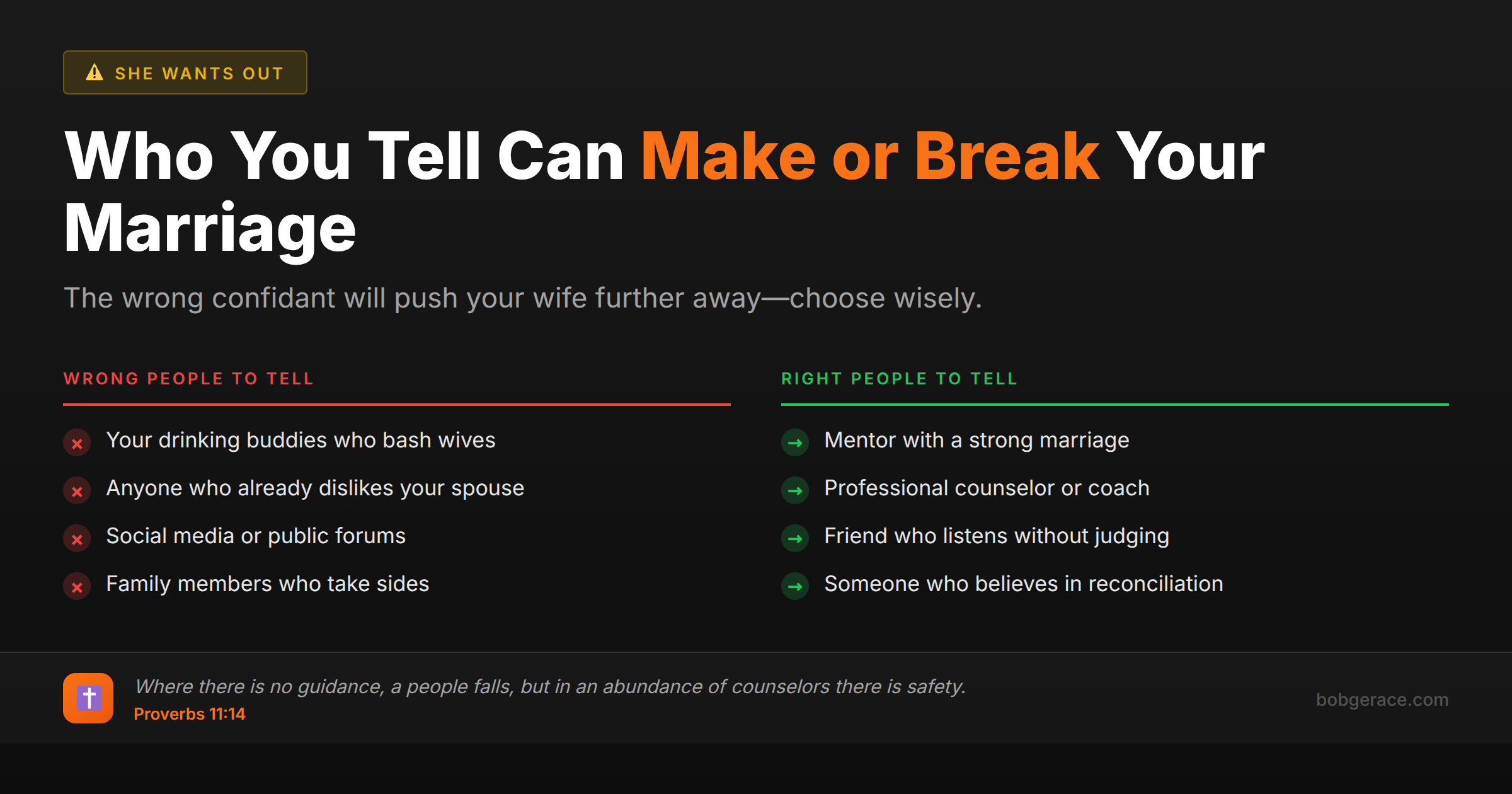
Tell one person immediately — someone who can sit with you without giving advice, taking sides, or broadcasting your situation. Do NOT tell: her family, your kids, social media, or anyone who will fuel your panic. You need a witness to your pain, not an army for your side. Choose carefully. One trusted person is enough for now.
The Full Picture
Your instinct right now is probably one of two extremes: tell no one and suffer alone, or tell everyone and rally troops to your side. Both instincts are wrong.
Why you need to tell someone: - Isolation amplifies crisis - You cannot think clearly alone right now - You need a witness to your pain — someone who knows what you're carrying - Secrets create shame, and shame will paralyze you
Why you can't tell everyone: - Anything you broadcast cannot be un-broadcast - Your marriage may recover — do you want everyone knowing your worst moment? - Her family knowing creates permanent tension - Your kids knowing before they need to damages them - Social media turns private pain into public performance - Some people will pour gasoline on your fire
Who to tell (in order of priority):
1. A counselor, coach, or pastor — someone trained to hold crisis without making it worse. This should be your first call.
2. One trusted friend or brother — not someone who will trash your wife. Not someone who will tell you what you want to hear. Someone who can sit with you in pain without needing to fix it.
3. One work contact if necessary — only if you need cover at work. Minimal information: 'Personal situation at home. I might be off for a bit.'
Who NOT to tell (not yet):
- Your kids — They don't need to know until there's something concrete to know. Premature disclosure traumatizes them unnecessarily.
- Her family — This will get back to her and feel like an attack. Let her control that narrative.
- Your family — Maybe eventually, but not Day 1. They'll want to help, and their 'help' might be harmful.
- Social media — Absolutely not. Not even vague posts. Not prayer requests. Nothing.
- Mutual friends — This puts them in the middle and forces them to pick sides.
What's Really Happening
From an attachment perspective, the urge to tell people serves a legitimate function: your attachment system is in crisis and is seeking co-regulation. This is healthy. Humans are not meant to process existential threat alone.
However, there's a difference between seeking support and seeking validation.
Seeking support sounds like: 'I'm in pain and I need someone to be present with me.'
Seeking validation sounds like: 'Tell me I'm right and she's wrong.'
One helps you heal. The other entrenches you in a narrative that will ultimately sabotage any chance of reconciliation.
Research on social support during marital crisis shows that the *quality* of support //blog.bobgerace.com/christian-marriage-measurement-track-what-matters/:matters more than the quantity. One person who can truly attune to your experience — without judgment, without advice, without their own agenda — is more valuable than twenty people who fuel your outrage or panic.
The danger of telling too many people too quickly is what we call 'coalition building.' When you recruit people to your side, you're creating pressure to follow through on the divorce narrative. People who know want updates. They expect you to stay angry. They make it harder to reconcile because reconciliation now means admitting to everyone that the story was more complicated than you made it sound.
Choose your one person wisely. Someone emotionally regulated. Someone with no stake in the outcome. Someone who can hold your pain without pouring lighter fluid on it.
What Scripture Says
Proverbs 11:13: 'A gossip betrays a confidence, but a trustworthy person keeps a secret.'
Your marriage crisis is not content for public consumption. The details of what's happening between you and your wife deserve protection — even from well-meaning friends and family.
This doesn't mean isolation. Galatians 6:2 says: 'Carry each other's burdens, and in this way you will fulfill the law of Christ.' You need someone to carry this burden with you.
The question is: who is qualified to carry it?
Jesus modeled this perfectly. In the Garden of Gethsemane, He didn't suffer alone — but He also didn't broadcast His agony to the masses. He brought three: Peter, James, and John. An inner circle. His closest brothers.
And even they couldn't stay awake with Him. Sometimes your support people will fail you. That's why your ultimate source of comfort must be the Lord Himself.
Psalm 62:8: 'Trust in him at all times, you people; pour out your hearts to him, for God is our refuge.' Pour out your heart first to God. Then to one or two trusted people. Not to the internet. Not to her family. Not to your kids.
Protect the sanctity of your marriage — even when your marriage is in crisis.
What To Do Right Now
-
1
Identify your one person. Who can hold this without needing to fix it, fuel it, or broadcast it? Call them today.
-
2
Write down who you're NOT going to tell right now: her family, kids, social media, certain friends. Commit to the boundary.
-
3
When you talk to your one person, lead with: 'I need to talk. I don't need advice right now. I just need someone to know.'
-
4
If you feel the urge to post on social media — anything, even vague — write it in a notes app instead. Get it out of your head without going public.
-
5
Consider reaching out to a professional — a counselor, coach, or pastor — within the first 48 hours. Your one friend is for presence. A professional is for guidance.
-
6
Decide on your default response for anyone who asks how you're doing: 'Going through some stuff, but I'm okay. Thanks for asking.' You don't owe anyone the full story.
Related Questions
- How do I function at work after hearing this?
- She dropped the bomb — what do I do in the next 24 hours?
- What do I say when she asks for divorce?
- Should I get a lawyer now or wait?
- What should I know before agreeing to anything?
- How do I tell the kids?
- Should I tell anyone right now?
- What support do I need?
- Why do I need other men?
- What does wise counsel look like?
Also find Bob on
Subscribe for weekly videos on Christian marriage.
You Don't Have to Figure This Out Alone
A coach who knows your specific marriage can help you navigate who to tell, when, and how — without making it worse. This is what I do.
Talk to Bob →