How do I do genogram work to understand patterns?
6 min read
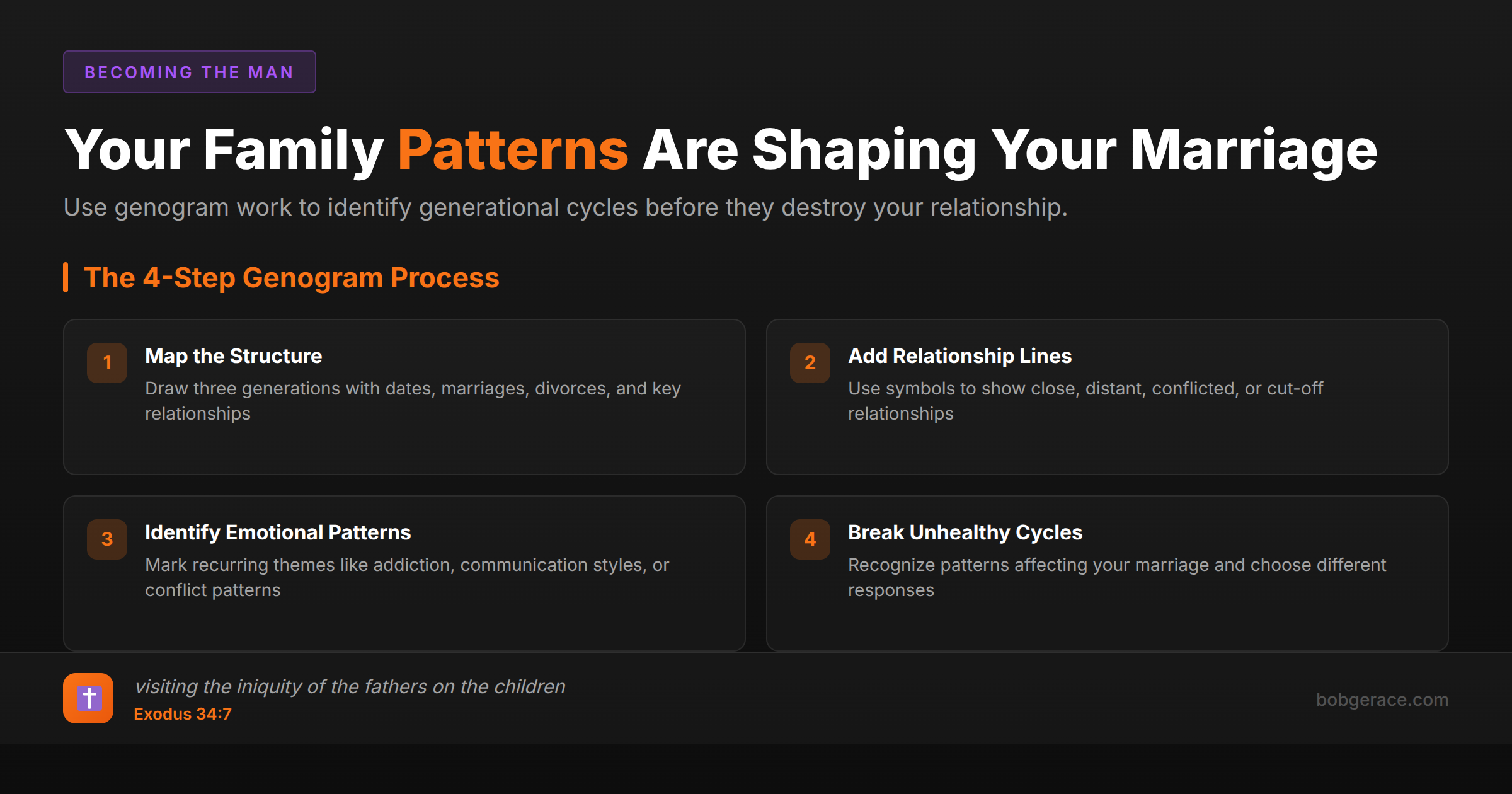
Genogram work involves creating a visual map of your family relationships across multiple generations to identify patterns, cycles, and dynamics that may be affecting your marriage. Start by drawing your family tree going back at least three generations, then add relationship symbols, emotional patterns, and significant events. Look for recurring themes like divorce, addiction, communication styles, or conflict patterns that might be showing up in your own relationship. This isn't about blame—it's about awareness and breaking unhealthy cycles while building on positive family strengths.
The Full Picture
Genogram work is one of the most powerful tools for understanding why you keep hitting the same walls in your marriage. Think of it as creating a family map that shows not just who's related to whom, but how people relate, what patterns get passed down, and where the emotional landmines are buried.
Here's what makes genograms different from family trees: While a family tree shows bloodlines, a genogram shows emotional lines, relationship patterns, and generational cycles. You're looking for the invisible forces that shape how you handle conflict, express love, deal with money, parent your kids, and navigate intimacy.
The process involves three main layers: First, you map the basic structure—births, deaths, marriages, divorces going back three generations. Second, you add relationship dynamics using symbols for close, distant, conflicted, or cut-off relationships. Third, you identify patterns like addiction, mental health issues, family roles, communication styles, and coping mechanisms.
This work often reveals surprising connections. Maybe your tendency to shut down during conflict mirrors your grandfather's pattern. Perhaps your spouse's anxiety around money makes sense when you see three generations of financial instability. Or you might discover that the communication style causing problems in your marriage is actually a family trademark you never recognized.
The goal isn't to excuse behavior or blame previous generations. It's to gain awareness so you can make conscious choices about what patterns to continue and what cycles to break. Understanding your family's emotional DNA helps you respond rather than react in your marriage.
What's Really Happening
From a clinical perspective, genograms reveal the multigenerational transmission process—how emotional patterns, relationship styles, and coping mechanisms get passed down through families, often unconsciously. When couples are stuck in repetitive cycles, there's usually a generational component at play.
The power of genogram work lies in making the invisible visible. Many couples come to therapy saying 'we keep having the same fights' or 'I don't know why I react this way,' without realizing they're operating from deeply ingrained family-of-origin patterns. The genogram helps identify these automatic responses and their origins.
What's particularly revealing is how couples often unconsciously recreate familiar family dynamics, even negative ones. Someone who grew up with an emotionally distant father might marry someone who struggles with emotional availability, or someone from a family where conflict was avoided might be drawn to a partner who processes through confrontation.
Genograms also highlight family rules—the unspoken guidelines about how emotions are expressed, what topics are safe to discuss, how problems are solved, and what roles people play. These invisible rules often govern behavior in the marriage without either spouse being aware of it.
The therapeutic value comes not from analyzing or pathologizing these patterns, but from bringing conscious awareness to unconscious processes. Once couples can see these generational influences clearly, they gain the power to choose different responses and create new, healthier patterns for their own family system.
What Scripture Says
Scripture clearly teaches that generational patterns exist and have real impact on our lives. Exodus 34:6-7 describes how 'the iniquity of the fathers' affects children 'to the third and fourth generation,' while also emphasizing God's abundant mercy and faithfulness. This isn't about punishment—it's about understanding how family patterns naturally flow through generations.
Ezekiel 18:19-20 provides hope: 'The child will not share the guilt of the parent, nor will the parent share the guilt of the child.' God makes it clear that each generation has the power to break negative cycles and establish new patterns through faithful choices.
Psalm 78:4-7 shows God's design for positive generational transmission: 'We will tell the next generation the praiseworthy deeds of the Lord, his power, and the wonders he has done... so the next generation would know them... and they in turn would tell their children.' This passage reveals God's heart for healthy family systems that pass down faith, wisdom, and blessing.
1 Corinthians 13:11 speaks to the maturation process: 'When I was a child, I talked like a child, I thought like a child, I reasoned like a child. When I became a man, I put the ways of childhood behind me.' Genogram work helps identify which childhood patterns need to be left behind for mature marriage relationships.
Genogram work aligns with biblical principles of wisdom, self-examination, and taking responsibility for our choices. It's not about excusing behavior based on family history, but about gaining understanding so we can 'choose this day whom we will serve' in our marriages and families.
What To Do Right Now
-
1
Start with basic structure: Draw three generations back including grandparents, parents, siblings, spouses, and children. Include birth/death dates, marriages, divorces, and significant relationships.
-
2
Add relationship symbols: Use lines to show relationship quality—solid for close, dotted for distant, jagged for conflicted, broken for cut-off. Include symbols for addiction, mental health, or other significant issues.
-
3
Map emotional patterns: Identify recurring themes like communication styles, conflict patterns, parenting approaches, financial attitudes, or ways of handling stress across generations.
-
4
Look for triangles and roles: Notice who gets pulled into conflicts, what roles people play (peacemaker, rebel, hero), and how these dynamics might be showing up in your marriage.
-
5
Identify strengths and resources: Don't just focus on problems—map positive patterns, family strengths, sources of resilience, and healthy relationship models you want to emulate.
-
6
Discuss discoveries together: Share your genograms with each other, looking for patterns that might be affecting your marriage. Focus on understanding, not blaming, and identify specific changes you want to make.
Related Questions
Ready to Break the Cycles?
Understanding your family patterns is just the beginning. Get personalized guidance for creating the marriage you actually want.
Work With Me →