What is 'intermittent reinforcement'?
6 min read
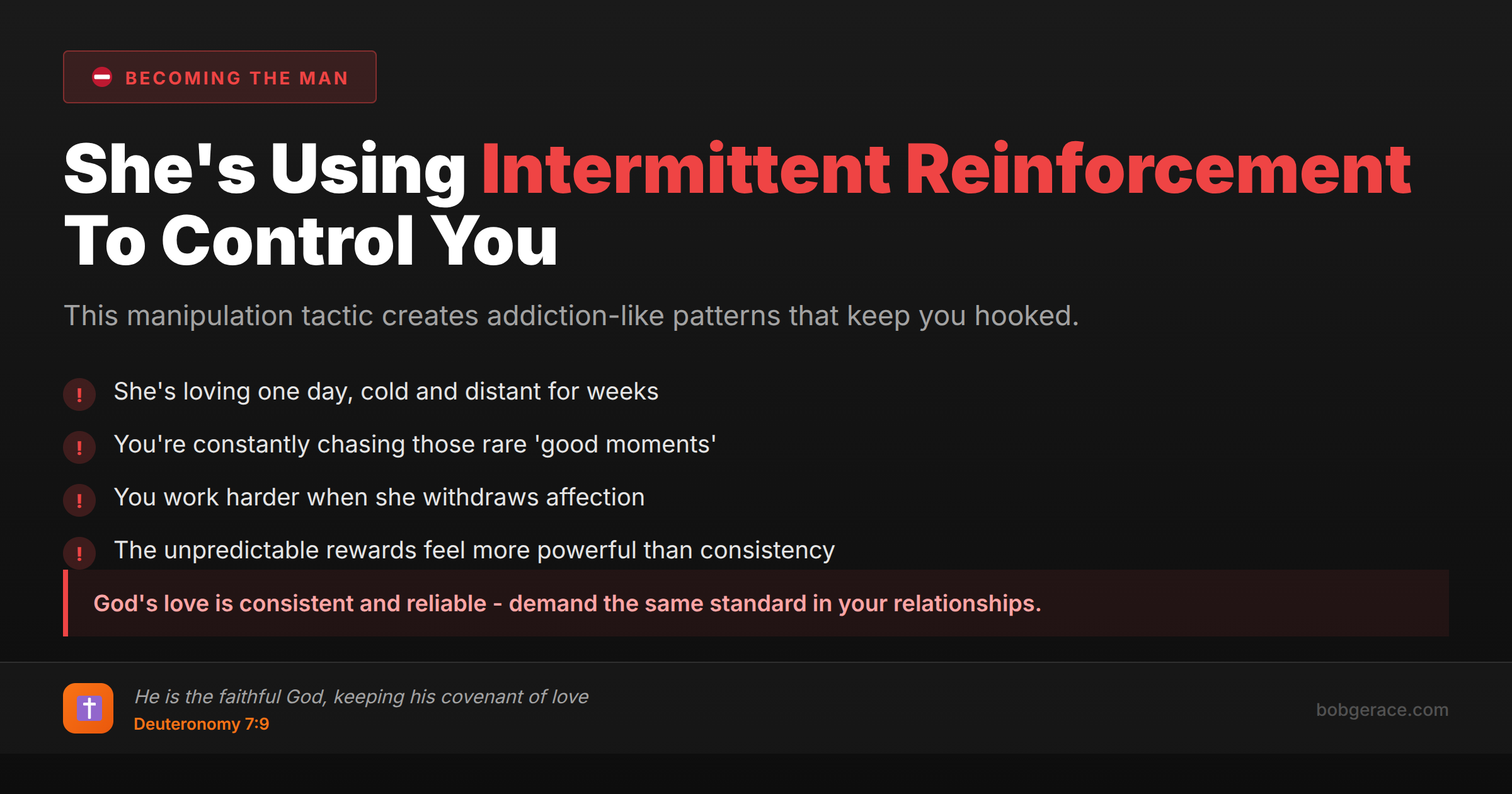
Intermittent reinforcement is one of the most powerful manipulation tactics used in toxic relationships. It's when someone gives you affection, attention, or positive treatment on an unpredictable schedule - sometimes you get it, sometimes you don't, and you never know which it will be. This creates an addiction-like cycle because your brain becomes wired to chase those occasional 'rewards' of good treatment. It's the same psychological principle that makes gambling so addictive - the unpredictable nature of the reward makes it more powerful than consistent positive treatment would be. In relationships, this might look like your partner being incredibly loving and attentive one day, then cold and distant for weeks, then suddenly romantic again without explanation.
The Full Picture
Intermittent reinforcement is arguably the most insidious form of emotional manipulation because it hijacks your brain's reward system. Unlike consistent abuse, which would drive most people away, intermittent reinforcement keeps you hooked by providing just enough positive experiences to make you believe things might get better.
Here's how it typically works:
- Your partner treats you poorly most of the time - criticism, neglect, emotional distance - Occasionally, they're incredibly loving, affectionate, and seem like the person you fell in love with - These positive moments come without warning and without any clear pattern - You start working harder and harder to recreate those good moments - You begin to blame yourself when the good treatment stops
Why it's so effective:
Your brain releases dopamine (the 'reward' chemical) more powerfully when rewards are unpredictable than when they're consistent. This is why slot machines are more addictive than getting a paycheck - you never know when the next 'win' will come.
In relationships, this means you become neurologically addicted to your partner's approval. You'll tolerate increasingly poor treatment because you're always chasing that next moment when they'll be loving again.
Common examples include: - Love-bombing followed by silent treatment - Incredible sex after big fights - Grand romantic gestures after periods of neglect - Sudden attention and affection when you're about to leave - Promises of change that are occasionally (but rarely) kept
The cruelest part? The person doing this often isn't even conscious of the pattern. They may genuinely feel loving sometimes and distant other times, but the impact on you is the same regardless of their intent.
What's Really Happening
From a clinical perspective, intermittent reinforcement creates what we call 'trauma bonding' - a psychological phenomenon where the victim becomes addicted to their abuser through cycles of abuse and affection.
Neurologically, your brain starts producing higher levels of dopamine in anticipation of potential reward than it would from consistent positive treatment. This is why women often report feeling more 'chemistry' or 'passion' with partners who treat them inconsistently - their brains are literally experiencing a chemical high from the uncertainty.
The pattern typically follows this cycle: Tension building → Incident → Reconciliation → Calm period → Repeat. During the reconciliation phase, the positive treatment feels incredibly intense because it's contrasted against the recent negative treatment. This contrast makes the good moments feel better than they actually are.
Over time, this creates several psychological changes: - Learned helplessness - you stop believing you can influence the outcome - Hypervigilance - you become obsessed with reading their moods and behavior - Self-blame - you assume their mood changes are your fault - Fantasy bonding - you become attached to the potential of who they could be
Recovery requires understanding that your intense feelings aren't proof of love - they're proof of addiction. The withdrawal from intermittent reinforcement is real and painful, which is why leaving these relationships feels so difficult even when you know they're unhealthy.
Healing involves rewiring your brain to appreciate consistent, stable love rather than the artificial highs created by unpredictability.
What Scripture Says
God's design for love is the complete opposite of intermittent reinforcement. His love is consistent, reliable, and unchanging - exactly what healthy human relationships should mirror.
God's love is consistent and dependable: *"The Lord your God is God; he is the faithful God, keeping his covenant of love to a thousand generations of those who love him and keep his commandments."* - Deuteronomy 7:9
Love should be patient and kind, not manipulative: *"Love is patient, love is kind. It does not envy, it does not boast, it is not proud. It does not dishonor others, it is not self-seeking, it is not easily angered, it keeps no record of wrongs."* - 1 Corinthians 13:4-5
We're called to discernment, not blind hope: *"By their fruit you will recognize them. Do people pick grapes from thornbushes, or figs from thistles?"* - Matthew 7:16
God wants us to experience peace in our relationships: *"But the fruit of the Spirit is love, joy, peace, forbearance, kindness, goodness, faithfulness, gentleness and self-control."* - Galatians 5:22-23
We're not meant to live in fear or uncertainty: *"There is no fear in love. But perfect love drives out fear, because fear has to do with punishment. The one who fears is not made perfect in love."* - 1 John 4:18
God calls us to wisdom in relationships: *"Above all else, guard your heart, for everything you do flows from it."* - Proverbs 4:23
God's design for marriage includes consistency, faithfulness, and reliability. When someone uses intermittent reinforcement, they're modeling the opposite of how Christ loves the church. You deserve the kind of steady, faithful love that reflects God's character, not the chaos and confusion that comes from unpredictable treatment.
What To Do Right Now
-
1
Document the pattern - Keep a simple daily log of how your partner treats you (good day/bad day) to see the intermittent pattern clearly
-
2
Stop chasing the highs - Recognize when you're working extra hard to recreate a good moment and consciously step back
-
3
Set consistent boundaries - Establish what behavior you will and won't accept, regardless of how they treated you yesterday
-
4
Build outside support - Connect with friends, family, or a counselor who can offer perspective when you're caught in the cycle
-
5
Practice self-validation - Stop looking to your partner's mood changes as a measure of your worth or their love for you
-
6
Seek professional help - Consider individual therapy to understand why you're susceptible to this pattern and how to heal
Related Questions
- What is 'love bombing'?
- What is the cycle of abuse/reconciliation?
- How do I distinguish hoovering from genuine pursuit?
- What are signs he's just scared not changed?
- What is 'performative remorse'?
- What are red flags that this is manipulation?
- How do I know if he's really changing?
- Is he manipulating me or actually different?
- What are markers of genuine remorse vs. guilt?
- How will he handle my doubt if he's genuine?
Also find Bob on
Subscribe for weekly videos on Christian marriage.
You Don't Have to Figure This Out Alone
If you're stuck in this cycle in your marriage, a coach who knows your specific situation can help you see what's real and what to do next.
Talk to Bob →