What if her withdrawal is protection not rejection?
6 min read
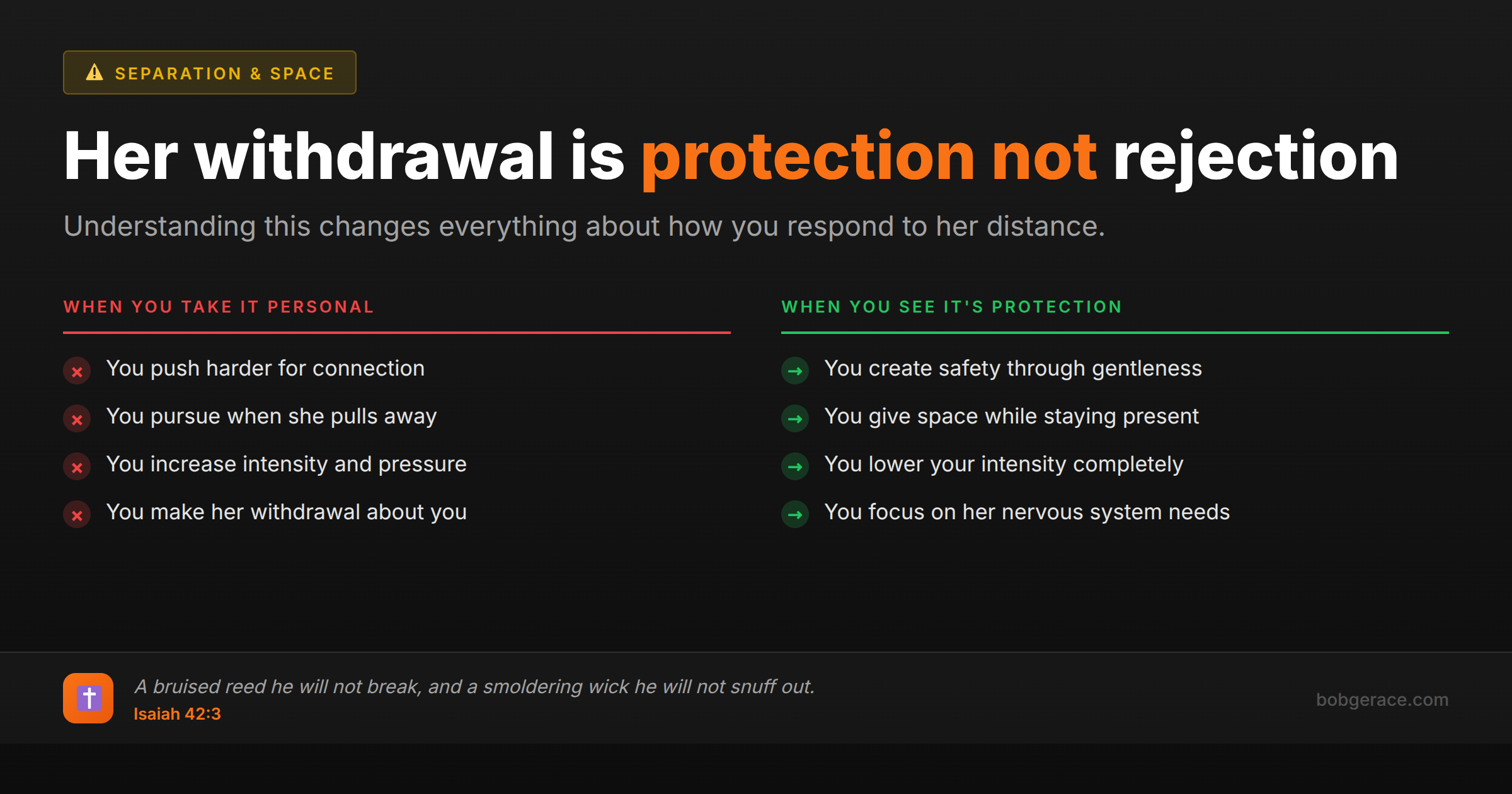
When your wife withdraws, it's often her nervous system's way of creating safety, not pushing you away. Trauma responses can make emotional connection feel dangerous, even when she logically knows you're safe. Her withdrawal is actually her body's attempt to regulate and protect itself from perceived threats. This isn't about you personally - it's about her internal experience of safety. Past wounds, whether from childhood, previous relationships, or even patterns in your marriage, can trigger protective responses. Understanding this distinction changes everything about how you respond. Instead of taking it personally or pushing harder for connection, you can create the conditions that help her nervous system settle and feel genuinely safe with you.
The Full Picture
Here's what most husbands miss: withdrawal isn't always rejection. Sometimes it's protection. Your wife's nervous system might be telling her that connection equals danger, even when her mind knows you love her.
The Trauma Response Cycle
When someone has experienced trauma - whether childhood wounds, past relationships, or ongoing stress - their nervous system becomes hypervigilant. It scans for threats, even in safe relationships. Withdrawal becomes a survival mechanism, not a relationship statement.
This can show up as: - Shutting down during conversations - Avoiding physical intimacy - Creating emotional distance - Seeming "checked out" or disconnected - Responding with minimal engagement
Why This Happens
Trauma literally rewires the brain. The amygdala (fear center) becomes overactive, while the prefrontal cortex (rational thinking) goes offline. When triggered, she's not choosing to reject you - her nervous system is choosing safety over connection.
This can be triggered by: - Tone of voice that feels threatening - Feeling cornered or pressured - Past memories being activated - Feeling misunderstood or unheard - Physical positioning that feels intimidating
The Protection vs. Rejection Test
Protection looks like: temporary withdrawal, seeking space to regulate, eventual return to connection when feeling safe.
Rejection looks like: consistent pushing away, refusing repair attempts, actively building walls, showing contempt or disgust.
Most struggling wives are protecting, not rejecting. They want connection but need safety first. Your job isn't to break through her walls - it's to help her nervous system recognize that those walls aren't needed with you.
What's Really Happening
From a trauma-informed perspective, withdrawal is often a adaptive response that once served a protective purpose. What we're seeing is the nervous system's attempt to maintain homeostasis when it perceives threat.
Neurobiological Reality
When someone enters a protective state, their autonomic nervous system shifts into sympathetic activation (fight/flight) or dorsal vagal shutdown (freeze/fawn). In this state, the social engagement system - our ability to connect and communicate effectively - goes offline. She's literally neurobiologically unavailable for connection, regardless of her conscious desires.
The Window of Tolerance
Every person has a 'window of tolerance' - the zone where they can handle stress and remain present. Trauma narrows this window. What might seem like minor stress to you could push her outside her window, triggering protective responses.
Therapeutic Implications
Traditional marriage advice often focuses on communication techniques, but if one partner is in a trauma response, those techniques won't work. The nervous system must be regulated first. This requires:
- Co-regulation through your calm presence - Predictable, safe interactions - Respect for her protective responses - Patience with the healing timeline
Breaking the Cycle
The goal isn't to prevent her protective responses - it's to help her nervous system learn that protection isn't needed with you. This happens through consistent, small experiences of safety, not grand gestures or intense conversations.
Remember: healing happens in relationship, but it requires a trauma-informed approach that honors her protective mechanisms while gently expanding her capacity for connection.
What Scripture Says
Scripture gives us clear guidance on how to respond to those who are wounded and protecting themselves. God's heart is always toward the broken and defensive.
Gentleness with the Wounded
*"A bruised reed he will not break, and a smoldering wick he will not snuff out."* - Isaiah 42:3
Jesus doesn't force connection with those who are wounded. He approaches gently, respecting their protective responses while offering safety. Your wife's withdrawal might be her 'bruised reed' state - requiring tenderness, not pressure.
Creating Safety for Others
*"Let your gentleness be evident to all."* - Philippians 4:5
Gentleness isn't weakness - it's strength under control. When someone is in protection mode, gentleness communicates safety more effectively than intensity or pursuing.
Patient Love
*"Love is patient, love is kind. It does not envy, it does not boast, it is not proud. It does not dishonor others, it is not self-seeking, it is not easily angered, it keeps no record of wrongs."* - 1 Corinthians 13:4-5
Patience means allowing her nervous system the time it needs to recognize safety. Self-seeking love demands immediate connection. Christ-like love creates conditions for connection without demanding it.
Bearing One Another's Burdens
*"Carry each other's burdens, and in this way you will fulfill the law of Christ."* - Galatians 6:2
Her protective responses aren't a burden she should carry alone. You can help bear this burden by creating safety, not by demanding she drop her defenses.
Wisdom in Approach
*"The simple believe anything, but the prudent give thought to their steps."* - Proverbs 14:15
Wisdom means understanding what's really happening before responding. If her withdrawal is protection, wisdom responds differently than if it were rejection.
Hope for Healing
*"He heals the brokenhearted and binds up their wounds."* - Psalm 147:3
God specializes in healing those who are protecting wounded hearts. You get to partner with Him in this healing by creating safety rather than demanding vulnerability.
What To Do Right Now
-
1
Stop Taking It Personally - Recognize her withdrawal as nervous system protection, not personal rejection. This isn't about your worth as a husband.
-
2
Lower Your Intensity - Speak more softly, move more slowly, give more space. High intensity triggers protective responses in traumatized nervous systems.
-
3
Communicate Safety Through Actions - Be predictable, keep your word, respect her no's, and follow through on small commitments. Safety is built through consistency.
-
4
Validate Her Need for Protection - Say things like 'It makes sense you'd need space' or 'I can see you're taking care of yourself.' Don't shame her protective responses.
-
5
Create No-Pressure Connections - Offer connection opportunities without expectation or pressure. Sit nearby without talking, invite without insisting, be available without pursuing.
-
6
Get Trauma-Informed Help - Work with a counselor who understands trauma responses. Both individual and couples therapy can help you learn to work with her nervous system, not against it.
Related Questions
- What is 'emotional disengagement'?
- Is her shutdown protective or permanent?
- What is 'deactivation' and did I cause it?
- Why does she seem numb/flat/dead inside?
- What have I done that made connection feel unsafe?
- How do I become a safe person again?
- What is 'betrayal trauma' and do I have it?
- What does 'holding space' actually mean?
- How do I pursue without pressuring?
- What does trauma recovery look like?
Also find Bob on
Subscribe for weekly videos on Christian marriage.
Your Marriage Isn't a Textbook Case
Understanding withdrawal in theory is one thing. Knowing what it means in your specific marriage—and what to do next Tuesday when she shuts down again—is different. A coach who knows your story can help you see what you're missing.
Talk to Bob →