What is 'sexual trauma' and how does it affect marriage?
6 min read
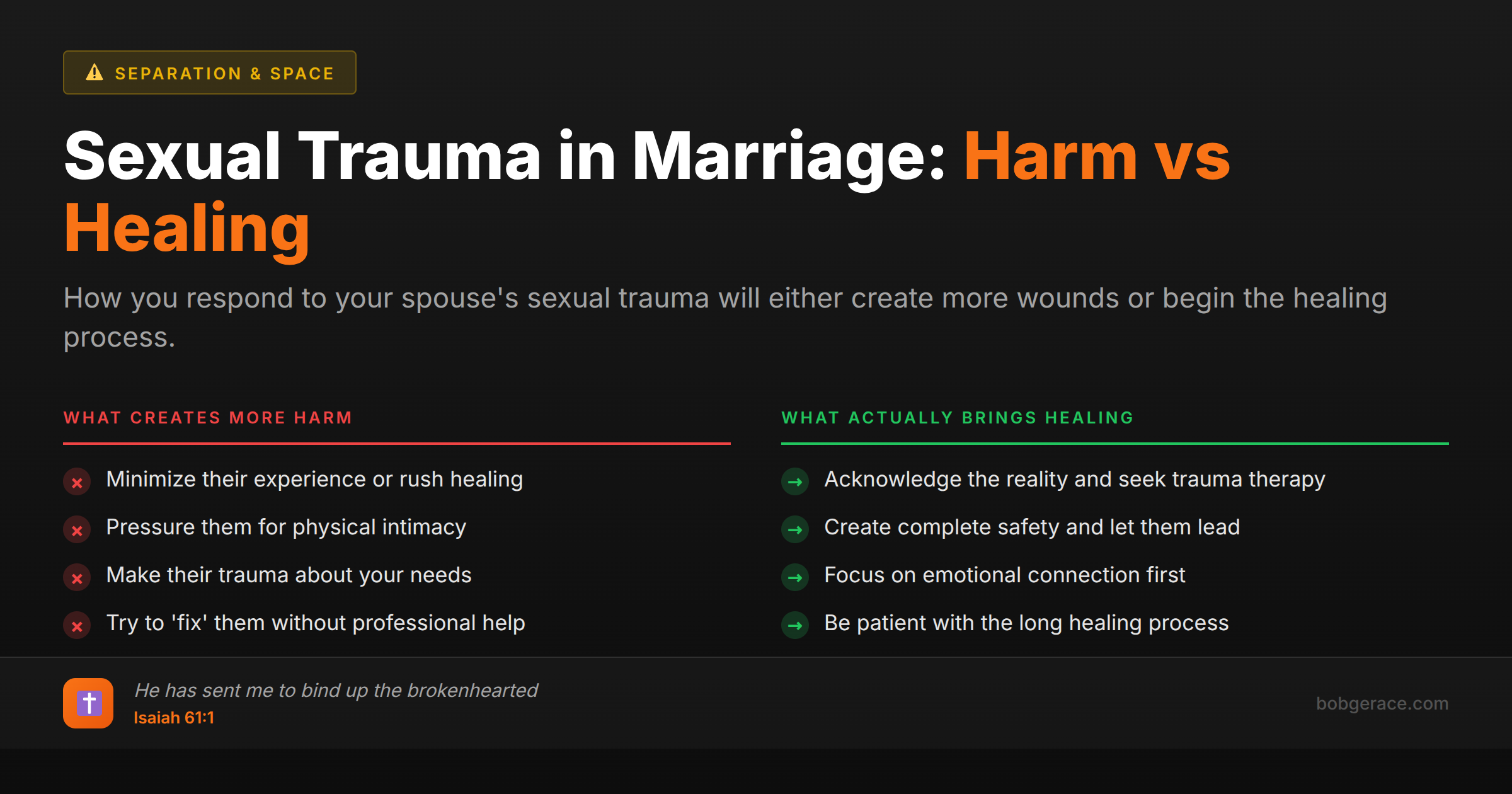
Sexual trauma refers to any unwanted sexual experience that causes psychological and emotional harm, including assault, abuse, coercion, or exploitation. This trauma creates deep wounds that significantly impact marriage relationships, particularly in areas of trust, intimacy, and emotional connection. When someone has experienced sexual trauma, their nervous system remains hypervigilant, making it difficult to feel safe and vulnerable with their spouse. In marriage, sexual trauma often manifests as avoidance of physical intimacy, emotional disconnection, hypervigilance during intimate moments, or involuntary physical responses like freezing or panic. The trauma survivor may struggle with feelings of shame, unworthiness, or fear of being hurt again. This creates a cycle where both spouses feel rejected, misunderstood, and disconnected, often leading to conflict and further emotional distance.
The Full Picture
Sexual trauma leaves invisible scars that profoundly impact every aspect of a person's life, especially their closest relationships. The trauma doesn't just affect the survivor—it affects the entire marriage. Understanding this reality is crucial for both spouses.
Trauma fundamentally changes how the brain processes safety and threat. When someone has experienced sexual violation, their nervous system becomes wired for protection rather than connection. This means that even in loving, safe relationships, their body may react as if danger is present. This isn't a choice or a lack of trust in their spouse—it's a physiological response to past harm.
Common ways sexual trauma impacts marriage include: - Physical intimacy challenges: Difficulty with touch, sexual avoidance, or dissociation during intimate moments - Emotional barriers: Struggle to be vulnerable, fear of abandonment, or difficulty receiving love - Communication breakdowns: Inability to express needs, triggers, or boundaries clearly - Trust complications: Even with a loving spouse, the nervous system may signal danger - Shame cycles: Feeling broken, damaged, or unworthy of love and connection
The non-traumatized spouse often feels confused, rejected, and helpless. They may take their partner's responses personally, not understanding that trauma reactions aren't about them. This creates a painful cycle where both partners feel misunderstood and disconnected.
Healing is possible, but it requires patience, professional help, and a trauma-informed approach that honors both the survivor's need for safety and the couple's desire for connection.
What's Really Happening
From a clinical perspective, sexual trauma creates what we call 'complex trauma responses' that affect multiple systems in the body and brain. The survivor's nervous system becomes dysregulated, meaning their fight-flight-freeze responses are easily triggered, even in safe situations.
Neurologically, trauma affects three key areas: The brainstem (survival responses), the limbic system (emotional processing), and the prefrontal cortex (rational thinking). When triggered, the lower brain regions take over, making it nearly impossible to access logic or feel emotionally present. This explains why a trauma survivor might 'disappear' mentally during intimate moments or have unexpected emotional reactions.
In marriage, we often see what I call 'intimacy avoidance patterns.' The survivor develops unconscious strategies to avoid triggers—emotional walls, physical distance, or even picking fights to create space. Meanwhile, their spouse often develops 'pursuit patterns,' trying harder to connect, which can inadvertently increase the survivor's sense of threat.
The key clinical insight is that healing happens through safety, not pressure. The survivor's nervous system needs to learn that intimate connection can be safe. This requires creating predictable, boundaried experiences where the survivor maintains complete control. Couples therapy with a trauma-informed therapist is essential because both partners need to understand these dynamics and learn new patterns of relating that support healing rather than retraumatization.
What Scripture Says
Scripture speaks powerfully about God's heart for those who have been wounded and His desire for healing in marriage relationships. God sees every violation and injustice, and His heart breaks for those who have been harmed.
Isaiah 61:1 declares God's mission: *'The Spirit of the Sovereign Lord is on me, because the Lord has anointed me to proclaim good news to the poor. He has sent me to bind up the brokenhearted, to proclaim freedom for the captives and release from darkness for the prisoners.'* This promise extends to those wounded by sexual trauma—God's desire is complete restoration and freedom.
Psalm 34:18 reminds us: *'The Lord is close to the brokenhearted and saves those who are crushed in spirit.'* Sexual trauma creates deep brokenness, but God doesn't abandon the wounded. He draws near with compassion and healing power.
For married couples, 1 Peter 3:7 instructs husbands to treat their wives *'with understanding, as the weaker partner and as heirs with you of the gracious gift of life.'* This doesn't mean weakness in character, but rather calls for tender, understanding love that honors the impact of past wounds.
Ephesians 4:32 calls both spouses to *'Be kind and compassionate to one another, forgiving each other, just as in Christ God forgave you.'* Healing from sexual trauma requires extraordinary patience and grace from both partners.
1 Corinthians 13:4-7 defines love as patient, kind, not self-seeking, and keeping no record of wrongs. This biblical model of love creates the safe environment necessary for trauma healing to occur in marriage.
What To Do Right Now
-
1
Acknowledge the reality - Stop minimizing or trying to 'fix' the trauma. Recognize that healing is a process that requires professional help and tremendous patience.
-
2
Find a trauma-informed therapist - Both individual therapy for the survivor and couples therapy with someone specifically trained in sexual trauma treatment are essential.
-
3
Create safety first - Establish clear boundaries around physical intimacy. Let the survivor lead and never pressure or guilt them into connection they're not ready for.
-
4
Learn about trauma responses - Educate yourselves about how trauma affects the nervous system. Understanding reduces blame and increases compassion for both partners.
-
5
Practice grounding techniques - Learn mindfulness and grounding exercises that help regulate the nervous system during triggered moments. Breathing exercises and safe touch can be powerful tools.
-
6
Build support systems - Connect with trauma-informed support groups, trusted friends, or pastoral care. Isolation makes healing harder while community provides strength and hope.
Related Questions
- Could her sexual shutdown be trauma-related?
- What does 'body keeps the score' mean for our sex life?
- Did something I did create sexual fear?
- What does coercion do to sexual desire long-term?
- What if her withdrawal is protection not rejection?
- What kills female sexual desire in marriage?
- What is 'betrayal trauma' and do I have it?
- What does trauma recovery look like?
- What is 'complex trauma' and do I have it?
- Is her leaving connected to past trauma?
Also find Bob on
Subscribe for weekly videos on Christian marriage.
Your Marriage Has a Specific Story
Sexual trauma doesn't follow a script. A coach who knows your situation can help you navigate what's actually happening in your bedroom and your marriage—not just theory.
Talk to Bob →