What does coercion do to sexual desire long-term?
6 min read
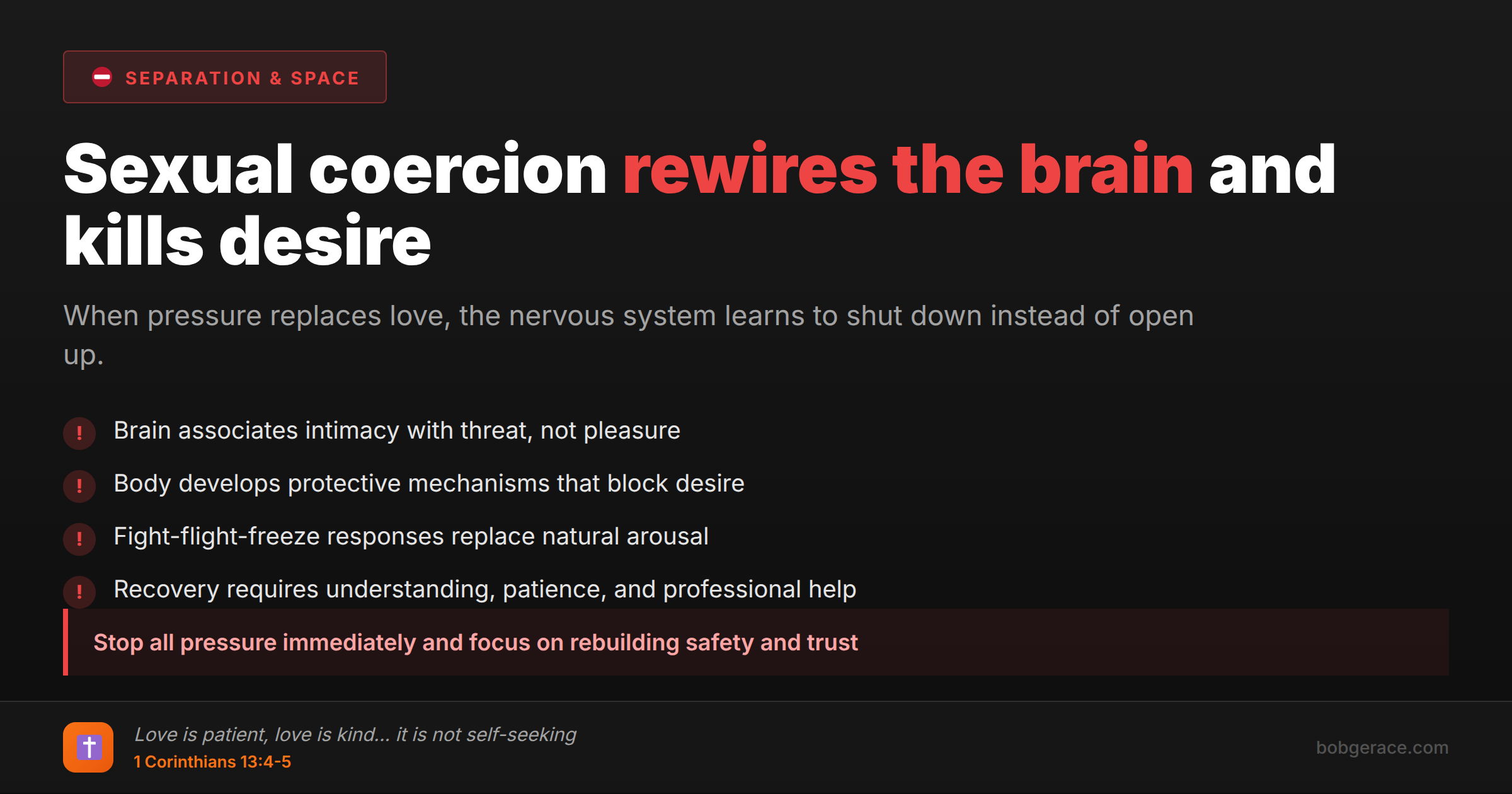
Sexual coercion fundamentally rewires the brain's response to intimacy, creating lasting damage to natural desire patterns. When someone experiences coercion - whether through pressure, manipulation, or force - their nervous system learns to associate sexual activity with threat rather than pleasure and connection. The long-term effects are profound: the body develops protective mechanisms that shut down desire as a survival strategy. This isn't a choice or weakness - it's a neurobiological response to trauma. The brain literally rewires itself to view sexual situations as dangerous, triggering fight-flight-freeze responses instead of arousal and openness. Recovery is possible, but it requires understanding, patience, and often professional support to rebuild trust and restore healthy desire patterns.
The Full Picture
Sexual coercion creates a cascade of neurobiological changes that can persist for years or even decades. When someone's sexual boundaries are violated through pressure, manipulation, guilt, or force, their brain's reward system becomes fundamentally altered.
The Neurobiological Impact
Coercion triggers the brain's threat detection system, flooding the body with stress hormones like cortisol and adrenaline during what should be intimate moments. Over time, this creates powerful negative associations with sexual activity. The brain literally learns that sexual situations equal danger.
The amygdala - the brain's alarm system - becomes hypervigilant during any sexual context. Meanwhile, the prefrontal cortex, responsible for pleasure and connection, goes offline. This neurological shift means that instead of feeling desire, arousal, and connection, the coerced partner experiences anxiety, dissociation, and emotional shutdown.
The Protective Response
What looks like 'low libido' or being 'checked out' is actually the nervous system doing its job - protecting against perceived threat. The body stops producing desire because desire leads to vulnerability, and vulnerability has become associated with harm.
This protective mechanism affects more than just physical response. It impacts emotional availability, the ability to be present during intimacy, and even the capacity to recognize one's own wants and needs. Many coercion survivors report feeling disconnected from their own sexuality entirely.
The Relationship Dynamic
Coercion doesn't just damage individual sexuality - it fundamentally alters relationship dynamics. Trust, the foundation of healthy intimacy, becomes fractured. The coerced partner may experience their spouse as unsafe, even if the coercive behavior has stopped. This creates a cycle where the more the coercive partner pushes for intimacy, the more the survivor's nervous system activates protective responses.
What's Really Happening
From a trauma-informed perspective, what we're seeing is a complex interplay between neurobiological injury and adaptive survival responses. Sexual coercion creates what we call 'betrayal trauma' - injury that occurs within a relationship that should be safe and nurturing.
The survivor's nervous system develops what I call 'intimacy hypervigilance.' Their body becomes exquisitely attuned to any signs of pressure or demand, often picking up on cues that the coercive partner isn't even aware they're sending. A certain tone of voice, a particular touch, or even a look can trigger the full stress response.
What's particularly damaging about sexual coercion is how it corrupts the neurobiological pathways of bonding and pleasure. Healthy sexuality involves a complex dance between the sympathetic nervous system (arousal, excitement) and the parasympathetic system (relaxation, openness). Coercion hijacks this process, making it extremely difficult for natural desire to emerge.
I often see survivors who have lost touch with their own sexual preferences and desires entirely. They've become so focused on managing threat and avoiding further coercion that they've disconnected from their own embodied experience. This isn't conscious - it's a protective adaptation that happens below the level of awareness.
Recovery requires more than just stopping the coercive behavior. It involves rebuilding safety in the nervous system, which takes time, patience, and often professional support. The good news is that with proper trauma-informed care, the brain can heal and healthy desire patterns can be restored.
What Scripture Says
God's design for sexuality is built on freedom, mutuality, and love - the complete opposite of coercion. Scripture consistently emphasizes that love cannot be forced or manipulated, and this principle applies powerfully to sexual intimacy.
Love Cannot Be Coerced
*"Love is patient, love is kind. It does not envy, it does not boast, it is not proud. It does not dishonor others, it is not self-seeking, it is not easily angered, it keeps no record of wrongs."* - 1 Corinthians 13:4-5
True love, including sexual love, operates through patience and kindness, never through pressure or manipulation. When we coerce, we fundamentally violate the nature of love itself.
Freedom in Marriage
*"The husband should fulfill his marital duty to his wife, and likewise the wife to her husband. The wife does not have authority over her own body but yields it to her husband. In the same way, the husband does not have authority over his own body but yields it to his wife."* - 1 Corinthians 7:3-4
This passage is often misused to justify coercion, but it actually teaches mutual submission and care. True authority in marriage means protecting and serving your spouse's wellbeing, never forcing or pressuring them.
Healing the Wounded
*"He heals the brokenhearted and binds up their wounds."* - Psalm 147:3
*"The Lord is close to the brokenhearted and saves those who are crushed in spirit."* - Psalm 34:18
God's heart is especially tender toward those who have been wounded. Sexual coercion creates deep wounds that require divine healing and patient restoration. This process cannot be rushed or forced.
True biblical sexuality flourishes in an atmosphere of safety, freedom, and mutual delight - never through coercion or pressure.
What To Do Right Now
-
1
Stop all forms of sexual pressure immediately - including guilt, manipulation, or demands for explanations about desire levels
-
2
Acknowledge the impact of past coercion - validate that coercive behavior has caused real harm that requires healing time
-
3
Commit to rebuilding safety - focus on emotional connection and trust-building rather than sexual outcomes
-
4
Seek trauma-informed professional help - both individual therapy for the survivor and couples therapy with a qualified specialist
-
5
Educate yourself about trauma responses - learn how coercion affects the nervous system and what true healing looks like
-
6
Practice patience with the healing process - understand that recovering from sexual coercion takes time and cannot be rushed
Related Questions
- What is 'sexual aversion' and does she have it?
- Could her sexual shutdown be trauma-related?
- What is 'sexual trauma' and how does it affect marriage?
- What does 'body keeps the score' mean for our sex life?
- What kills female sexual desire in marriage?
- What's the relationship between emotional safety and sexual desire?
- Why does sex feel contaminated now?
- What is post-affair sexual healing?
- How do I reclaim our intimacy?
- What does trauma recovery look like?
Also find Bob on
Subscribe for weekly videos on Christian marriage.
Your Marriage Has Its Own Story Here
Coercion damage doesn't heal the same way in every relationship. A coach who knows your specific history can help you rebuild what's actually broken in yours.
Talk to Bob →