What does 'body keeps the score' mean for our sex life?
6 min read
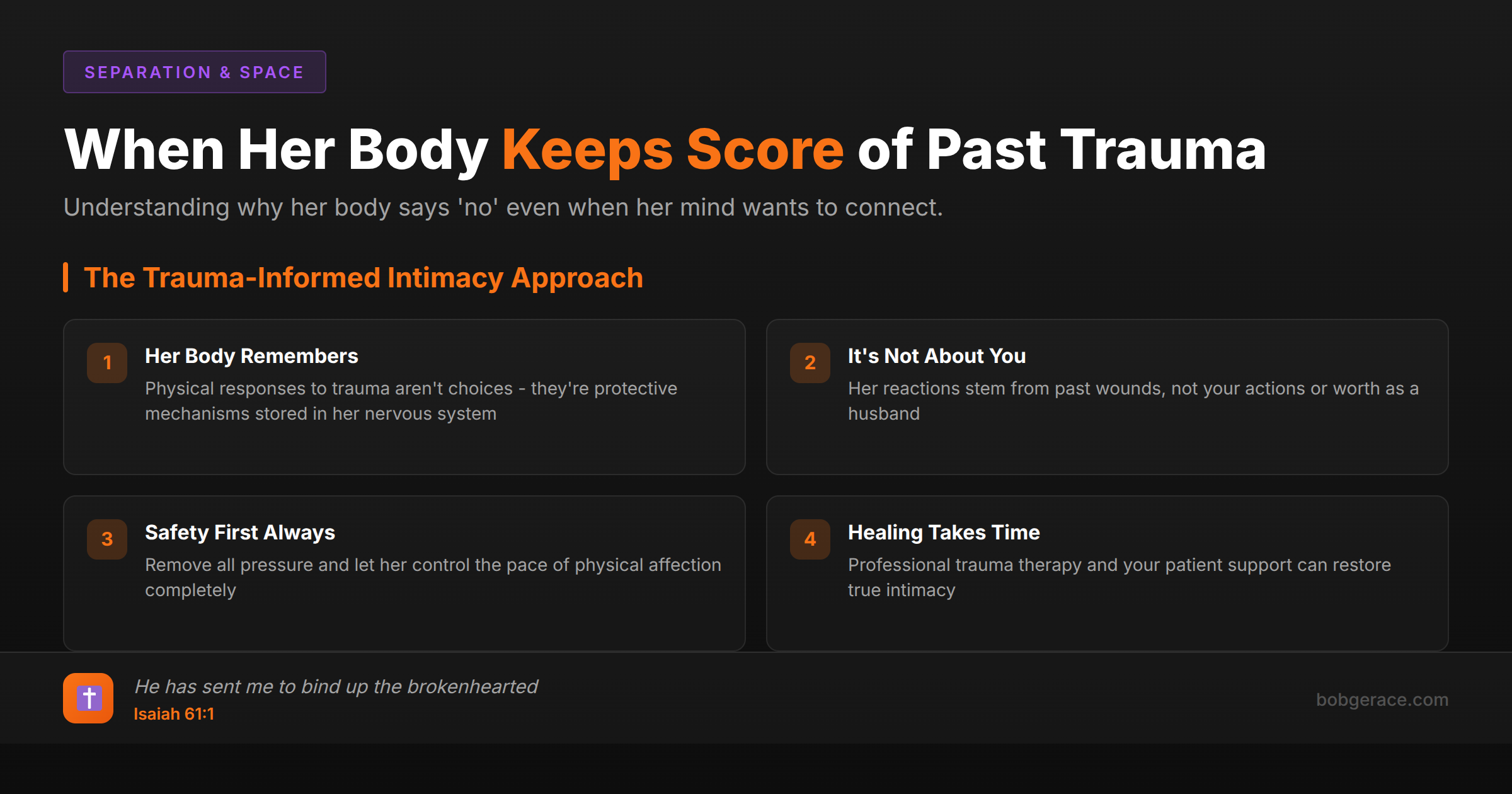
"The body keeps the score" refers to how traumatic experiences are stored physically in our bodies, not just mentally. When it comes to your sex life, this means past trauma can create involuntary physical responses - muscle tension, panic, dissociation, or shutdown - even when your mind says you're safe with your spouse. Your wife's body may be reacting to triggers you can't see, remembering past pain or violation. This isn't a choice she's making or something she can simply "get over." The nervous system holds these memories and responds protectively, often making physical intimacy feel threatening rather than connecting. Understanding this helps you respond with patience rather than taking her reactions personally, creating space for true healing to begin.
The Full Picture
Dr. Bessel van der Kolk's groundbreaking work "The Body Keeps the Score" revealed what trauma survivors have always known - trauma isn't just in your head, it lives in your body. When your wife experienced trauma, whether sexual, physical, or emotional, her nervous system learned to protect her by staying hypervigilant or shutting down.
In your marriage bed, this shows up as: - Sudden physical tension or pulling away - Emotional disconnection during intimacy - Panic responses to certain touches or positions - Complete shutdown or "going somewhere else" mentally - Physical pain without medical cause - Inability to be present or enjoy pleasure
Here's what most husbands don't understand: her body is trying to protect her, even from you. It doesn't matter that you're safe, loving, or nothing like whoever hurt her. Her nervous system doesn't distinguish between past and present when triggered.
This creates a heartbreaking cycle. She wants to connect with you but her body rebels. You feel rejected and confused, which increases pressure. More pressure triggers more protective responses. Soon, sex becomes associated with stress for both of you.
The breakthrough comes when you understand: This isn't about you, your attractiveness, or your marriage. It's about unhealed trauma that needs specific, patient attention. Your wife isn't broken - her body is doing exactly what it was designed to do: protect her from perceived danger.
Recovery requires professional help, usually trauma-informed therapy that works with the body, not just the mind. Approaches like EMDR, somatic therapy, or trauma-focused counseling can help reprogram these automatic responses.
What's Really Happening
From a clinical perspective, trauma creates lasting changes in the nervous system, particularly in areas that govern safety detection and stress response. The amygdala becomes hyperactive while the prefrontal cortex - responsible for rational thinking - goes offline during triggered states.
In sexual intimacy, this manifests as somatic flashbacks - body memories that don't necessarily include visual or narrative memories. Your wife might experience unexplained panic, pain, or dissociation without consciously remembering what triggered it. Her body is responding to sensory cues - touch, positioning, vulnerability - that mirror past trauma.
Key neurological responses include: - Hyperarousal: fight-or-flight activation during intimate moments - Hypoarousal: emotional numbing or physical shutdown - Dissociation: mental separation from physical experience - Muscle memory: tension patterns that recreate protective positions
Trauma-informed treatment focuses on nervous system regulation before addressing sexual issues. We help clients develop window of tolerance - the zone where they can experience intimacy without triggering survival responses. This involves teaching grounding techniques, boundary setting, and gradual exposure to physical connection.
For couples, I emphasize that healing isn't linear. Progress includes setbacks. The goal isn't to "fix" your wife but to create safety where her nervous system can learn new patterns. This requires the husband to manage his own emotional responses and resist pressuring for quick solutions.
Recovery typically involves individual trauma therapy combined with couples work focused on rebuilding trust and communication around physical intimacy.
What Scripture Says
God's heart for trauma survivors is beautifully woven throughout Scripture. He sees, He heals, and He restores what's been broken.
He binds up the brokenhearted: *"The Spirit of the Sovereign Lord is on me, because the Lord has anointed me to proclaim good news to the poor. He has sent me to bind up the brokenhearted, to proclaim freedom for the captives and release from darkness for the prisoners"* (Isaiah 61:1). Christ came specifically to heal trauma's deep wounds.
He knows our bodies intimately: *"For you created my inmost being; you knit me together in my mother's womb. I praise you because I am fearfully and wonderfully made"* (Psalm 139:13-14). God designed our nervous systems, including their protective mechanisms. He understands how trauma affects our physical beings.
He calls husbands to sacrificial love: *"Husbands, love your wives, just as Christ loved the church and gave himself up for her"* (Ephesians 5:25). Christ's love was patient, self-sacrificing, and focused on her healing, not His needs.
He promises restoration: *"And the God of all grace, who called you to his eternal glory in Christ, after you have suffered a little while, will himself restore you and make you strong, firm and steadfast"* (1 Peter 5:10). Healing takes time, but God is actively working toward wholeness.
He values gentleness: *"A bruised reed he will not break, and a smoldering wick he will not snuff out"* (Isaiah 42:3). This is how Christ treats the wounded - with infinite gentleness and patience.
Your role as a husband mirrors Christ's heart: patient, protective, prioritizing her healing over your desires, creating safety where God's restoration can unfold.
What To Do Right Now
-
1
Stop taking her physical responses personally - her body's reactions are about trauma, not you
-
2
Remove all pressure for sexual intimacy while she gets professional help
-
3
Find a trauma-informed therapist who specializes in somatic approaches to healing
-
4
Learn about trauma responses so you can recognize triggers and respond supportively
-
5
Focus on non-sexual physical affection that she initiates and controls completely
-
6
Get your own counseling to process the impact this has on you without burdening her
Related Questions
- Could her sexual shutdown be trauma-related?
- What is 'sexual trauma' and how does it affect marriage?
- Did something I did create sexual fear?
- What does coercion do to sexual desire long-term?
- What if her withdrawal is protection not rejection?
- What does healing from sexual disconnection look like?
- What is 'betrayal trauma' and do I have it?
- What does trauma recovery look like?
- What therapies help with this kind of trauma?
- What is EMDR and could it help?
Also find Bob on
Subscribe for weekly videos on Christian marriage.
Your Marriage Isn't a Textbook Case
Understanding trauma is one thing. Knowing how to navigate it in your specific marriage — her triggers, your frustration, the actual conversations you're having — requires a coach who hears your story.
Talk to Bob →