How do I become a safe person again?
6 min read
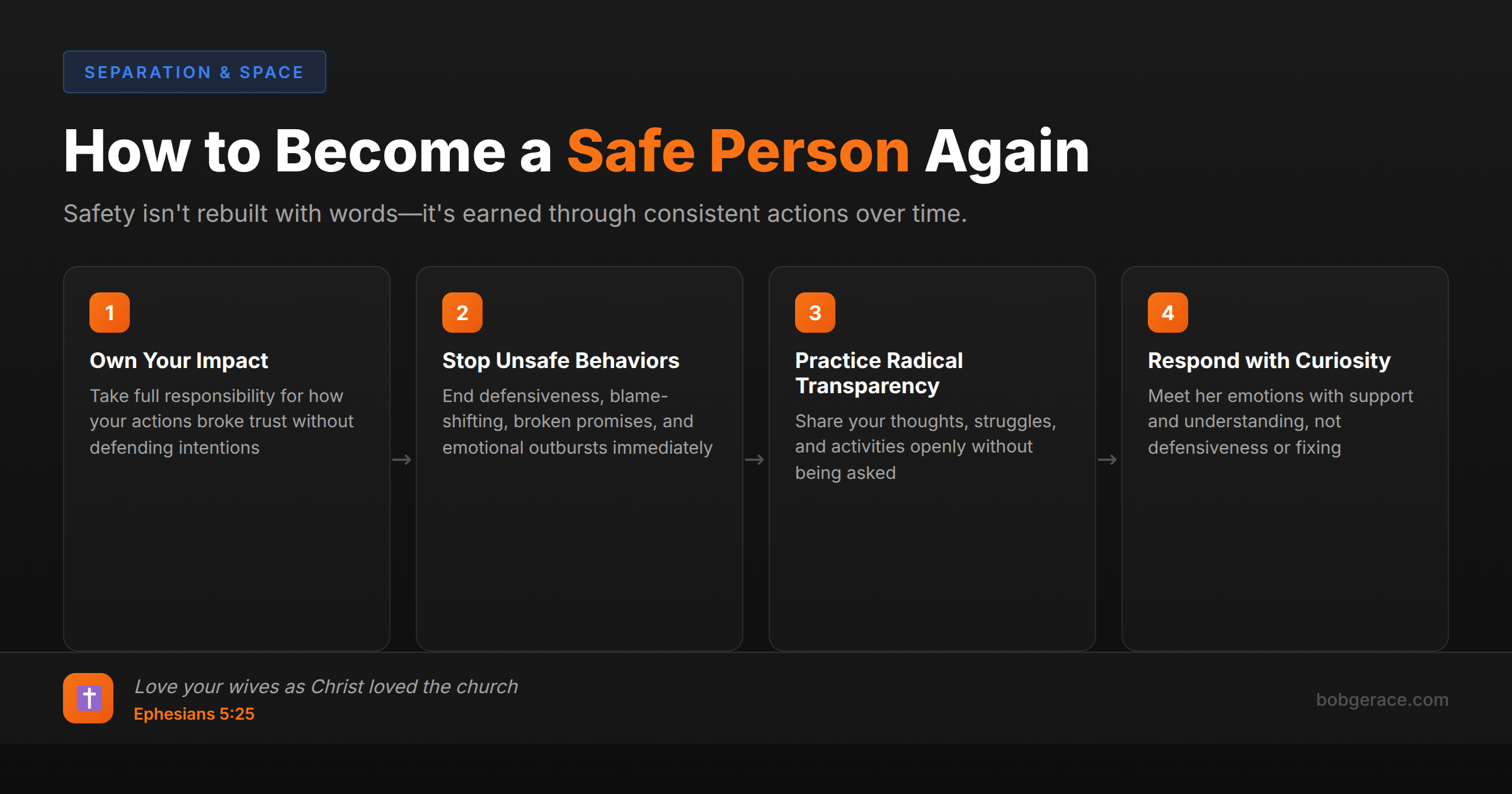
Becoming a safe person again starts with taking full ownership of how your actions broke trust and created emotional danger for your spouse. This isn't about explaining your intentions or asking for forgiveness—it's about demonstrating through consistent actions that you understand the impact of your choices and are committed to change. Safety is rebuilt through radical transparency, consistent follow-through on commitments, and patience with your spouse's healing process. You must prove over time that you can handle their emotions without defensiveness, that your words match your actions, and that you're willing to do the hard work of personal growth. This process takes months or years, not weeks.
The Full Picture
When your spouse has checked out emotionally, it's often because you've become an unsafe person in their world. Safety isn't just about avoiding big betrayals—it's about being someone your spouse can trust with their heart, emotions, and vulnerabilities on a daily basis.
Most men don't realize they've become unsafe until it's too late. You might think, "I never cheated" or "I'm not abusive," but safety goes much deeper. Have you dismissed her concerns? Minimized her feelings? Made promises you didn't keep? Reacted defensively when she tried to share her heart? These patterns create emotional danger.
Your spouse's emotional walls didn't go up overnight, and they won't come down quickly. She's protecting herself from further harm. Those walls feel personal and punishing to you, but they're actually a survival mechanism. She's not trying to hurt you—she's trying to protect herself from someone who has proven to be emotionally unsafe.
Becoming safe again requires you to understand that trust is not your right—it's something you earn through consistent, patient action. You can't argue your way back to safety, manipulate your way there, or rush the process. You have to prove through your behavior, over time, that you've genuinely changed.
This means accepting that your spouse may remain guarded while you demonstrate change. It means handling her emotions without making them about you. It means following through on every commitment, no matter how small. Most importantly, it means doing this work whether she responds positively or not, because becoming safe is about who you choose to be, not what you can get from her.
What's Really Happening
From an attachment perspective, when someone becomes emotionally unsafe, they trigger their partner's threat detection system. The nervous system literally perceives the relationship as dangerous, activating protective mechanisms that create emotional distance.
This isn't conscious or intentional—it's neurobiological. Your spouse's brain has categorized you as a potential source of harm rather than safety. Her emotional withdrawal, criticism, or walls aren't personality flaws—they're adaptive responses to perceived relational threat.
Rebuilding safety requires what we call 'earned security.' This happens when the previously unsafe partner consistently demonstrates reliability, emotional regulation, and attunement over an extended period. The key word is consistently. One good day doesn't override months of unsafe behavior.
Neurologically, you're literally rewiring your spouse's nervous system response to you. This requires predictable, non-threatening interactions that gradually signal safety. Every defensive reaction, every broken promise, every emotional outburst resets this process.
The most crucial element is emotional co-regulation—your ability to remain calm and present when your spouse is activated or upset. If you become defensive or reactive when she's struggling, you're reinforcing the pattern that made you unsafe in the first place. True safety means she can bring you her worst moments and trust that you'll remain steady and supportive.
What Scripture Says
Scripture calls husbands to be sources of safety and security for their wives. Ephesians 5:25 commands us to "love your wives as Christ loved the church," and Christ's love created the ultimate safe space—one where we could bring our worst and still be accepted.
1 Peter 3:7 instructs husbands to "live with your wives in an understanding way, showing honor to the woman as the weaker vessel, since they are heirs with you of the grace of life." This isn't about capability—it's about recognizing your responsibility to create emotional safety and protection.
The process of rebuilding trust requires the humility described in Philippians 2:3-4: "Do nothing from selfish ambition or conceit, but in humility count others more significant than yourselves. Let each of you look not only to his own interests, but also to the interests of others." Becoming safe means prioritizing your spouse's emotional well-being over your own comfort.
Proverbs 27:6 reminds us that "faithful are the wounds of a friend." Your spouse's walls and distance may feel wounding, but they're actually faithful feedback about the safety you need to rebuild. Don't resent the message—receive it.
James 1:19 provides the blueprint for safety: "Let every person be quick to hear, slow to speak, slow to anger." This is the daily practice of safety—listening first, speaking carefully, and managing your emotions so you can be present for hers.
Finally, Romans 12:18 calls us to "live peaceably with all," especially our wives. Peace in marriage isn't the absence of conflict—it's the presence of safety that allows conflict to be navigating together rather than something that threatens the relationship itself.
What To Do Right Now
-
1
Take complete ownership of how your actions created emotional danger without defending your intentions or asking for immediate forgiveness
-
2
Stop all behaviors that created unsafety—defensiveness, minimizing, blame-shifting, emotional outbursts, or broken promises
-
3
Practice radical transparency by sharing your thoughts, struggles, and daily activities without being asked
-
4
Respond to your spouse's emotions with curiosity and support rather than defensiveness or attempts to fix her feelings
-
5
Follow through consistently on every commitment you make, no matter how small, and communicate proactively if circumstances change
-
6
Give your spouse complete freedom to process her hurt and set boundaries without making her emotional journey about your comfort or timeline
Related Questions
- What is 'attachment shutdown'?
- What would make her want to risk opening up?
- What signals threat to her nervous system?
- What do I do that activates her defense?
- What would help her ventral vagal (social engagement)?
- What does safety look like to her nervous system?
- How do I listen without fixing?
- What does 'taking responsibility' actually look like?
- What does non-defensive response look like?
Also find Bob on
Subscribe for weekly videos on Christian marriage.
You Don't Have to Rebuild Alone
A coach who knows your marriage can see what you're missing and calibrate the work to where your wife actually is—not where you hope she is.
Talk to Bob →