What does 'do not separate' mean practically?
6 min read
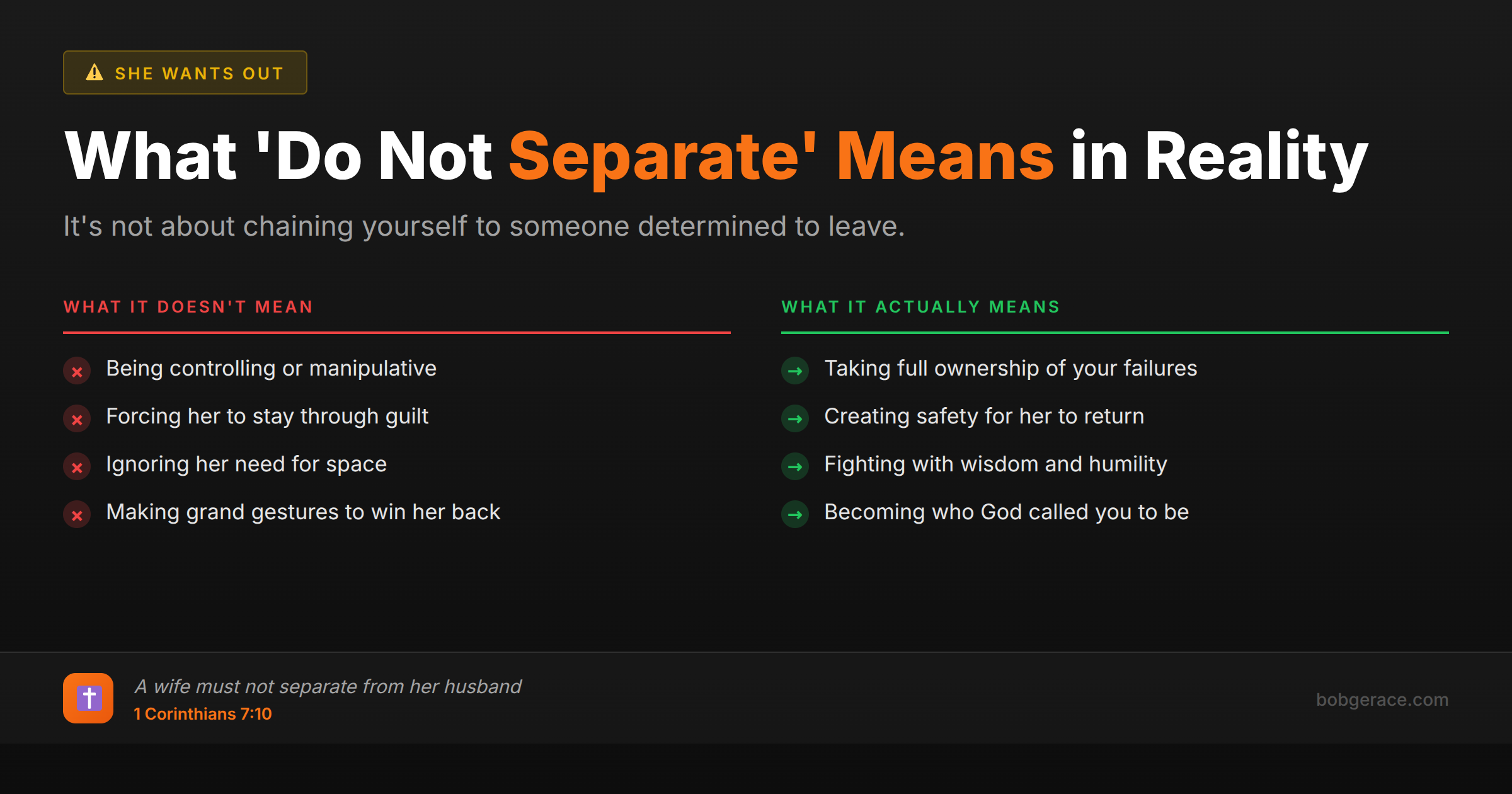
The biblical principle 'do not separate' doesn't mean you chain yourself to someone who's determined to leave. It means you honor the covenant by doing everything in your power to heal and restore the marriage before accepting separation as a last resort. Practically, this looks like taking full ownership of your contribution to the marriage problems, pursuing genuine transformation, creating safety for your spouse to return, and exhausting every reasonable avenue for reconciliation. It's about becoming the husband God called you to be, regardless of your wife's response. You honor 'do not separate' by fighting for your marriage with wisdom, humility, and persistence - not by being controlling or manipulative.
The Full Picture
'Do not separate' is about your heart posture, not controlling outcomes. When Paul writes this command in 1 Corinthians 7, he's addressing believers who might be tempted to abandon their marriage for convenience or cultural pressure. He's not commanding you to physically restrain a spouse who's determined to leave.
The principle means you exhaust every godly option before accepting separation. This includes:
• Deep personal transformation - addressing the character issues, emotional patterns, and relational failures that contributed to the crisis • Creating genuine safety - proving through consistent actions that you've changed, not just promising with words • Pursuing professional help - counseling, coaching, pastoral guidance, and therapeutic intervention • Building emotional and spiritual intimacy - learning to connect at levels you may have never reached before • Respecting boundaries while staying engaged - giving space when needed without disengaging from the relationship
The biggest mistake men make is thinking this command means they should argue, plead, or pressure their wife to stay. That's actually violating the principle because you're not loving her well. True covenant love sometimes means stepping back and doing the hard work of becoming someone worth staying with.
'Do not separate' is ultimately about character - yours. It's about becoming a man who fights for his marriage with wisdom, patience, and genuine love rather than desperation or control. You honor this principle by being willing to do whatever it takes to heal the relationship, while simultaneously respecting your wife's agency and timeline.
What's Really Happening
From a therapeutic perspective, the 'do not separate' principle aligns with attachment theory and trauma-informed care. When marriages reach crisis points, both partners are typically operating from activated nervous systems - fight, flight, or freeze responses that make rational decision-making nearly impossible.
Research on successful marriage recovery shows that couples who navigate separation threats successfully have one partner who remains emotionally regulated and committed to the relationship's healing. This doesn't mean being passive or enabling harmful behavior, but rather maintaining what we call 'secure functioning' - the ability to stay connected while managing your own emotional state.
The neuroscience is clear: when someone feels trapped or controlled, their brain's threat detection system becomes hyperactive, making reconciliation nearly impossible. The practical application of 'do not separate' must include respecting your spouse's autonomy and creating what attachment theorists call 'earned security' - demonstrating through consistent behavior that you're safe to be vulnerable with.
Clinically, we see that men who successfully honor this principle focus on becoming what Dr. Stan Tatkin calls a 'secure functioning partner' - someone who can self-regulate, take responsibility without defensiveness, and create safety for their spouse's nervous system to calm down. This often requires addressing underlying trauma, learning emotional intelligence skills, and developing genuine empathy.
The key insight is that 'do not separate' is most effective when it's expressed through becoming genuinely attractive - emotionally, spiritually, and relationally - rather than through pressure or negotiation.
What Scripture Says
Scripture provides clear guidance on the heart behind 'do not separate' while acknowledging the complexity of broken relationships.
1 Corinthians 7:10-11 - "To the married I give this command (not I, but the Lord): A wife must not separate from her husband. But if she does, she must remain unmarried or else be reconciled to her husband. And a husband must not divorce his wife." This passage establishes the principle while acknowledging that separation sometimes happens.
Ephesians 5:25 - "Husbands, love your wives, just as Christ also loved the church and gave Himself for her." The standard for husbands is Christ's sacrificial love - which includes respect for free will and genuine care for the other's wellbeing.
1 Peter 3:7 - "Husbands, in the same way be considerate as you live with your wives, and treat them with respect as the weaker partner and as heirs with you of the gracious gift of life, so that nothing will hinder your prayers." Practical covenant love includes consideration and respect.
Matthew 19:6 - "So they are no longer two, but one flesh. Therefore what God has joined together, let no one separate." This speaks to the sacred nature of the marriage covenant and God's intention for permanence.
Hosea 3:1-3 demonstrates God's own approach - pursuing with patience, creating space for response, and proving faithfulness through actions rather than words. Hosea didn't force Gomer to return; he created conditions that made return possible and attractive.
The biblical model is active love that creates space for choice - fighting for the marriage while respecting the person.
What To Do Right Now
-
1
Take full inventory of your contributions to the marriage problems without defending or minimizing
-
2
Stop any behaviors that feel controlling, pressuring, or manipulative to your wife
-
3
Create physical and emotional space if she's requested it while staying emotionally available
-
4
Begin intensive personal development work - counseling, coaching, or therapeutic intervention
-
5
Demonstrate changes through consistent actions over weeks and months, not grand gestures
-
6
Pray for your wife's wellbeing and healing, even if it means accepting outcomes you don't want
Related Questions
- Does the Bible address separation specifically?
- Is agreeing to separation the same as agreeing to divorce?
- How do I honor her request while honoring my vows?
- What is my responsibility if she forces separation?
- What does faithfulness look like when we're apart?
- How do I remain married in my heart when we live apart?
- What does biblical forgiveness require of me?
- What's the difference between forgiveness and reconciliation?
- What does Scripture say about divorce?
- What does faithfulness require when she won't reciprocate?
Also find Bob on
Subscribe for weekly videos on Christian marriage.
You Don't Have to Figure This Out Alone
Coaching means a human who knows your specific marriage, sees what's actually happening between you two, and helps you honor the covenant without losing yourself in the process.
Talk to Bob →