We're roommates, not spouses
6 min read
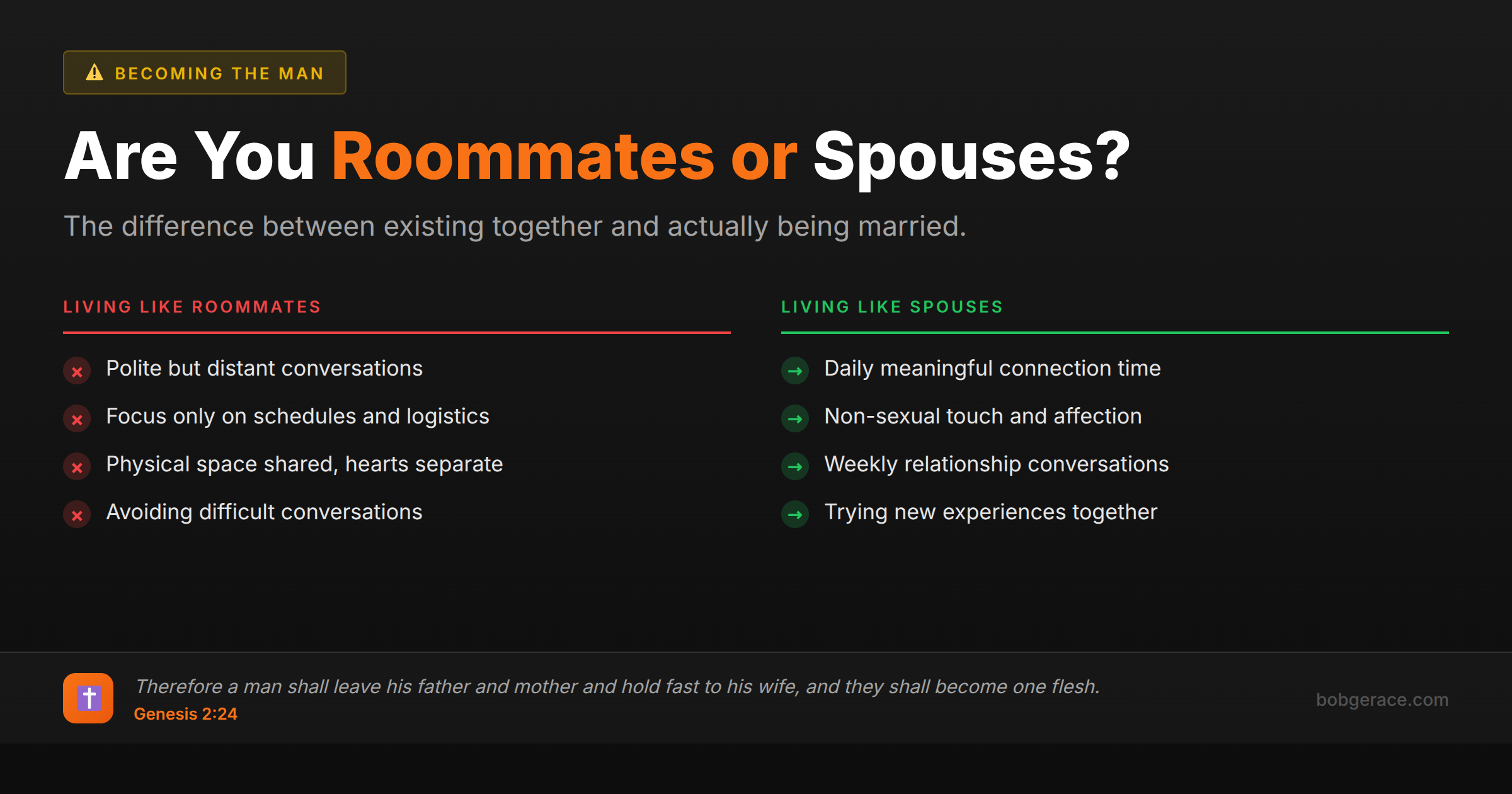
When you feel like roommates instead of spouses, you're experiencing what therapists call 'emotional disconnection' - a state where you share physical space and logistics but lack emotional intimacy, passion, and deep connection. This typically develops gradually as couples focus on responsibilities, avoid difficult conversations, and drift into parallel lives rather than an intertwined partnership. This isn't just about romance or physical intimacy - it's about feeling like strangers who happen to share bills and schedules. You might be polite, functional, even friendly, but you've lost that sense of being teammates, lovers, and best friends. The good news? This pattern can absolutely be reversed with intentional effort from both partners.
The Full Picture
The roommate marriage is one of the most common complaints I hear from couples, and it's exactly what it sounds like - you're functioning like two people who happen to share living space rather than two people who chose to build a life together.
Here's what the roommate dynamic typically looks like:
- Conversations revolve around logistics: schedules, bills, kids' activities - Physical affection is rare or feels obligatory - You sleep in the same bed but don't really connect - Date nights are infrequent or feel forced - You know more about your spouse's day from social media than from talking - Conflicts are avoided rather than worked through - You live parallel lives with occasional intersection points
This didn't happen overnight. Most couples slide into roommate status gradually. Life gets busy - careers demand attention, kids need constant care, financial pressures mount, health issues arise. Slowly, the relationship shifts from being the priority to being the thing that runs in the background while everything else gets your best energy.
The danger isn't just the unhappiness - though that's real. The danger is that roommate marriages are vulnerable. When there's no emotional connection, no intimacy, no sense of partnership, it becomes easy to start looking elsewhere for those needs to be met. Affairs often start not from passion but from finally feeling understood and valued by someone.
But here's what I want you to understand: feeling like roommates doesn't mean your marriage is doomed. It means you've developed some patterns that need to change. The foundation is still there - you're still choosing to share a life. Now you need to rebuild the connection on top of that foundation.
What's Really Happening
From a clinical perspective, the roommate marriage represents what we call 'emotional divorce' - couples who remain legally and practically married but have disconnected emotionally and intimately. This typically develops through a predictable pattern.
First, couples stop having meaningful conversations. They discuss logistics but avoid deeper topics about dreams, fears, feelings, or relationship concerns. This creates emotional distance that compounds over time.
Second, physical affection decreases significantly. Without emotional connection, physical touch feels less natural and satisfying. Partners may avoid even casual affection to prevent expectations or awkwardness.
Third, couples develop separate social worlds and interests without inviting their spouse to participate. They stop being curious about each other's inner world and daily experiences.
The psychological impact is significant. Partners often report feeling lonely despite not being alone, questioning their worth and attractiveness, and grieving the loss of what their marriage once was. Many describe feeling like they're 'going through the motions' of marriage without experiencing its benefits.
However, research shows that emotional disconnection can be reversed when both partners commit to specific, consistent actions that rebuild intimacy. The key is understanding that connection requires intentional cultivation - it doesn't maintain itself automatically, especially during stressful life seasons.
What Scripture Says
Scripture is clear that marriage is designed to be far more than a practical arrangement. God's design is for deep unity, intimacy, and partnership that goes well beyond sharing household duties.
Genesis 2:24 tells us, *'Therefore a man shall leave his father and mother and hold fast to his wife, and they shall become one flesh.'* The phrase 'one flesh' speaks to complete unity - emotional, physical, and spiritual. You're called to be united, not just cohabitating.
Ecclesiastes 4:12 reminds us, *'Though one may be overpowered, two can defend themselves. A cord of three strands is not quickly broken.'* Marriage is meant to be a partnership where you're stronger together - not two people living separate lives under one roof.
1 Corinthians 7:3-4 speaks directly to mutual care: *'The husband should fulfill his marital duty to his wife, and likewise the wife to her husband. The wife does not have authority over her own body but yields it to her husband. In the same way, the husband does not have authority over his own body but yields it to his wife.'* This isn't just about physical intimacy - it's about being fully available to each other.
Ephesians 5:25 commands husbands to *'love your wives, just as Christ loved the church and gave himself up for her,'* while verse 33 calls wives to respect their husbands. This requires knowing each other well enough to love and respect effectively.
The roommate marriage falls short of God's design because it lacks the intimacy, care, and unity that Scripture calls us to. But God's grace provides both the motivation and the power to rebuild what's been lost.
What To Do Right Now
-
1
Start with one meaningful conversation daily - Ask about their day, their thoughts, their feelings, not just logistics. Put phones away and actually listen.
-
2
Increase non-sexual physical touch - Hold hands while watching TV, hug goodbye in the morning, sit closer on the couch. Rebuild comfort with affection.
-
3
Schedule weekly connection time - One hour weekly dedicated to talking about your relationship, your dreams, your concerns. No kids, no distractions.
-
4
Do something new together monthly - Break the routine with a new restaurant, activity, or adventure. Shared experiences create connection.
-
5
Express appreciation daily - Say thank you for specific things your spouse does, acknowledge their efforts, compliment them genuinely.
-
6
Address the pattern directly - Have an honest conversation about feeling like roommates and commit together to rebuilding intimacy in your marriage.
Related Questions
- She says she loves me but isn't 'in love'
- She's physically present but emotionally gone
- She lights up for everyone but me
- When did she stop caring?
- She seems happier when I'm not around
- How did we get here without me noticing?
- What is 'emotional disengagement'?
- We haven't had sex in months/years
- She doesn't want to be touched
- What kills female sexual desire in marriage?
Also find Bob on
Subscribe for weekly videos on Christian marriage.
Your Marriage Isn't Generic. Neither Is the Fix.
Roommate drift looks different in every marriage — how you got here, what she needs to feel it shift, what actually moves the needle for you two. A coach who knows your specific situation calibrates faster than you can alone.
Talk to Bob →