Can porn cause betrayal trauma in marriage?
6 min read
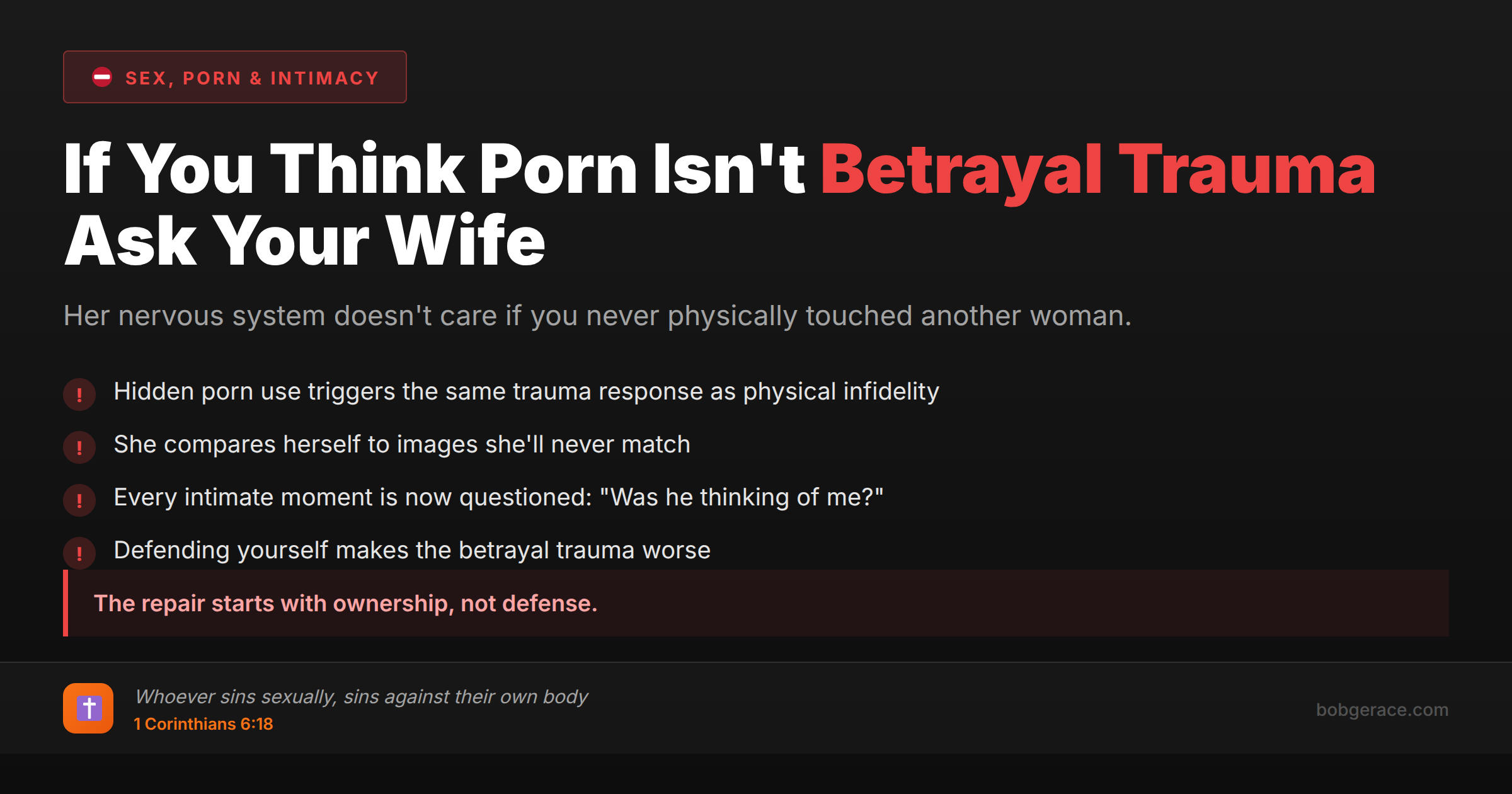
Yes. Porn can absolutely cause betrayal trauma in your wife, even if you never physically touched another woman. Betrayal trauma is not about whether you think porn is cheating. It's about the neurological and emotional impact of discovering that intimacy, trust, and sexual connection were not what she thought they were. When she learns you've been using porn—especially if it was hidden, minimized, or lied about—her nervous system can respond the same way it would to infidelity: hypervigilance, intrusive images, loss of safety, and a collapse of trust. This is not her overreacting. It's her brain and body trying to make sense of a relational injury. She may replay moments when you were distant after sex, compare herself to images she'll never match, or wonder if you were thinking of someone else when you touched her. The trauma is not just about what you did. It's about what she now questions: Was I ever enough? Did he ever really see me? The repair starts with ownership, not defense.
What Betrayal Trauma Actually Looks Like in a Marriage
Betrayal trauma happens when the person you depend on for safety becomes the source of the wound. Your wife didn't just discover a behavior. She discovered a secret life. She may now be asking herself: How long? How often? Was he thinking about them when he was with me? Did he choose pixels over me? The answers don't always help, because the injury is deeper than facts.
She may experience flashbacks, intrusive thoughts, or physical reactions when you reach for her. She may check your phone, your browser history, or your eyes when you're in public. This isn't control. It's a nervous system in survival mode. Her brain is scanning for threat because the man she trusted just became unpredictable. She may also feel shame—wondering if she wasn't attractive enough, adventurous enough, or available enough. That shame is misplaced, but it's real.
Many men minimize porn because it feels private, not relational. But your wife experiences it as relational. You brought other women into your sexual life without her knowledge. You trained your arousal system to respond to novelty, variety, and performance she can't compete with. You hid it, which means you knew it mattered. And now she's wondering what else you've hidden. Betrayal trauma is the cost of that discovery. It doesn't matter if you didn't mean to hurt her. She's hurt. And her body is responding accordingly.
The Neuroscience of Betrayal Trauma and Attachment Injury
Betrayal trauma is not a metaphor. It's a diagnosable response to relational violation, especially when the betrayal comes from an attachment figure. Dr. Jennifer Freyd's research shows that trauma is most severe when it comes from someone you depend on. Your wife's brain expected safety with you. When she discovered the porn use—especially if it was hidden or lied about—her brain registered it as a threat to the attachment bond.
Her amygdala may now be hyperactive. She's scanning for danger. Her prefrontal cortex, the part that regulates emotion and perspective, may be offline. This is why she can't "just get over it" or "move on." Her nervous system is stuck in a trauma response: fight, flight, freeze, or fawn. She may lash out, withdraw, go numb, or perform sexually to win you back. None of these are her character. They're her nervous system trying to survive.
Porn also creates a secondary injury: the comparison wound. She now knows you've been aroused by other women—women who don't have her body, her history, or her limitations. Even if you say she's enough, her brain has evidence to the contrary. This is compounded if you've been less interested in sex with her, if you've struggled with erectile issues, or if you've been emotionally distant. She may now interpret all of that through the lens of porn: He didn't want me. He wanted them. That belief, even if incorrect, becomes the filter through which she experiences you. Healing requires more than stopping the behavior. It requires rebuilding safety, transparency, and emotional presence.
Porn, Covenant, and the Cost of Hidden Sin
Scripture is clear: sexual sin is not just about the body. It's about the whole person. "Flee from sexual immorality. All other sins a person commits are outside the body, but whoever sins sexually, sins against their own body" (1 Corinthians 6:18). Porn is not a victimless sin. It fractures your integrity, your intimacy, and your wife's trust. It also violates the covenant you made before God to forsake all others.
Jesus said, "Anyone who looks at a woman lustfully has already committed adultery with her in his heart" (Matthew 5:28). This isn't legalism. It's reality. Lust is relational. It redirects desire away from your wife and toward fantasy. It trains your heart to want what you don't have and devalue what you do. Your wife feels that. She may not have had the language for it before, but she felt the distance, the distraction, the sense that she was being measured against an invisible standard.
Repentance is more than remorse. It's a change of direction. "If we confess our sins, he is faithful and just and will forgive us our sins and purify us from all unrighteousness" (1 John 1:9). Confession to God is essential. But so is confession to your wife. She is the one you sinned against in the flesh. She is the one whose trust you broke. Healing requires you to own the injury without minimizing it, without blaming her, and without expecting her to forgive on your timeline. God's grace is sufficient for you. But your wife's healing will take time, truth, and consistent presence.
Action Steps
-
1
Stop using porn completely. No exceptions, no "just one more time," no testing yourself. Install accountability software like Covenant Eyes or Truple, and give your wife full access if she wants it.
-
2
Own the betrayal without defending yourself. Say, "I hurt you. I broke your trust. I brought other women into our sexual life without your knowledge. I'm sorry." Don't explain why it wasn't that bad.
-
3
Let her feel what she feels without trying to fix it. She may be angry, sad, numb, or disgusted. Don't rush her. Don't ask her to forgive you yet. Just be present.
-
4
Get help. Join a men's recovery group, work with a Christian counselor trained in betrayal trauma, or get a coach who understands the neuroscience of porn and attachment injury.
-
5
Rebuild transparency over time. Let her ask questions. Let her see your phone. Let her know where you are. This isn't about control. It's about rebuilding safety in a nervous system that no longer trusts you.
Related Questions
Also find Bob on
Subscribe for weekly videos on Christian marriage.
You Can't Heal This Alone
Betrayal trauma doesn't resolve with apologies and promises. It requires a complete rebuild of safety, presence, and integrity. If your wife is pulling away or your marriage feels like it's hanging by a thread, let's talk.
Talk to Bob →