How do I build a real recovery plan from porn?
5 min read
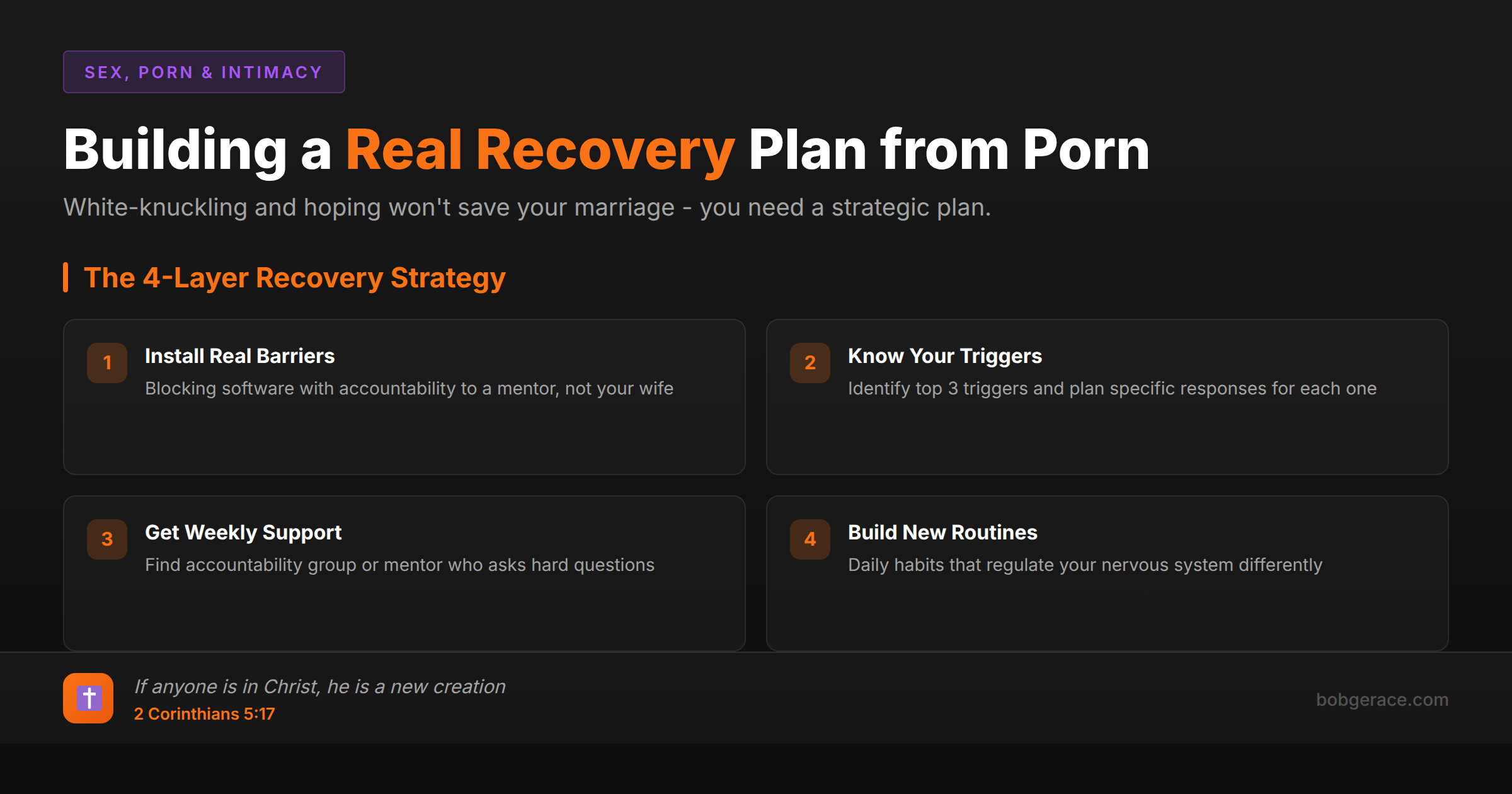
A real recovery plan isn't just installing accountability software and hoping for the best. It's a multi-layered strategy that addresses why you use porn, what triggers you, how you'll regulate your nervous system differently, and how you'll rebuild trust with your wife. It requires honesty, structure, and outside support. You can't white-knuckle your way out of a pattern you've reinforced for years. Your plan needs to be specific, measurable, and relational. It should include practical barriers, emotional awareness, spiritual disciplines, and accountability that doesn't depend on your wife policing you. If your plan is vague or relies only on willpower, it will fail. You need to treat this like the serious threat to your marriage that it is.
Why Most Recovery Attempts Fail
Most men try to quit porn the same way they try to quit any bad habit: they decide to stop, feel motivated for a few days, then relapse when stress or temptation hits. They think the problem is lack of willpower. It's not. The problem is they're trying to eliminate a behavior without replacing it with a better regulation strategy.
Porn isn't just about lust. It's about escape, soothing, control, and dopamine. You use it when you're stressed, bored, lonely, angry, or avoiding something uncomfortable. If you don't address those underlying drivers, you'll keep cycling back to porn no matter how many times you delete your browser history or promise your wife it's the last time.
Most men also try to recover in isolation. They don't tell anyone, or they only confess to their wife, which puts her in the impossible position of being both the wounded party and the accountability partner. That doesn't work. She can't heal from betrayal while also managing your sobriety. You need other men in your corner who can call you out, pray with you, and check in without the emotional weight she's carrying.
A real recovery plan acknowledges that porn has neurological, emotional, relational, and spiritual dimensions. You can't just pray it away or block it away. You have to rewire your brain, learn to feel your feelings, repair the trust you broke, and build a life where porn isn't your go-to when things get hard. That takes time, structure, and support.
The Neuroscience and Nervous System Work Required
Porn hijacks your brain's reward system. Every time you use it, you're reinforcing a neural pathway that says: stress or discomfort equals porn equals relief. Over time, that pathway becomes automatic. Your brain doesn't even ask if you want to use porn. It just fires the craving when the trigger hits.
Recovery means building new pathways. That requires repetition, not perfection. You need to practice different responses to the same triggers. Stressed? Go for a walk. Bored? Call a friend. Lonely? Pray. Angry? Journal. Every time you choose a different response, you weaken the old pathway and strengthen the new one. But it takes time. Neuroplasticity is real, but it's not instant.
You also need to understand your nervous system states. Porn use often happens when you're dysregulated—either hyper-aroused (anxious, restless, agitated) or hypo-aroused (numb, disconnected, flat). Learning to notice your state and regulate it without porn is the core skill. That might mean breathwork, cold showers, exercise, talking to someone, or simply sitting with the discomfort instead of running from it.
Finally, you need to address the relational nervous system impact. Porn creates secrecy, which creates disconnection, which creates more stress, which drives you back to porn. Breaking that cycle means bringing your struggles into the light with safe people. Your nervous system needs co-regulation, not just self-regulation. That's why isolation doesn't work. You need other humans in the process.
Sanctification Is a Process, Not an Event
Scripture is clear that sexual sin is serious. 1 Corinthians 6:18 says to flee sexual immorality because it sins against your own body. Porn isn't a victimless crime. It damages your brain, your marriage, and your witness. But the Bible is also clear that transformation is possible. 2 Corinthians 5:17 says if anyone is in Christ, he is a new creation. The old has passed away; the new has come.
That newness doesn't happen overnight. Sanctification is the process of becoming who you already are in Christ. You're already forgiven. You're already clean. Now you're learning to walk in that reality. Philippians 2:12-13 says to work out your salvation with fear and trembling, for it is God who works in you. You do the work, but God does the transforming. That's the partnership.
Your recovery plan should include spiritual disciplines that keep you connected to God. Daily Scripture reading, prayer, worship, fasting, and confession. These aren't religious hoops to jump through. They're the means of grace that rewire your heart. Psalm 119:9-11 says, 'How can a young man keep his way pure? By guarding it according to your word. I have stored up your word in my heart, that I might not sin against you.' You need God's Word in you, not just around you.
Action Steps
-
1
Install blocking software on all devices (Covenant Eyes, Truple, etc.) and give the accountability reports to a same-sex friend or mentor, not your wife.
-
2
Identify your top three triggers (time of day, emotional state, location) and write a specific plan for what you'll do instead when each one hits.
-
3
Find a weekly accountability group or individual mentor who will ask you the hard questions and pray with you. This cannot be your wife.
-
4
Build a daily routine that includes physical exercise, Scripture reading, and at least one face-to-face conversation with another human. Isolation feeds the cycle.
-
5
Track your progress in a journal. Note triggers, wins, slips, and what you're learning. Share this with your accountability partner and, if she's willing, your wife.
Related Questions
- Is husband porn addiction damaging my marriage?
- What does porn addiction do to a marriage?
- Why do I keep going back to porn when I love my wife?
- How do I rebuild trust after hiding porn?
- What is the connection between emotional safety and sexual desire?
- How do I talk about porn before it becomes a crisis?
Also find Bob on
Subscribe for weekly videos on Christian marriage.
Build a Plan That Actually Works
Recovery from porn isn't about trying harder. It's about building a system that addresses the real drivers and rebuilds trust with your wife. If you're ready to stop the cycle and do the deeper work, let's talk.
Talk to Bob →