How do I comfort her pain without defending my behavior?
5 min read
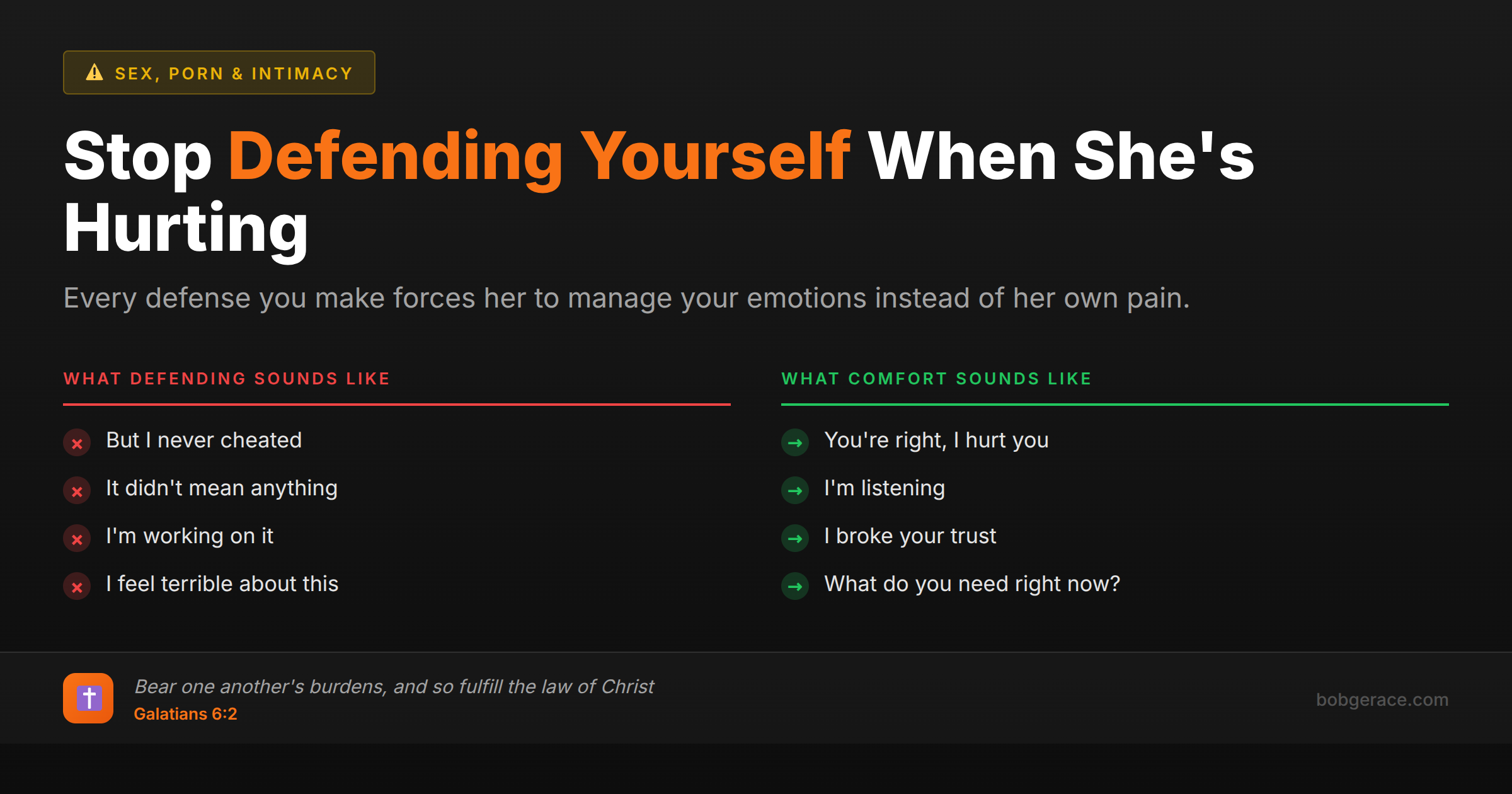
You comfort her pain by listening without defending, validating without explaining, and owning the full impact without making it about your intentions. She doesn't need you to prove you're not a bad guy. She needs you to sit with her hurt and let it be real. Every time you defend, minimize, or redirect the conversation to your guilt, you're asking her to manage your emotions instead of letting you hold hers. Comforting her means you absorb her anger, her questions, her grief, and her fear without flinching. It means you don't say 'but I never cheated' or 'it didn't mean anything' or 'I'm working on it.' Those are defenses. Comfort sounds like: 'You're right. I broke your trust. I hurt you. I'm listening.' Then you stay present and let her process at her pace, not yours.
Why Your Instinct to Defend Makes It Worse
When your wife confronts you about porn, your nervous system goes into threat mode. You feel exposed, ashamed, and afraid of losing her. Your instinct is to defend yourself, minimize the behavior, or explain why it wasn't as bad as she thinks. You say things like 'It was only a few times,' 'I wasn't thinking about other women,' or 'It has nothing to do with you.' You think you're calming her down. You're not. You're invalidating her.
Her pain isn't about the frequency or your intentions. It's about the betrayal, the secrecy, the comparison, and the fact that you chose pixels over presence. When you defend, you're telling her that her feelings are wrong or overblown. That makes her feel crazy, unheard, and more alone. She's not looking for a legal defense. She's looking for you to own what you did and the impact it had.
Most men also try to fix her pain by promising it will never happen again or by immediately jumping into recovery mode. That's still about you managing her emotions so you can feel less guilty. She doesn't need your promises right now. She needs your presence. She needs you to sit in the wreckage with her and not run from it.
Defending also keeps you from facing the truth. If you're busy explaining why it wasn't that bad, you're not reckoning with the fact that it was bad enough to break her trust. Comfort requires you to stop protecting yourself and start protecting her. That means you take the full weight of her pain without deflecting it back onto her or onto your guilt.
Betrayal Trauma and the Nervous System Response
When your wife discovers your porn use, her nervous system experiences it as betrayal trauma. This isn't an overreaction. Betrayal activates the same brain regions as physical threat. Her amygdala is firing, her cortisol is spiking, and her body is in fight-or-flight. She may rage, shut down, obsess over details, or swing between all three. That's a trauma response, not manipulation.
Betrayal trauma is especially acute in marriage because you're supposed to be her safe person. You're the one she's vulnerable with, the one she trusts with her body and her heart. When she finds out you've been secretly using porn, it shatters that safety. She doesn't know what else you've hidden. She doesn't know if you've been thinking about other women when you're with her. She doesn't know if she can trust anything you say.
Your job is not to talk her out of that fear. Your job is to validate it and then, over time, rebuild safety through consistent, honest action. Validation sounds like: 'I understand why you don't trust me right now. I broke that trust. I'm going to earn it back, and I know that takes time.' That's comforting. Saying 'You're overreacting' or 'I said I'm sorry, what more do you want?' is re-traumatizing.
You also need to understand that her nervous system won't calm down just because you apologized. She needs to see sustained change over weeks and months before her body starts to feel safe again. That means you stay regulated even when she's dysregulated. You don't match her anger with defensiveness. You don't shut down when she cries. You stay present, grounded, and non-reactive. That's how you co-regulate her nervous system and help her heal.
Bearing Her Burden Without Shifting Blame
Galatians 6:2 says to bear one another's burdens, and so fulfill the law of Christ. Right now, your wife is carrying the burden of betrayal, broken trust, and shattered safety. Your job is to help carry that burden, not add to it by defending yourself or making her manage your guilt. Bearing her burden means you absorb the weight of her pain without asking her to lighten it for you.
Proverbs 28:13 says, 'Whoever conceals his transgressions will not prosper, but he who confesses and forsakes them will obtain mercy.' Confession isn't just admitting what you did. It's agreeing with God and with her about the full truth of it. That means no minimizing, no excuses, no 'but.' You say: 'I was wrong. I hurt you. I broke your trust. I'm sorry.' Then you forsake the behavior and prove it with your life.
Jesus didn't defend Himself when He bore our sin. Isaiah 53:7 says He was oppressed and afflicted, yet He did not open His mouth. You're not Jesus, but you can follow His example of absorbing pain without deflecting it. Your wife's anger and grief are not attacks to defend against. They're the natural response to being wounded by someone she loved. You take it, you own it, and you let God transform you through it.
Action Steps
-
1
When she expresses pain, say 'You're right' or 'I hear you' before you say anything else. Don't explain, defend, or redirect.
-
2
Ask her what she needs from you right now, then do it without negotiating. If she needs space, give it. If she needs to talk, listen.
-
3
Write down the specific ways your porn use hurt her (broke trust, made her feel compared, created secrecy, etc.) and read it back to her. Let her add to the list.
-
4
Stop saying 'I'm sorry' repeatedly and start showing change. Apologies without action are just noise.
-
5
If you feel the urge to defend yourself, pause and ask: 'Is this about protecting her or protecting me?' If it's the latter, stay quiet and listen.
Related Questions
Also find Bob on
Subscribe for weekly videos on Christian marriage.
She Needs You to Get This Right
Comforting your wife after betrayal isn't about saying the right words. It's about becoming a different man. If you're ready to stop defending and start rebuilding, let's talk about how to do that.
Talk to Bob →