How do I quit porn for the sake of my marriage?
5 min read
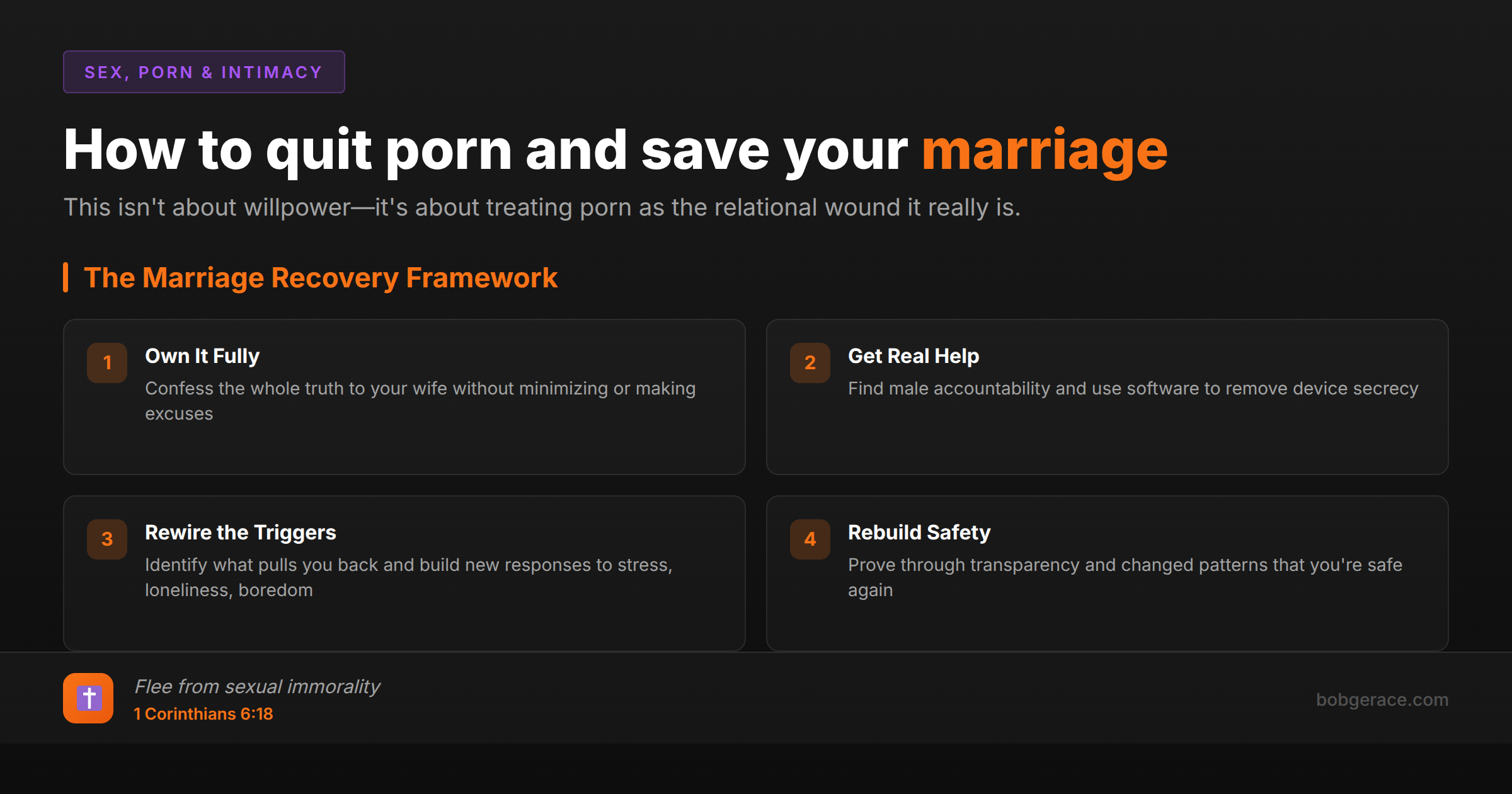
You quit porn for your marriage by treating it as a relational wound, not just a private habit you need better discipline around. That means full ownership without minimizing, ongoing accountability with another man who knows the whole truth, and addressing the underlying patterns—stress, loneliness, avoidance, arousal as emotional regulation—that keep pulling you back. Your wife doesn't need promises. She needs to see you take this seriously enough to get help, stay honest, and rebuild safety. The work isn't just stopping the behavior. It's rewiring how you handle shame, boredom, rejection, and desire. It's learning to stay present when your nervous system wants to escape. And it's proving over time, through transparency and changed patterns, that you're safe again. This isn't about perfection. It's about ownership, honesty, and doing the deeper work that makes sobriety sustainable.
Why Willpower Alone Won't Work
Most men try to quit porn the same way they attack a business problem: set a goal, apply discipline, white-knuckle through urges, and expect results. That works for a week, maybe a month. Then stress hits, she's distant, you're alone at night, and the same neural pathway fires. You're back in the cycle, now with added shame and secrecy.
Porn isn't just a visual habit. It's a nervous system strategy. You use it to regulate loneliness, stress, boredom, anger, or the fear of rejection. It gives you control, novelty, and arousal without the vulnerability of real intimacy. Your brain has learned: when I feel this way, I do this thing, and I feel better. That's not a moral failure. That's conditioning. And you can't discipline your way out of conditioning without addressing what's underneath.
Your wife isn't asking you to be perfect. She's asking you to stop hiding. She's asking you to prove that she's not competing with a screen for your attention, your desire, and your honesty. Every time you relapse and don't tell her, you're choosing the same pattern that broke her trust in the first place. Every time you minimize it or blame stress, you're telling her the problem isn't serious enough for real change.
Quitting porn for your marriage means you stop treating it like a private struggle and start treating it like the relational injury it is. That requires transparency, accountability, and the humility to admit you can't do this alone. It also requires you to address the emotional avoidance, the stress patterns, and the intimacy gaps that make porn feel necessary in the first place.
The Neuroscience of Habit and the Relational Cost of Secrecy
Pornography hijacks your brain's reward circuitry. It delivers supernormal stimuli—more novelty, more intensity, more dopamine—than real intimacy ever could. Over time, your brain recalibrates. Real sex feels less exciting. Your wife's body feels less compelling. Desire becomes tied to screens, secrecy, and the rush of something forbidden. This isn't about her attractiveness. It's about how your brain has been trained.
When you try to quit without addressing the underlying triggers, you're fighting your nervous system. Stress activates your sympathetic system. Loneliness or boredom drops you into shutdown. Porn becomes the quickest way to feel something, to escape, or to self-soothe. If you don't build new regulation strategies—breath work, movement, connection, prayer, honest conversation—you'll default back to the old one.
The relational damage isn't just about what you watched. It's about the secrecy. Every time you hid your phone, cleared your history, or lied about where you were, you taught your wife that you're not safe. She learned that you'll choose comfort over honesty. That you'll protect yourself before you protect her. That's attachment injury. And it doesn't heal with promises. It heals with sustained transparency, accountability, and proof over time that you've changed the pattern.
Recovery requires more than stopping the behavior. It requires you to grieve what porn cost you, to own the harm without defensiveness, and to build a life where you're addressing your emotional needs in healthy ways. That's the work that makes sobriety last.
Purity, Covenant, and the Call to Bring Darkness into Light
Scripture is clear: "Flee from sexual immorality" (1 Corinthians 6:18). "I have made a covenant with my eyes not to look lustfully" (Job 31:1). "Nothing is hidden that will not be made manifest, nor is anything secret that will not be known" (Luke 8:17). God's design for sexuality is covenant intimacy—exclusive, embodied, mutual, and life-giving. Porn is the opposite. It's solitary, disembodied, self-focused, and shame-producing.
But God's call isn't just to stop sinning. It's to walk in the light. "If we walk in the light, as he is in the light, we have fellowship with one another, and the blood of Jesus his Son cleanses us from all sin" (1 John 1:7). The healing doesn't come from hiding your struggle better. It comes from bringing it into the light—with God, with your wife, with a brother who will hold you accountable.
Your marriage is a picture of Christ and the church (Ephesians 5:25–32). That means your leadership isn't about being flawless. It's about being honest, repentant, and willing to lay down your pride for her good. Quitting porn isn't about earning her trust back through performance. It's about stewarding your heart, your eyes, and your integrity as an act of worship and covenant faithfulness. God doesn't call you to do this alone. He calls you to confess, to seek help, and to walk in community where sin loses its power in the light.
Action Steps
-
1
Confess fully to your wife—no minimizing, no blaming stress, no 'it was just a few times.' Own the pattern and the secrecy without expecting her to forgive you immediately.
-
2
Get into accountability with another man who knows the whole truth and will check in weekly. Use software like Covenant Eyes or Truple to remove secrecy from your devices.
-
3
Identify your three biggest triggers—stress, loneliness, boredom, rejection, late nights—and build a new response for each one that doesn't involve a screen.
-
4
Work with a coach or therapist who understands porn recovery and attachment repair. This isn't something you can willpower your way through alone.
-
5
Commit to 90 days of full transparency with your wife—no hidden devices, no deleted history, no locked phones. Let her see that you're serious about rebuilding safety.
Related Questions
Also find Bob on
Subscribe for weekly videos on Christian marriage.
You Don't Have to White-Knuckle This Alone
Quitting porn for good requires more than willpower. It requires accountability, nervous system work, and a plan to rebuild trust with your wife. I help men do the deeper work that makes recovery last.
Talk to Bob →