How do I repent from porn without performing remorse?
6 min read
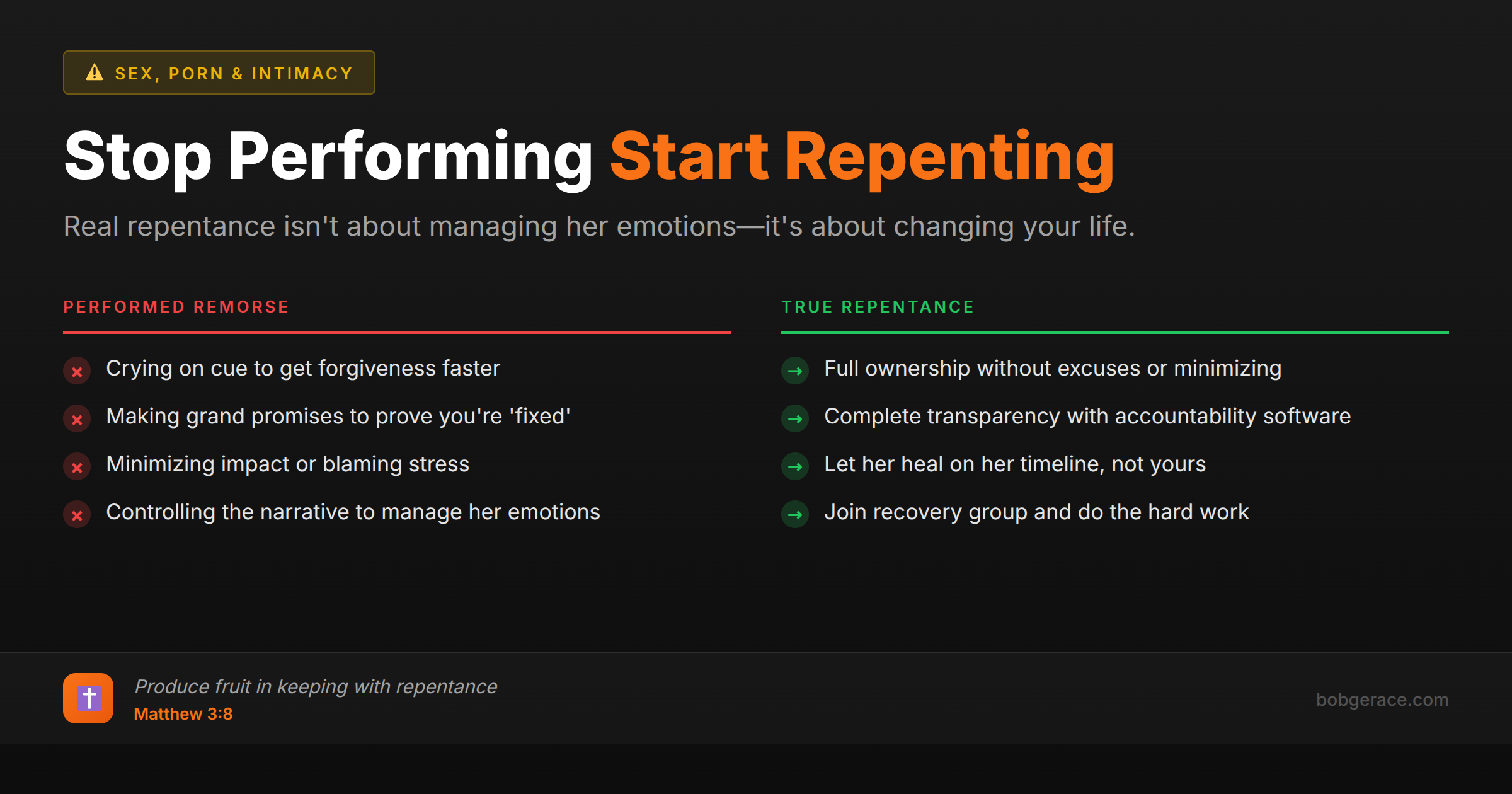
Real repentance is not a performance. It's not crying on cue, making grand promises, or saying the right words to get your wife to forgive you faster. Repentance is a change of direction that shows up in your behavior, your transparency, and your willingness to let your wife heal on her timeline—not yours. If you're trying to manage her emotions, control the narrative, or prove you're "fixed" so she'll move on, you're still operating from self-protection, not true repentance. Authentic repentance starts with ownership. You don't minimize the impact, blame stress or temptation, or compare yourself to other men who "have it worse." You say, "I hurt you. I broke your trust. I sinned against you and God. I'm sorry." Then you back it up with action: full transparency, accountability, and a commitment to do the hard work of recovery—whether she forgives you today or not. Repentance is not about getting her back. It's about becoming a man of integrity, regardless of the outcome.
What Performing Remorse Looks Like and Why It Backfires
Performing remorse is when you say and do the right things to get the result you want—usually your wife's forgiveness, her trust, or her willingness to move on. It looks like this: You cry, apologize, promise it will never happen again, maybe even throw away your phone or delete apps. You're emotional, contrite, and seemingly broken. But underneath, you're managing her response. You're trying to get her to feel safe again so the tension will stop, so she'll have sex with you again, so life can go back to normal.
Your wife can feel the difference. She may not have the words for it, but her nervous system knows when you're performing versus when you're truly repentant. Performed remorse is about you—your relief, your reputation, your need for her to forgive you so you can stop feeling shame. True repentance is about her—her pain, her healing, her need for safety and truth.
Performing remorse also shows up in how you respond when she doesn't forgive you right away. If you get frustrated, defensive, or start asking, "How long is this going to take?" you've revealed your motive. You weren't repenting. You were negotiating. Real repentance doesn't have a timeline. It doesn't demand that she trust you again just because you said you're sorry. It accepts that trust is rebuilt through consistent, transparent behavior over time—not through emotional displays.
Another sign of performance: you focus on what you've stopped doing ("I haven't looked at porn in three weeks!") instead of what you're becoming. Repentance is not just about behavior modification. It's about heart transformation. It's about asking, "Why did I choose this? What was I avoiding? What am I willing to face in myself so this doesn't happen again?" If you're not asking those questions, you're not repenting. You're just white-knuckling sobriety until the next trigger.
Shame, Self-Protection, and the Neuroscience of Authentic Change
Shame is one of the biggest obstacles to authentic repentance. When you feel shame, your nervous system goes into self-protection mode. You may collapse into self-loathing, lash out in defensiveness, or perform remorse to escape the discomfort. None of these are repentance. They're survival strategies. Dr. Brené Brown's research shows that shame drives disconnection, secrecy, and self-focus—the opposite of what's needed for relational repair.
Authentic repentance requires you to move through shame, not around it. This means you feel the weight of what you've done without collapsing into "I'm a terrible person" or deflecting with "But I'm trying." You stay present with the injury you caused. You let yourself feel the grief of how your choices hurt your wife. And you don't ask her to make you feel better about it. This is hard. It requires a regulated nervous system and the ability to tolerate discomfort without numbing, defending, or performing.
Neurologically, real change happens when you address the underlying drivers of the behavior, not just the behavior itself. Porn is often a coping mechanism for stress, loneliness, inadequacy, or emotional avoidance. If you stop using porn but don't address what you were using it for, you'll either relapse or replace it with another coping mechanism—work, alcohol, anger, withdrawal. True repentance involves getting curious about your internal world: What was I feeling before I used porn? What need was I trying to meet? What am I afraid to face?
This is where accountability and community become essential. You can't do this alone. You need other men who will ask you the hard questions, call you out when you're performing, and remind you that your worth is not tied to your wife's forgiveness. You need a counselor or coach who understands the neuroscience of addiction, attachment, and shame. And you need to be willing to do the work even if your wife never fully trusts you again. That's the test of authentic repentance.
Repentance as Metanoia: A Complete Change of Mind and Direction
The Greek word for repentance is metanoia—a complete change of mind, heart, and direction. It's not remorse. It's not regret. It's transformation. When John the Baptist called people to repentance, he said, "Produce fruit in keeping with repentance" (Matthew 3:8). In other words, don't just say you're sorry. Show it. Let your life be different.
Jesus told the parable of the two sons (Matthew 21:28-31). One son said he would obey his father but didn't. The other said he wouldn't, but later changed his mind and did. Jesus said the second son did the will of his father. Repentance is not about what you say. It's about what you do. If you tell your wife you're done with porn but you're still hiding your phone, still defensive when she asks questions, still unwilling to get real help, you're the first son. You're performing, not repenting.
David's repentance in Psalm 51 is a model. He didn't minimize his sin. He didn't blame Bathsheba or his circumstances. He said, "Against you, you only, have I sinned and done what is evil in your sight" (Psalm 51:4). He asked God to create in him a clean heart and renew a right spirit within him (Psalm 51:10). He knew that repentance was not just about stopping the behavior. It was about becoming a different kind of man.
God's grace is sufficient for you (2 Corinthians 12:9). But grace is not cheap. It cost Jesus everything. And it will cost you something too—your pride, your self-protection, your need to control the outcome. Real repentance is surrendering to God's work in you, trusting that He is faithful to complete it (Philippians 1:6), and letting your wife see that transformation over time, not demanding that she believe it right now.
Action Steps
-
1
Confess the full truth to your wife without minimizing, blaming, or managing her response. Say, "I used porn. I hid it from you. I hurt you. I'm sorry." Then stop talking and let her respond.
-
2
Install accountability software (Covenant Eyes, Truple) and give her full access. Let her see your phone, your browser history, your location. Transparency is not optional in repentance.
-
3
Join a men's recovery group or work with a Christian counselor trained in sexual integrity and betrayal trauma. Do this whether your wife asks you to or not. This is about your character, not her comfort.
-
4
Stop asking her, "Do you forgive me?" or "How long is this going to take?" Let her heal on her timeline. Your job is to be consistent, transparent, and present—not to manage her emotions.
-
5
Get curious about what drove the behavior. Journal, pray, or work with a coach to explore: What was I avoiding? What need was I trying to meet? What am I afraid to face in myself? This is the deeper work of repentance.
Related Questions
Also find Bob on
Subscribe for weekly videos on Christian marriage.
Repentance Requires More Than Remorse
If you've confessed but your wife still doesn't trust you, or if you're stuck in a cycle of relapse and shame, you need a guide who understands the deeper work of transformation. Let's talk.
Talk to Bob →