Should I confess more after she finds porn?
6 min read
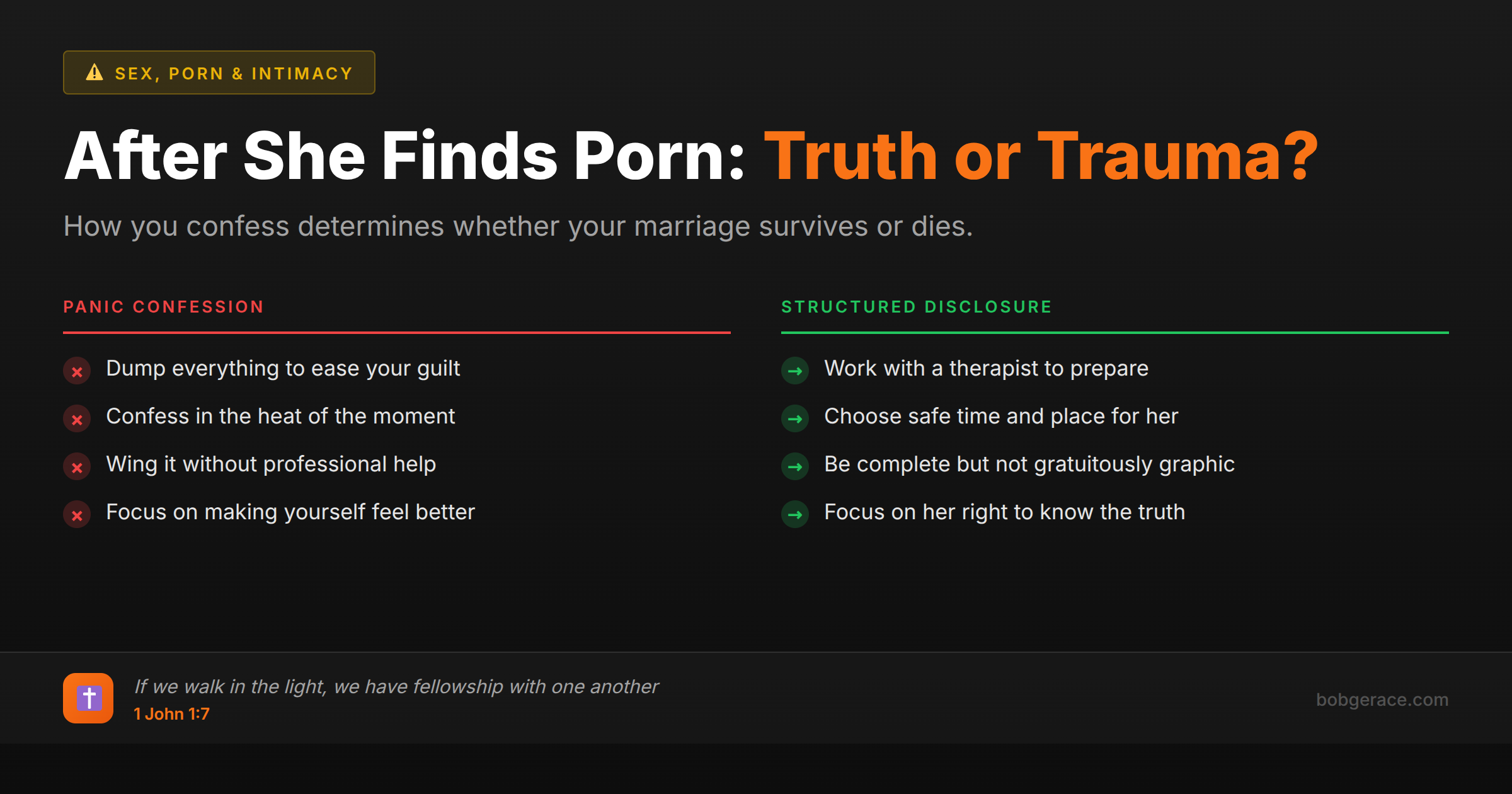
Yes, but not in the way you're thinking. Trickle truth—where she finds out a little, then more, then more—destroys trust faster than the original betrayal. If there's more she doesn't know, she needs to hear it now. But dumping everything in a panic to ease your guilt will retraumatize her. Full disclosure is necessary, but it requires structure. You don't confess to feel better. You confess because she deserves to make decisions about her life based on the truth. That means working with a therapist or coach to prepare what you'll say, how you'll say it, and how you'll support her after. This isn't a conversation you wing.
Why Trickle Truth Is Worse Than the Original Lie
When she found porn, her world shifted. She's now questioning everything—how long, how often, what kind, whether you've been lying about other things. If you only admit what she already found, you're setting her up for another betrayal when the rest comes out. And it will come out.
Trickle truth is when you confess in installments. She finds browser history. You admit to 'a few times.' She finds a charge on the credit card. You admit it's been longer. She finds messages. You admit there was interaction. Each new revelation resets her trauma. She can't heal because the wound keeps reopening.
You might think you're protecting her by holding back. You're not. You're protecting yourself from her reaction. And in doing so, you're making it impossible for her to trust anything you say. She'll spend the next year wondering what else you're hiding, checking your phone, and waiting for the next shoe to drop.
Full disclosure doesn't mean graphic details she didn't ask for. It means the scope, the timeline, the patterns, and any other behaviors that broke trust. If there were affairs, emotional or physical, she needs to know. If there were financial secrets tied to the behavior, she needs to know. If there were lies about where you were or who you were with, she needs to know.
The goal isn't to punish yourself or overwhelm her. It's to give her the full truth so she can decide what she wants to do with it. You don't get to control her response by controlling the information. That's manipulation, not protection.
Trauma, Disclosure, and the Window of Tolerance
Betrayal trauma is real. When your wife discovered your porn use, her nervous system went into threat mode. She's hypervigilant, scanning for danger, replaying memories, questioning everything. Her amygdala is running the show. She's not overreacting. She's having a normal response to relational trauma.
Full disclosure, done poorly, can retraumatize her. If you dump everything in a moment of panic or guilt, you flood her system. She can't process it. She dissociates, shuts down, or spirals into rage. That's not healing. That's harm.
Done well, disclosure is a structured event. You work with a therapist to prepare. You write out what you need to say. You anticipate her questions. You plan for her emotional response. You don't do it late at night or right before she has to go to work. You create a container where she can fall apart safely.
After disclosure, her nervous system needs co-regulation, not your defensiveness. She may scream. She may go silent. She may ask the same questions over and over. Your job is to stay present, answer honestly, and not shut down or retaliate. This is the cost of rebuilding trust.
Some men confess everything and then expect immediate forgiveness. That's not how trauma works. Her brain is trying to reconcile the man she thought she married with the man who lied to her face. That takes time. Your job is to hold the discomfort without demanding she make you feel better about it.
Walking in the Light, Not Managing the Darkness
Scripture calls us to walk in the light. 'But if we walk in the light, as he is in the light, we have fellowship with one another, and the blood of Jesus his Son cleanses us from all sin' (1 John 1:7). Confession isn't about shame management. It's about stepping out of darkness into truth.
Jesus said, 'Nothing is covered up that will not be revealed, or hidden that will not be known' (Luke 12:2). You can hide it from your wife for a season, but the truth has a way of surfacing. Better to bring it into the light yourself than have it dragged out in pieces.
Confession is also an act of love. 'Therefore, having put away falsehood, let each one of you speak the truth with his neighbor, for we are members one of another' (Ephesians 4:25). Your wife isn't your enemy. She's your covenant partner. Lying to her, even by omission, treats her like a threat instead of a teammate.
But confession without repentance is manipulation. 'Godly grief produces a repentance that leads to salvation without regret, whereas worldly grief produces death' (2 Corinthians 7:10). If you're confessing to ease your guilt or control her response, that's worldly grief. Godly grief means you're broken over the harm you caused and committed to change.
Your wife may not forgive you immediately. That's her right. Forgiveness is a gift, not a transaction. Your job is to tell the truth, own the consequences, and let God do the heart work in both of you.
Action Steps
-
1
Don't confess more in the heat of the moment. Schedule a session with a therapist or coach who specializes in betrayal trauma and disclosure. Prepare what you'll say with professional guidance.
-
2
Write out the full scope of what she doesn't know—timeline, frequency, types of content, any interactions with other people, financial impact. Be specific but not gratuitously graphic unless she asks.
-
3
Choose a time and place where she feels safe and has space to respond. Not late at night. Not before a family event. Not in the car. Give her control over the environment.
-
4
After you disclose, don't defend yourself or minimize. Answer her questions honestly. If you don't know the answer, say so. Don't lie to make it easier on yourself.
-
5
Expect her to need time and space. She may not want to be near you. She may ask you to leave. She may need to talk to her own therapist or trusted friends. Let her have that without guilt-tripping her.
Related Questions
Also find Bob on
Subscribe for weekly videos on Christian marriage.
Full Disclosure Isn't Something You Do Alone
If you're sitting on more truth and don't know how to bring it forward without destroying everything, you need help. This is the moment where you either rebuild trust or lose it forever. Let's talk about how to do this right.
Talk to Bob →