What does accountability look like without shaming myself?
5 min read
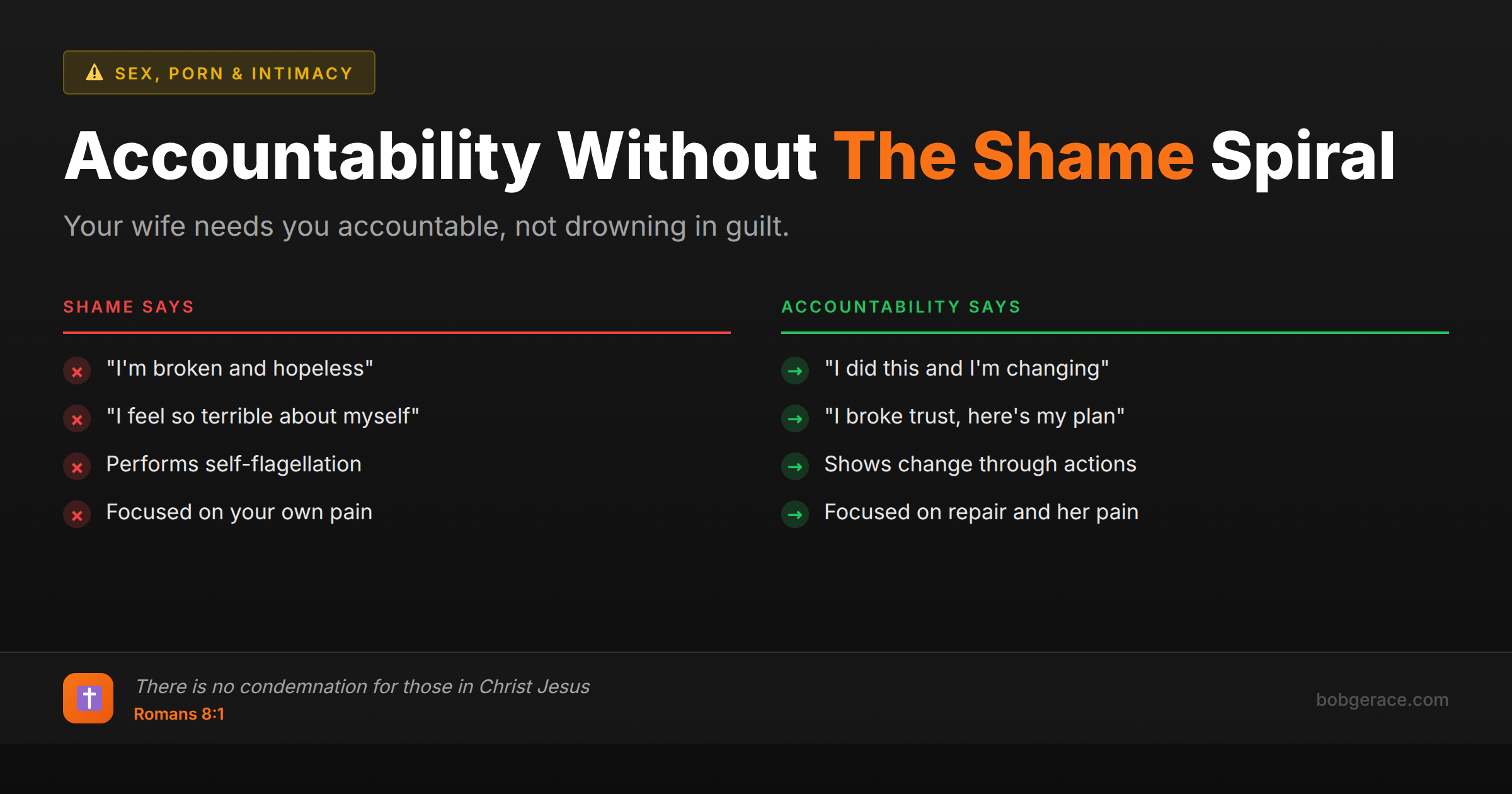
Accountability without shame means you own what you did and the impact it had, without collapsing into self-pity or hiding behind guilt. Shame says "I'm broken and hopeless." Accountability says "I did this, it hurt her, and I'm going to do the work to change." You don't need to perform self-flagellation to prove you're serious. You need to stop minimizing, stop hiding, and start showing up differently. Your wife doesn't need you drowning in shame. She needs you sober, honest, and present. Shame keeps you focused on your own pain instead of hers. Accountability keeps you focused on repair. It's the difference between "I'm such a terrible person" and "I broke trust, here's how I'm rebuilding it." One keeps you stuck. The other moves you forward.
Why Shame Feels Like Accountability But Isn't
Most men confuse shame with accountability because both feel bad. But shame is self-focused. It's about how terrible you feel, how broken you are, how you can't believe you did this again. It keeps the spotlight on your internal drama instead of the actual damage done to your wife and your marriage.
Your wife didn't marry you to manage your guilt. She married you to be seen, loved, and safe. When you collapse into shame after she discovers your porn use, you're asking her to comfort you about the thing that hurt her. That's not accountability. That's role reversal. She becomes your emotional manager instead of the wounded party who deserves your full attention.
Shame also gives you an out. If you're too broken to change, you don't have to do the hard work. You can stay stuck in the cycle: use porn, feel terrible, confess, promise to change, feel shame, repeat. Accountability breaks that cycle. It says: I did this. It hurt you. I'm going to face why I did it and build a different pattern, whether I feel good about myself or not.
Real accountability is uncomfortable but not paralyzing. It's honest without being dramatic. It's owning the impact on her trust, her body image, her sense of safety in the marriage. It's answering her questions without defensiveness. It's doing the work even when she's not watching. Shame keeps you in the pit. Accountability climbs out and starts rebuilding.
The Nervous System Trap of Shame
Shame activates your dorsal vagal shutdown response. Your nervous system interprets shame as a threat to your social standing and survival, so it collapses inward. You feel heavy, hopeless, stuck. This is why shame doesn't lead to change. It leads to freeze.
Porn use is often a dysregulation strategy. You're stressed, lonely, bored, or avoiding something uncomfortable, and porn offers a quick dopamine hit and nervous system reset. When you add shame on top of that pattern, you create a secondary dysregulation loop. Now you're using porn to escape stress, then feeling shame about the porn, which creates more stress, which drives you back to porn.
Accountability, by contrast, activates your ventral vagal system. It's relational. It's connected. It says: I can face this, own it, and stay present with the person I hurt. That's a regulated state. You're not hiding. You're not collapsing. You're standing in the truth and doing the next right thing.
This is why accountability without shame requires you to separate your behavior from your identity. You're not a porn addict who's hopelessly broken. You're a man who used porn as a coping mechanism and now you're learning healthier ways to regulate. That distinction matters. It keeps you out of the shame spiral and in the repair process. Your wife needs you regulated and present, not drowning in self-loathing.
Conviction vs. Condemnation
Scripture draws a clear line between conviction and condemnation. Romans 8:1 says there is no condemnation for those in Christ Jesus. Condemnation is shame. It says you're beyond hope, beyond repair, beyond redemption. That's not from God. Conviction, on the other hand, is the Holy Spirit showing you the truth so you can repent and change. Conviction leads to life. Condemnation leads to death.
When you confess sin, you're not groveling to prove you're sorry enough. You're agreeing with God about what's true, then turning toward Him for transformation. 1 John 1:9 promises that if we confess our sins, He is faithful and just to forgive and cleanse us. That's accountability. You own it, you bring it into the light, and you receive grace that empowers change.
Your wife is not your priest, but she is your covenant partner. Part of accountability is letting her see your repentance in action, not just in words. James 5:16 says to confess your sins to one another and pray for one another, that you may be healed. Healing happens in community, in honesty, in the light. Shame keeps you isolated. Accountability brings you into relationship with God and with her, where real transformation happens.
Action Steps
-
1
Stop apologizing repeatedly for the same thing. Apologize once with specificity, then show change through your actions.
-
2
Name the impact on her without making it about your guilt. Say 'I broke your trust and made you feel unsafe' instead of 'I feel so terrible about myself.'
-
3
Build a recovery plan that doesn't depend on her monitoring you. Use software, find a same-sex accountability partner, and do your own work.
-
4
When shame hits, notice it and redirect. Ask yourself: 'What does accountability require right now?' then do that thing.
-
5
Track your progress in a journal. Write what you're learning, what triggers you're noticing, and how you're responding differently. Share it with her if she wants to see it.
Related Questions
- Is husband porn addiction damaging my marriage?
- What does porn addiction do to a marriage?
- Why do I keep going back to porn when I love my wife?
- How do I rebuild trust after hiding porn?
- How do I rebuild sexual desire without begging for it?
- What is the connection between emotional safety and sexual desire?
Also find Bob on
Subscribe for weekly videos on Christian marriage.
You Don't Have to Figure This Out Alone
Porn isn't just a private struggle. It's a marriage issue that requires real strategy, not just willpower. If you're ready to build a recovery plan that actually works and rebuild trust with your wife, let's talk.
Talk to Bob →