What does my reaction to rejection teach my wife?
5 min read
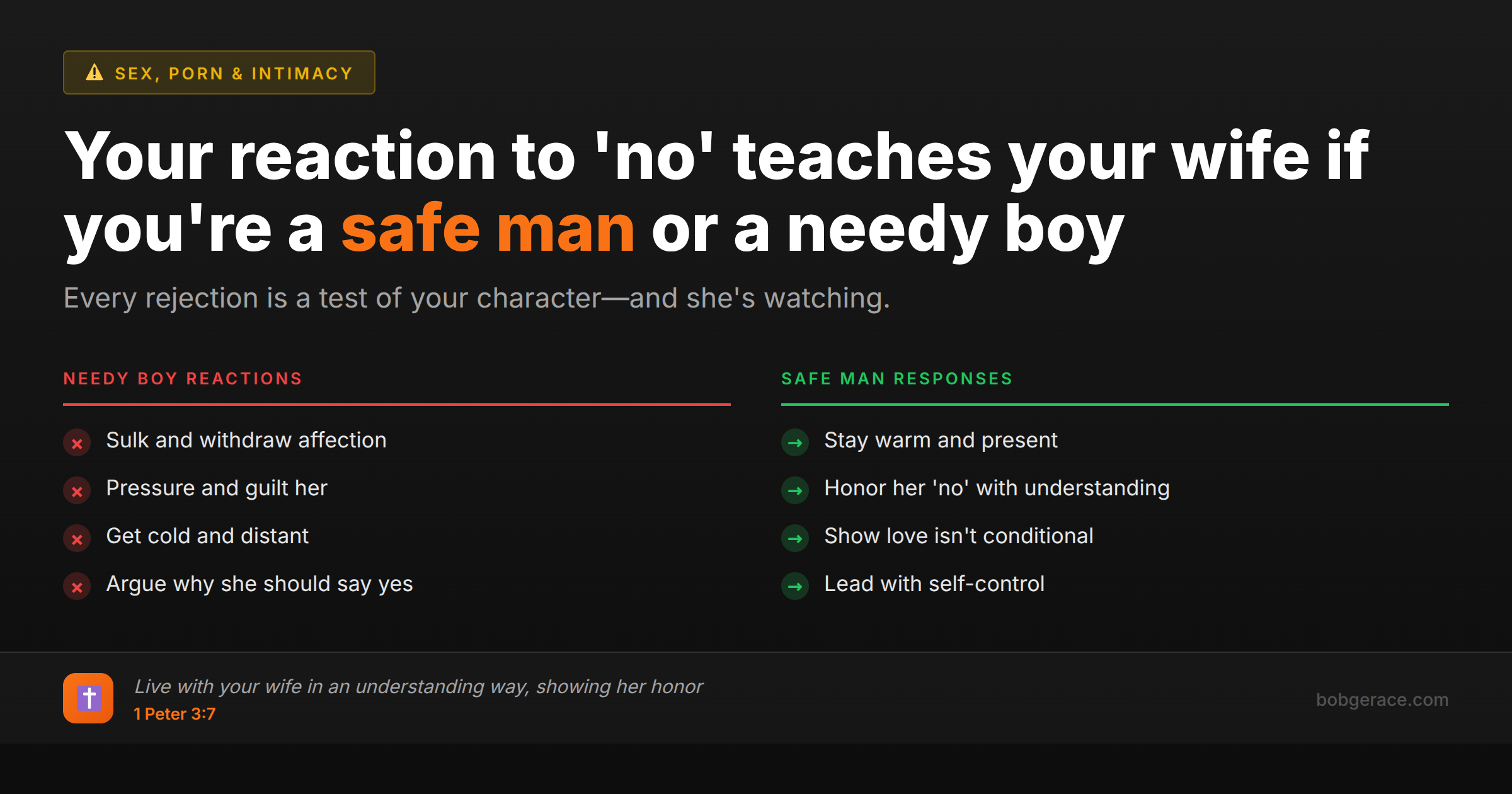
Your reaction to sexual rejection teaches your wife what you really want from her. If you sulk, withdraw, or get cold, you teach her that sex is the price of your affection. If you pressure, guilt, or argue, you teach her that her body matters more than her heart. If you stay warm, kind, and present, you teach her that she's safe with you—that you love her, not just what she can give you. She's watching. Every time she says no, she's testing whether you're a safe man or a needy one. Whether you can handle disappointment like a leader or react like a child. Your response either builds trust or confirms her worst fear: that you only value her for sex.
She's Learning Whether She's Safe With You
Every time your wife says no to sex, she's not just declining intimacy—she's watching how you handle it. Your reaction in that moment teaches her more about your character than a hundred conversations. It reveals whether you see her as a whole person or a sexual object. Whether you can self-regulate or need her to manage your emotions. Whether you're leading with love or operating from entitlement.
If you sulk, she learns that your kindness is conditional. That you'll withdraw affection when you don't get what you want. She starts to feel like she has to perform sexually to keep the peace. Sex becomes a transaction, not a gift. She begins to dread your advances because she knows what's coming if she says no: the silent treatment, the cold shoulder, the emotional distance.
If you pressure her—through guilt, logic, or negotiation—she learns that her no doesn't matter. That you'll override her boundaries if you're persistent enough. She feels violated even without physical force. Her body becomes a battleground. She starts avoiding you altogether because saying no is too costly.
If you get angry or defensive, she learns that you're not safe. That your need for sex is more important than her need for respect. She shuts down emotionally. Intimacy becomes something she endures, not something she desires. The relational foundation crumbles, and the bedroom becomes a place of tension instead of connection.
But if you respond with calm strength—acknowledging your disappointment without making it her problem—she learns something different. She learns that you're a man who can handle hard things. That your love isn't fragile. That she can trust you with her no, which makes her yes more meaningful. You create the safety that desire requires.
Rejection as a Relational Stress Test
Sexual rejection is one of the most vulnerable moments in a marriage. It activates both partners' attachment systems and reveals the underlying health of the relationship. For you, rejection often triggers core wounds: fear of being unwanted, shame about your desire, or anger at feeling controlled. How you respond in that triggered state teaches your wife whether you're emotionally regulated or reactive.
From a nervous system perspective, your reaction either co-regulates her or dysregulates her. If you stay calm and warm after she says no, you're sending a signal to her nervous system: "You're safe. I'm stable. We're okay." This builds secure attachment. She learns that she can be honest with you without relational consequences. Over time, this safety increases her willingness to be vulnerable—including sexually.
But if you react with withdrawal, anger, or guilt, you're dysregulating her nervous system. You're signaling danger. Her body goes into threat response: fight, flight, freeze, or fawn. She may apologize excessively (fawn), avoid you (flight), shut down emotionally (freeze), or argue defensively (fight). None of these states are conducive to intimacy. You've just taught her that saying no is dangerous.
Your reaction also reveals your implicit beliefs about sex and marriage. If you sulk, you believe sex is owed to you. If you pressure, you believe her body is yours to access. If you stay kind, you believe she's a person with agency, not a resource to manage. These beliefs shape the entire relational dynamic. She's not just learning about sex—she's learning whether you see her as an equal or an object.
The good news: you can retrain this. Every time you respond well to rejection, you're building new neural pathways. You're teaching both your nervous system and hers that disappointment doesn't equal danger. That's how you rebuild trust and create the conditions for genuine desire.
Christlike Love in the Face of Rejection
Jesus was rejected more than any man in history. Isaiah 53:3 calls Him "despised and rejected by men, a man of sorrows and acquainted with grief." Yet He never withdrew His love. He never punished those who rejected Him. He stayed present, even on the cross, praying for the people who nailed Him there. That's the model for how you respond when your wife says no.
First Peter 3:7 tells you to live with your wife in an understanding way, showing her honor as a fellow heir of grace. Honoring her means respecting her no. It means valuing her personhood over your sexual satisfaction. It means leading with patience, not pressure. When you respond to rejection with kindness, you're reflecting the character of Christ. When you sulk or manipulate, you're reflecting the flesh.
Ephesians 5 doesn't just call you to love your wife—it calls you to lay down your life for her. That includes laying down your ego, your entitlement, and your need to control her response. It means absorbing the disappointment of rejection without making her pay for it. It means trusting God with your unmet needs instead of demanding she meet them on your timeline.
Your reaction to rejection is a discipleship issue, not just a marriage issue. It reveals whether you're walking in the Spirit or the flesh. Galatians 5:22-23 says the fruit of the Spirit is love, patience, kindness, self-control. If your response to sexual rejection lacks those qualities, you're not operating in the Spirit. The solution isn't trying harder—it's surrendering more fully to God's work in you.
Action Steps
-
1
Next time she says no, notice your first impulse. Don't act on it. Pause. Breathe. Choose a response that reflects the man you want to be, not the boy you were.
-
2
Say something like, "I'm disappointed, but I understand. I love you." Then stay warm. Don't withdraw. Don't go silent. Show her that your affection isn't conditional on sex.
-
3
After the moment, reflect: What did my reaction teach her? Did I show her she's safe? Did I honor her no? Did I lead with self-control? Write it down. Bring it to God in prayer.
-
4
If you've been reacting poorly for years, own it. Tell her, "I've been teaching you that my love is conditional. That's wrong. I'm working on it. I'm sorry." Then prove it with consistent, calm responses over time.
-
5
Work with a coach or mentor to identify the core wound driving your reaction. Is it fear of rejection? Shame about desire? Entitlement? Heal the root, and your response will change.
Related Questions
- What if our sex life only happens when I initiate?
- Why does my wife seem relieved when I stop pursuing sex?
- How do I stop making sex the scoreboard for our marriage?
- Why does she tense up when I try to be affectionate?
- How do I show desire without making her feel hunted?
- How do I stop sulking after sexual rejection?
Also find Bob on
Subscribe for weekly videos on Christian marriage.
Rebuild Trust Before It's Too Late
If your reactions to rejection have been teaching your wife that she's not safe, the damage won't heal on its own. You need a plan to rebuild trust and lead with emotional strength. Let's build that plan together.
Talk to Bob →