What does repentance from porn look like to a wife?
6 min read
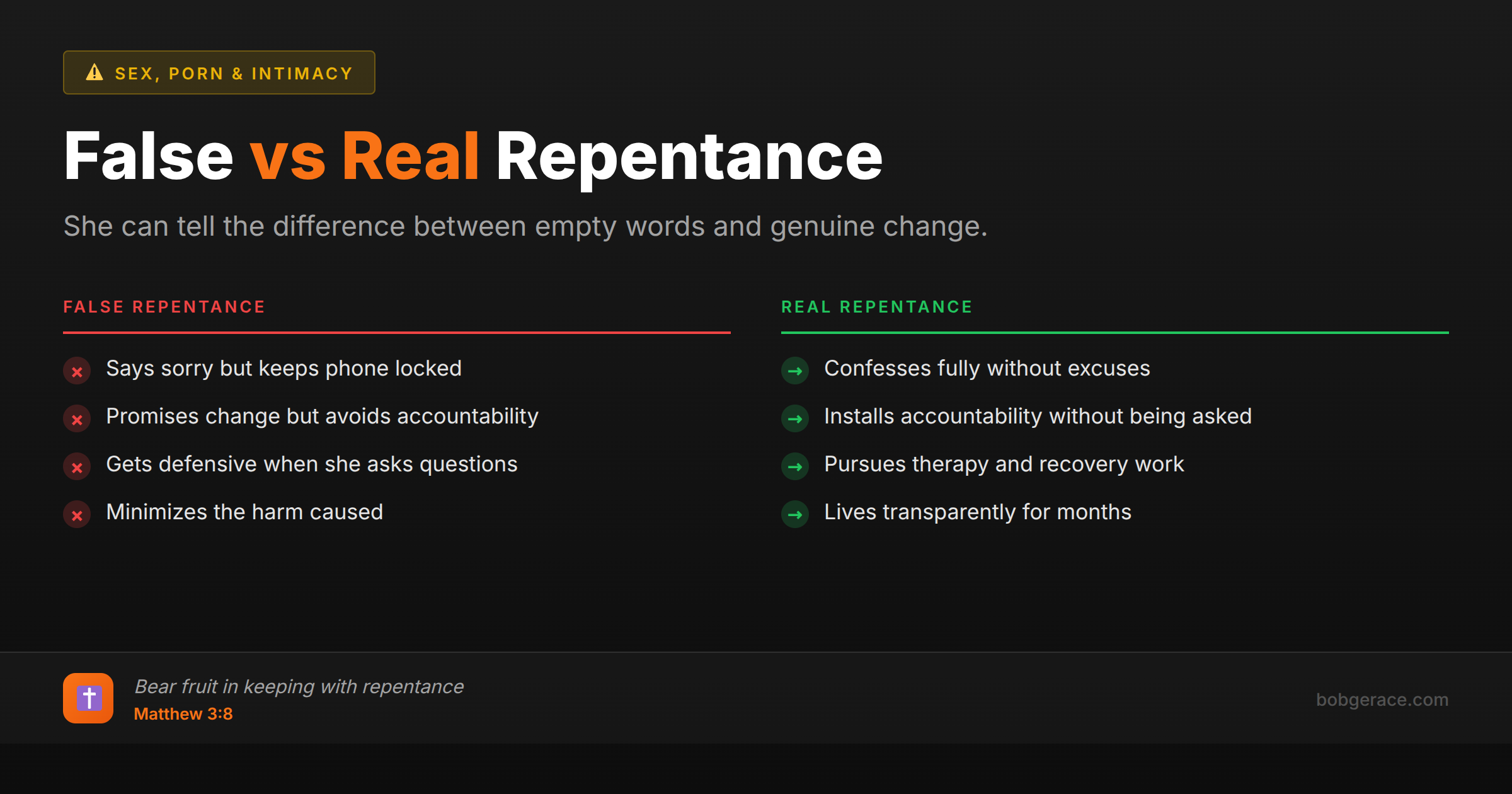
Repentance from porn, to your wife, looks like sustained change, not just words. She needs to see you confess fully without minimizing, take ownership without blaming her or stress, install accountability without her asking, pursue therapy or recovery work, and live transparently for months without slipping back into secrecy. Repentance isn't a one-time apology. It's a pattern of humility, honesty, and follow-through that proves you're serious about becoming a different man. She's not looking for perfection. She's looking for proof that you understand the harm you caused, that you're willing to do hard things to change, and that you're choosing her over your comfort. If you say you're sorry but keep your phone locked, avoid accountability, or get defensive when she asks questions, she'll know your repentance is shallow. Real repentance costs you something. And she can tell the difference.
What She's Actually Watching For
Your wife isn't waiting for you to be perfect. She's watching to see if you're different. After years of secrecy, apologies mean nothing. She's heard "I'm sorry" before. She's heard "I'll stop" before. What she hasn't seen is sustained change. That's what repentance looks like to her: a man who follows through, who stays humble when it's hard, and who doesn't go back to hiding when the shame gets heavy.
She's watching how you respond when she's angry. Do you get defensive, minimize her pain, or tell her to move on? Or do you sit with her grief, validate her feelings, and let her process without trying to fix it? She's watching whether you install accountability software without her nagging. Whether you go to therapy without her threatening to leave. Whether you bring up your struggles before she asks.
She's also watching whether you're doing this for her approval or because you actually want to change. If you're white-knuckling sobriety to keep her from leaving, she'll feel it. That's behavior modification, not repentance. Repentance means you're grieved by your sin, not just its consequences. It means you're pursuing holiness because you want to be a man of integrity, not because you're afraid of losing her.
Many wives describe a moment when they knew their husband's repentance was real. It wasn't a grand gesture. It was him proactively confessing a struggle. Or staying calm when she checked his phone for the tenth time. Or showing up to therapy even when he didn't feel like it. Repentance is proven in the small, consistent choices that show you're living differently.
Repentance as Relational Repair
From a clinical perspective, repentance after porn secrecy requires both behavioral change and emotional attunement. Your wife's nervous system is in survival mode. She's hypervigilant, scanning for signs that you're lying again. Repentance means helping her nervous system feel safe, and that happens through consistency, transparency, and empathy.
Behavioral change is the foundation. That means total sobriety, accountability software, open devices, therapy, and recovery work. But behavior alone isn't enough. She also needs to see that you understand the emotional impact of what you did. That you're not just sorry you got caught. That you're grieved by the pain you caused her.
This is where many men fail. They focus on sobriety but avoid the relational repair. They stop using porn but don't talk about it. They install accountability but get irritated when she asks questions. They go to therapy but don't share what they're learning. That's not repentance. That's damage control.
Repentance requires vulnerability. It means saying, "I see how much I hurt you. I was selfish. I chose fantasy over you. I lied to protect myself. I made you feel unseen and unwanted. I'm sorry." And then proving it with action. It means letting her be angry without defending yourself. Letting her grieve without rushing her. Letting her ask hard questions without shutting down.
Attachment research shows that repair happens when the offending partner demonstrates consistent empathy and accountability over time. One heartfelt apology doesn't heal betrayal. Six months of humble, transparent follow-through does. Your wife's brain needs repeated proof that you're safe before it will let her trust you again.
True Repentance: Fruit, Not Just Words
John the Baptist told the Pharisees to "bear fruit in keeping with repentance" (Matthew 3:8). Repentance isn't just feeling bad or saying sorry. It's a changed life. It's fruit. Your wife is looking for fruit. She's looking for evidence that your heart has turned, not just your behavior.
In 2 Corinthians 7:10-11, Paul describes godly grief that leads to repentance: "For see what earnestness this godly grief has produced in you, but also what eagerness to clear yourselves, what indignation, what fear, what longing, what zeal, what punishment!" Real repentance produces urgency. It produces a desire to make things right. It produces humility, not defensiveness.
If you're truly repentant, you'll be eager to prove it. You won't resist accountability. You won't minimize her pain. You won't say, "I already apologized, what more do you want?" You'll say, "I'll do whatever it takes. I'll be as transparent as you need. I'll go to therapy. I'll join a recovery group. I'll let you see my phone anytime. I'll sit with your anger as long as it takes."
Proverbs 28:13 says, "Whoever conceals his sins will not prosper, but he who confesses and forsakes them will obtain mercy." Repentance means both confession and forsaking. You can't just confess and keep hiding. You can't just stop using porn and refuse to talk about it. You have to bring it into the light and leave it there.
Jesus calls us to love our wives as He loved the church (Ephesians 5:25). He didn't hide His suffering. He didn't minimize the cost. He laid down His life in full view. That's the model. Repentance means laying down your pride, your self-protection, and your comfort to love her well.
Action Steps
-
1
Confess fully, with specifics, and let her ask any question she needs to. Don't trickle-truth. Don't minimize. Own the full weight of what you did.
-
2
Install accountability software and give her access to reports. Don't wait for her to ask. Show her you're serious by doing it proactively.
-
3
Find a Christian therapist or join a recovery group (Samson Society, Pure Desire, Conquer Series). Commit to 90 days and share what you're learning with her.
-
4
Apologize without expecting immediate forgiveness. Say: 'I hurt you. I broke trust. I'll do whatever it takes to rebuild. I'm not asking you to be okay. I'm asking you to let me prove I'm different.'
-
5
Check in weekly. Ask her how she's doing, what she needs from you, and whether you're following through. Don't get defensive. Just listen and adjust.
Related Questions
Also find Bob on
Subscribe for weekly videos on Christian marriage.
Repentance Is More Than Quitting
Real repentance requires humility, accountability, and a plan. If you're ready to prove you're serious about change but don't know where to start, let's talk.
Talk to Bob →