What safeguards actually help a husband quit porn?
5 min read
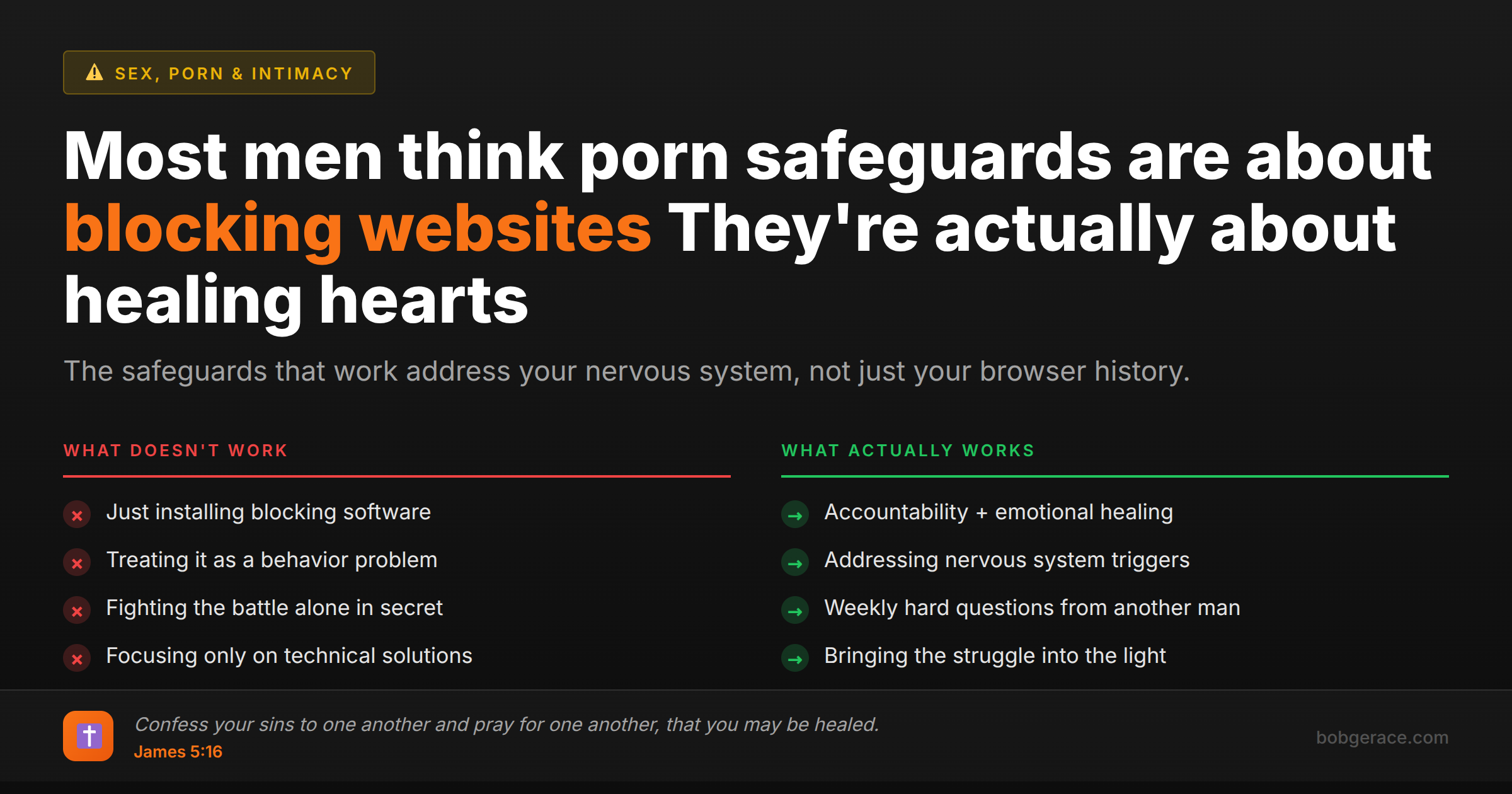
The safeguards that work aren't just technical. They're relational, emotional, and spiritual. Yes, you need accountability software and device boundaries. But you also need a man who asks you hard questions weekly, a plan for what you'll do when you're triggered, and the willingness to address the emotional pain that drives you to porn in the first place. Most men fail because they treat porn like a behavior problem. It's not. It's a nervous system, intimacy, and spiritual problem. The safeguards that work address all three layers, not just your browser history.
The Full Picture: Why Most Safeguards Fail
Most men start with accountability software. Covenant Eyes. Accountable2You. Net Nanny. They block sites, send reports, and feel safe for a few days. Then they find a workaround. Or they white-knuckle it for a month and relapse hard. The software didn't fail. The strategy did.
Porn isn't just a behavior. It's a coping mechanism. You use it to manage stress, loneliness, rejection, boredom, or anxiety. If you only block access without addressing what drives you to porn, you'll find another outlet. You'll binge on YouTube. You'll scroll Instagram models. You'll fantasize without screens. The underlying problem—your inability to regulate your nervous system and connect emotionally—remains untouched.
Effective safeguards work on three levels: external boundaries (software, device limits), relational accountability (a man who knows your triggers and asks real questions), and internal work (understanding why you use porn and building healthier ways to manage emotion). Most men only do the first level. That's why they keep failing.
The other reason safeguards fail is shame. You install software, relapse, feel like a failure, and hide it. Shame keeps you isolated. Isolation keeps you stuck. The safeguards that work are the ones that reduce shame, increase honesty, and help you see porn as a symptom of deeper relational and spiritual disconnection—not just a sin to white-knuckle your way out of.
Clinical Insight: Nervous System Regulation and Relapse Prevention
Porn use is often a form of nervous system dysregulation. When you're stressed, anxious, or emotionally flooded, your brain looks for a quick way to downregulate. Porn provides that. It floods your system with dopamine, numbs emotional pain, and gives you a sense of control. The problem is that it's a maladaptive coping strategy. It works in the short term but destroys intimacy, trust, and self-respect in the long term.
Effective safeguards help you build adaptive coping strategies. That means learning to notice when you're triggered (stress at work, fight with your wife, feeling inadequate), pausing instead of acting, and choosing a different response (prayer, exercise, calling your accountability partner, talking to your wife). This is nervous system retraining. It takes time. It requires you to tolerate discomfort instead of medicating it.
Relapse prevention research shows that the most effective interventions combine behavioral boundaries with emotional awareness and relational support. Behavioral boundaries (software, no phone in the bedroom) reduce opportunity. Emotional awareness (journaling, therapy, naming your triggers) reduces the internal pressure. Relational support (accountability partner, marriage coaching, honest conversations with your wife) reduces isolation and shame.
Most men skip the emotional and relational layers. They think they can logic or discipline their way out of porn. But porn isn't a logic problem. It's a nervous system and attachment problem. You need safeguards that address the whole system, not just your browser.
Biblical Framework: Accountability, Confession, and Transformation
James 5:16 says, 'Confess your sins to one another and pray for one another, that you may be healed.' Healing doesn't come from hiding. It comes from confession and community. Porn thrives in secrecy. The safeguards that work bring your struggle into the light.
That doesn't mean you confess to everyone. It means you have at least one man who knows your battle, asks you hard questions, and prays with you. It means you're honest with your wife (if you haven't been) about the scope of the problem. Secrecy keeps you sick. Confession starts the healing process.
Paul tells us to 'take every thought captive to obey Christ' (2 Corinthians 10:5). That's not just about willpower. It's about renewing your mind (Romans 12:2). Porn has trained your brain to associate arousal with fantasy, control, and isolation. Renewing your mind means retraining your brain to associate intimacy with presence, vulnerability, and covenant love. That requires more than software. It requires spiritual disciplines: Scripture memory, prayer, fasting, and community.
Proverbs 27:17 says, 'Iron sharpens iron, and one man sharpens another.' You can't quit porn alone. You need men who will sharpen you, challenge you, and hold you accountable. Not just for your behavior, but for your heart. The safeguards that work are the ones that keep you connected to God and to other men who are fighting the same battle.
Action Steps
-
1
Install accountability software (Covenant Eyes or Accountable2You) and give your wife or accountability partner full access to reports. No exceptions.
-
2
Remove your phone from your bedroom at night. Charge it in the kitchen or another room. This eliminates late-night temptation when your defenses are low.
-
3
Find one man who will text or call you weekly and ask: 'How's your heart? What are you struggling with? Have you used porn?' Not just 'Are you clean?'
-
4
Journal your triggers: write down every time you feel the urge to use porn and what emotion or situation preceded it. Patterns will emerge. Address those patterns.
-
5
Work with a coach or therapist who understands porn recovery as nervous system and intimacy work, not just sin management. You need to rebuild your capacity for real connection.
Related Questions
- Is husband porn addiction damaging my marriage?
- What does porn addiction do to a marriage?
- Why do I keep going back to porn when I love my wife?
- How do I rebuild trust after hiding porn?
- Why does she not believe me when I say porn meant nothing?
- Why does porn make real intimacy feel emotionally risky?
Also find Bob on
Subscribe for weekly videos on Christian marriage.
Ready to Quit Porn for Good?
Accountability software isn't enough. You need a plan that addresses your nervous system, your marriage, and your heart. I help men build safeguards that actually work.
Talk to Bob →