Why does she not believe me when I say porn meant nothing?
5 min read
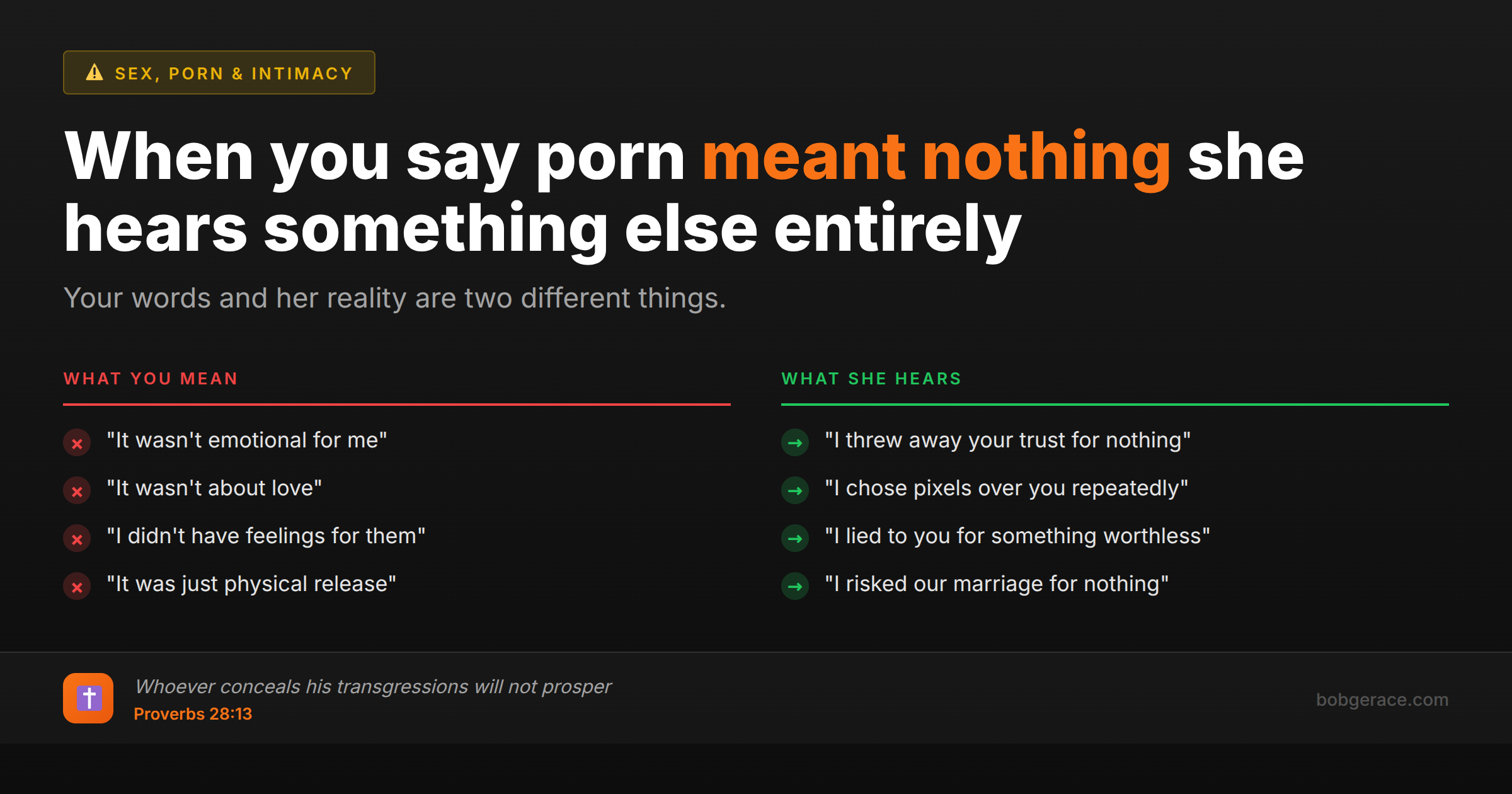
She doesn't believe you because your actions say otherwise. If porn really meant nothing, you wouldn't have chosen it over her. You wouldn't have hidden it. You wouldn't have lied when she asked if something was wrong. You wouldn't have risked your marriage, your integrity, and her trust for something meaningless. When you say "it meant nothing," she hears, "I threw away your trust for nothing." That doesn't make it better. It makes it worse. She's not asking whether porn had emotional significance to you. She's asking why you chose it over her, over and over, in secret. And that choice meant everything.
What "It Meant Nothing" Actually Communicates
You think saying "it meant nothing" will make her feel better. You think it proves you weren't emotionally involved, that it wasn't like an affair, that she's still the one you love. But that's not what she hears.
What she hears is: "I risked our marriage for something I didn't even care about." She hears: "I lied to you repeatedly over something trivial." She hears: "I chose pixels over you, and I can't even explain why." That doesn't comfort her. It terrifies her. Because if you'll betray her for nothing, what does that say about your character? What does that say about your ability to protect the marriage?
Here's the truth you're avoiding: porn didn't mean nothing. It meant something, or you wouldn't have kept going back. It gave you something—escape, control, dopamine, fantasy, relief from stress, a way to avoid intimacy. You used it for a reason, even if you don't want to admit it. And until you're honest about what it gave you, she can't trust that you've actually stopped.
She also knows that porn shaped how you see her. You've been training your brain to be aroused by women who don't exist—perfect bodies, no needs, no emotions, always available, always performing. Then you come to bed with her, and she can feel the comparison. She knows she's not what you've been watching. So when you say it meant nothing, she's thinking, "Then why does it feel like I'm not enough?"
Minimizing porn is another form of gaslighting. She's felt the distance. She's noticed the times you turned her down. She's seen you choose your phone over her. She knows something was off. When you say it meant nothing, you're telling her that her intuition is wrong, that her pain is an overreaction, that she's making a big deal out of nothing. That's not reassurance. That's dismissal.
Why Minimizing Deepens the Betrayal Trauma
When you minimize porn use, you're engaging in what therapists call "defensive disclosure." You're admitting just enough to relieve your guilt, but not enough to take full responsibility. You're trying to control her reaction by controlling the narrative. That doesn't rebuild trust. It erodes it further.
Your wife's brain is already in betrayal trauma. Her nervous system is hypervigilant, scanning for signs that you're still lying. When you say "it meant nothing," her brain flags it as another lie. Because the evidence says otherwise. You hid it. You chose it over her. You kept going back. That's not nothing.
Minimizing also prevents you from doing the real work. If porn meant nothing, then you don't need to understand why you used it. You don't need to examine what you were avoiding, what you were medicating, what intimacy fears you were running from. You can just white-knuckle your way through sobriety and hope she gets over it. But that's not recovery. That's just waiting for the next relapse.
Here's what she needs to hear instead: "Porn wasn't nothing. It was a betrayal. I used it to escape, to avoid real intimacy, to get a dopamine hit without the vulnerability of being with you. I chose it over you, and that was wrong. I'm not minimizing it anymore. I'm getting help, and I'm going to rebuild your trust through my actions, not my words."
That kind of honesty is terrifying. But it's the only thing that starts to repair the rupture. She doesn't need you to make it smaller. She needs you to make it right.
The Danger of Minimizing Sin
Proverbs 28:13 says, "Whoever conceals his transgressions will not prosper, but he who confesses and forsakes them will obtain mercy." Notice it doesn't say, "Whoever admits his transgressions but calls them no big deal." Confession means naming sin for what it is, not downplaying it to avoid consequences.
When you say porn meant nothing, you're doing what Adam did in the garden: deflecting responsibility. Adam blamed Eve. Eve blamed the serpent. You're blaming the insignificance of porn itself. But God doesn't grade sin on a curve. He calls you to integrity, purity, and covenant faithfulness. Porn is a violation of all three.
James 4:17 says, "Whoever knows the right thing to do and fails to do it, for him it is sin." You knew porn was wrong. You knew it violated your marriage covenant. You knew it required secrecy and lies. You did it anyway. That's not nothing. That's willful disobedience.
Your wife is made in the image of God. When you chose porn over her, you were choosing a counterfeit over the real thing. You were saying that a fantasy was more appealing than the woman God gave you. That's not just a betrayal of her—it's a betrayal of God's design for marriage.
Repentance isn't minimizing. It's owning the full weight of what you've done and turning completely away from it. It's saying, "I sinned against you, against her, and against God. I'm not going to pretend it was small. I'm going to treat it like the betrayal it was and do whatever it takes to make it right."
Action Steps
-
1
Stop saying "it meant nothing"—own that porn gave you something or you wouldn't have kept using it.
-
2
Get honest about what porn was medicating: stress, intimacy avoidance, control, escape, or fear of vulnerability.
-
3
Acknowledge the full betrayal: the secrecy, the lies, the choosing it over her, and the impact on her trust.
-
4
Find a counselor or coach who specializes in porn addiction and betrayal trauma—don't try to fix this alone.
-
5
Rebuild trust through sustained integrity, not words: let your actions over months prove that you're serious about change.
Related Questions
Also find Bob on
Subscribe for weekly videos on Christian marriage.
Stop Minimizing. Start Rebuilding.
If you're ready to stop defending your porn use and start doing the real work of recovery and trust repair, I can help. Let's build a plan that actually works.
Talk to Bob →