Why does she not want me even though I have changed?
6 min read
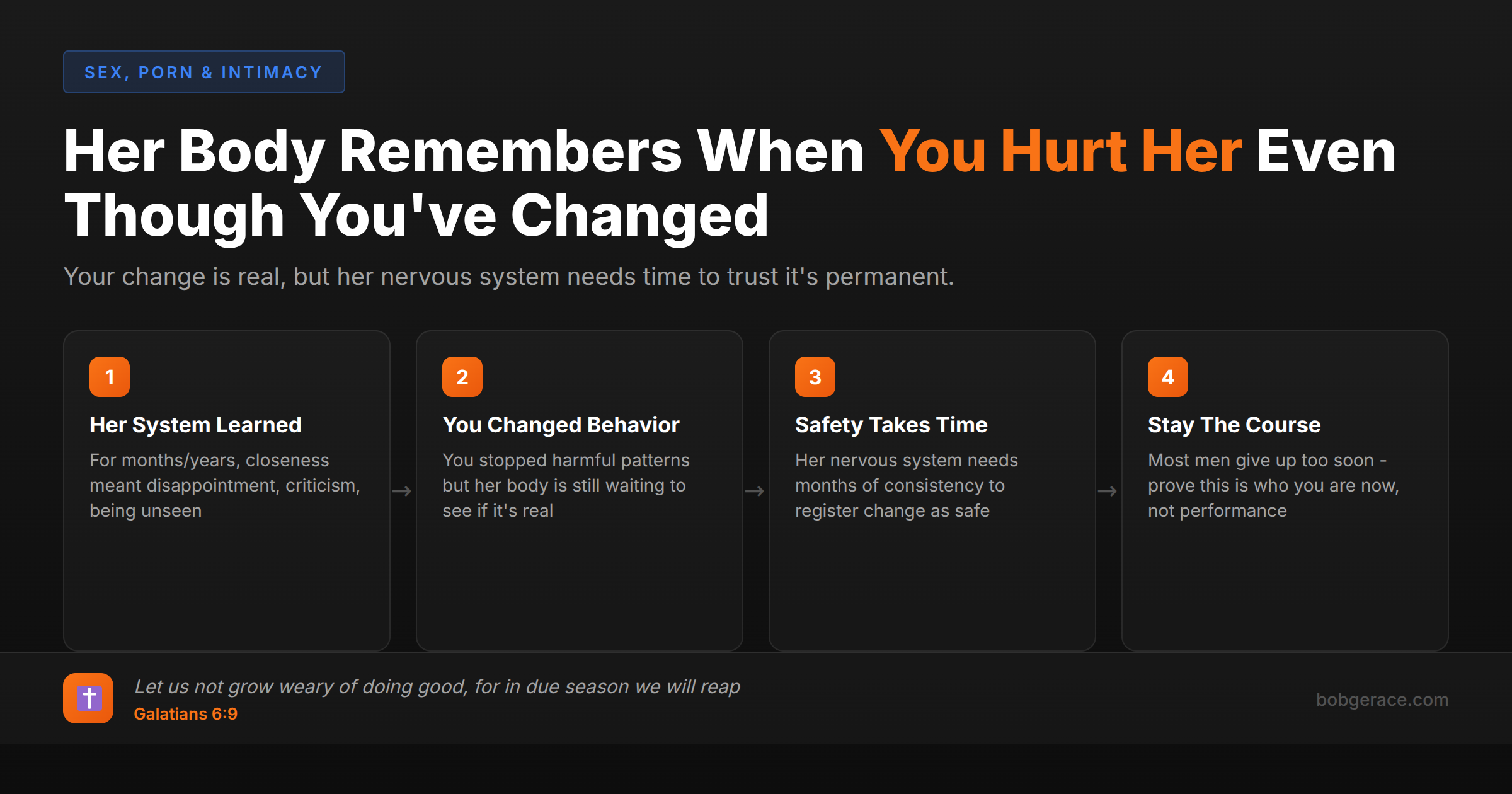
You have changed, but her nervous system has not caught up yet. Change takes time to register as safe. For months or years, her body learned that closeness with you meant disappointment, criticism, or being unseen. You may have stopped the behaviors that hurt her, but her system is still waiting to see if the change is real or temporary. She is not withholding desire to punish you. She is protecting herself from being hurt again. The other possibility: you changed the wrong things. You may have fixed surface behaviors—helping more around the house, being less critical, initiating less—but missed the deeper relational patterns she actually needs. She does not just need you to do different things. She needs to feel emotionally safe, seen, and desired for who she is, not just for what you want from her. If your change feels like a strategy to get her back instead of genuine transformation, her body knows the difference.
Why Change Does Not Immediately Restore Desire
You stopped yelling. You started helping with the kids. You read the marriage books, went to therapy, and apologized for the ways you hurt her. But she is still distant. She still does not want you. You feel frustrated, maybe even resentful. You did the work. Why is she not responding?
Here is what most men miss: change is not a transaction. You do not get to deposit good behavior and withdraw desire. Your wife's nervous system has been shaped by years of relational patterns. Every time you dismissed her feelings, every night you touched her only when you wanted sex, every promise you broke—those experiences are stored in her body. She learned that being vulnerable with you is not safe. That learning does not undo itself just because you apologized or changed for a few weeks.
Her body is waiting to see if the change is real. Is this who you are now, or is this a performance to win her back? Will you stay regulated when she pushes back, or will you revert to old patterns the moment she does not respond the way you want? She is not consciously testing you, but her nervous system is. It needs repeated, consistent experiences of you being different before it will lower its defenses.
The other issue: you may have changed the wrong things. You focused on what you thought she needed—more help, fewer arguments, more compliments—but missed what she actually needs. She does not just need you to be less bad. She needs you to be emotionally present, curious about her inner world, and safe with her vulnerability. She needs to feel like you see her, not just as a wife or mother, but as a woman. If your change is all about behavior modification and none of it is about emotional connection, she will feel it. And her desire will stay shut down.
The Nervous System Lag Between Change and Trust
Neuroscience shows that the nervous system is slow to update its threat assessments. Your wife's autonomic system has been conditioned over time to associate you with emotional pain. Even if you have genuinely changed, her body does not immediately recognize that. It takes weeks or months of consistent, safe experiences for the nervous system to recalibrate and begin to trust that the threat is gone.
This is called neuroception—the subconscious process by which the nervous system detects safety or danger. Your wife's neuroception is still reading you as unsafe, even if her rational mind acknowledges that you have changed. She may even feel guilty about it. She may want to want you. But her body is not cooperating because it has not yet experienced enough safety to override the old conditioning.
Rebuilding desire requires co-regulation over time. That means you stay emotionally steady even when she does not respond the way you hope. You do not withdraw, get defensive, or pressure her to feel differently. You stay present, curious, and consistent. You prove through your actions—not your words—that you are a safe person to be vulnerable with again.
The other clinical reality: desire is not just about safety. It is also about differentiation and polarity. If your change has made you passive, overly accommodating, or walking on eggshells, you may have solved the safety problem but created a new one. She needs you to be grounded, confident, and emotionally regulated—not a people-pleaser trying to earn her approval. Desire requires both safety and strength. If you have only focused on one, you are missing the full picture.
Patience, Perseverance, and Trusting God's Timing
Galatians 6:9 says, "Let us not grow weary of doing good, for in due season we will reap, if we do not give up." You have done the hard work of changing. You have owned your sin, repented, and started living differently. But the harvest does not come immediately. You are in the season of sowing. Your job is to stay faithful, even when you do not see the fruit yet.
Most men give up too soon. They change for a month or two, do not see results, and either revert to old patterns or grow bitter. But James 1:4 says, "Let steadfastness have its full effect, that you may be perfect and complete, lacking in nothing." God is not just changing your behavior. He is transforming your character. That takes time. Your wife's heart softening is not the goal—your Christlikeness is. Trust that if you stay faithful, God will do what only He can do.
Proverbs 3:5-6 says, "Trust in the Lord with all your heart, and do not lean on your own understanding. In all your ways acknowledge him, and he will make straight your paths." You do not control your wife's response. You do not control her timeline. You control your faithfulness. Keep doing the right thing, not because it guarantees a result, but because it is who God has called you to be.
Also, examine your motives. Are you changing to become the man God created you to be, or are you changing to manipulate your wife into wanting you again? If your change is a strategy, she will feel it. And it will backfire. But if your change is rooted in genuine repentance and a desire to honor God, that will bear fruit—whether or not it looks like what you hoped.
Action Steps
-
1
Give her time. Stop expecting her to respond on your timeline. Her nervous system needs months, not weeks, of consistent safety before it will trust the change is real.
-
2
Ask her directly: 'What do you need from me that I'm still missing?' Listen without defending. You may have changed the wrong things.
-
3
Stay consistent even when she doesn't respond. Do not withdraw, get bitter, or revert to old patterns. Prove through your actions that this is who you are now, not a performance.
-
4
Focus on emotional presence, not just behavior. She needs to feel seen, heard, and safe—not just managed or accommodated. Work on your emotional intelligence and regulation.
-
5
Work with a coach who can help you see what you're still missing. You cannot see your own blind spots. Get outside perspective from someone who knows how to rebuild desire and trust.
Related Questions
- What if she says she wants emotional connection before physical intimacy?
- Why does my wife feel pressure even when I am being nice?
- Can I rebuild attraction after years of resentment?
- What if my wife says she does not feel emotionally safe with me?
- How did we become business partners instead of lovers?
- What if we sleep in the same bed but live separate lives?
Also find Bob on
Subscribe for weekly videos on Christian marriage.
Get the Full Picture of What She Needs
You've changed, but something is still missing. Let's identify what she actually needs and build a plan to close the gap between your effort and her response.
Talk to Bob →