How did we become business partners instead of lovers?
6 min read
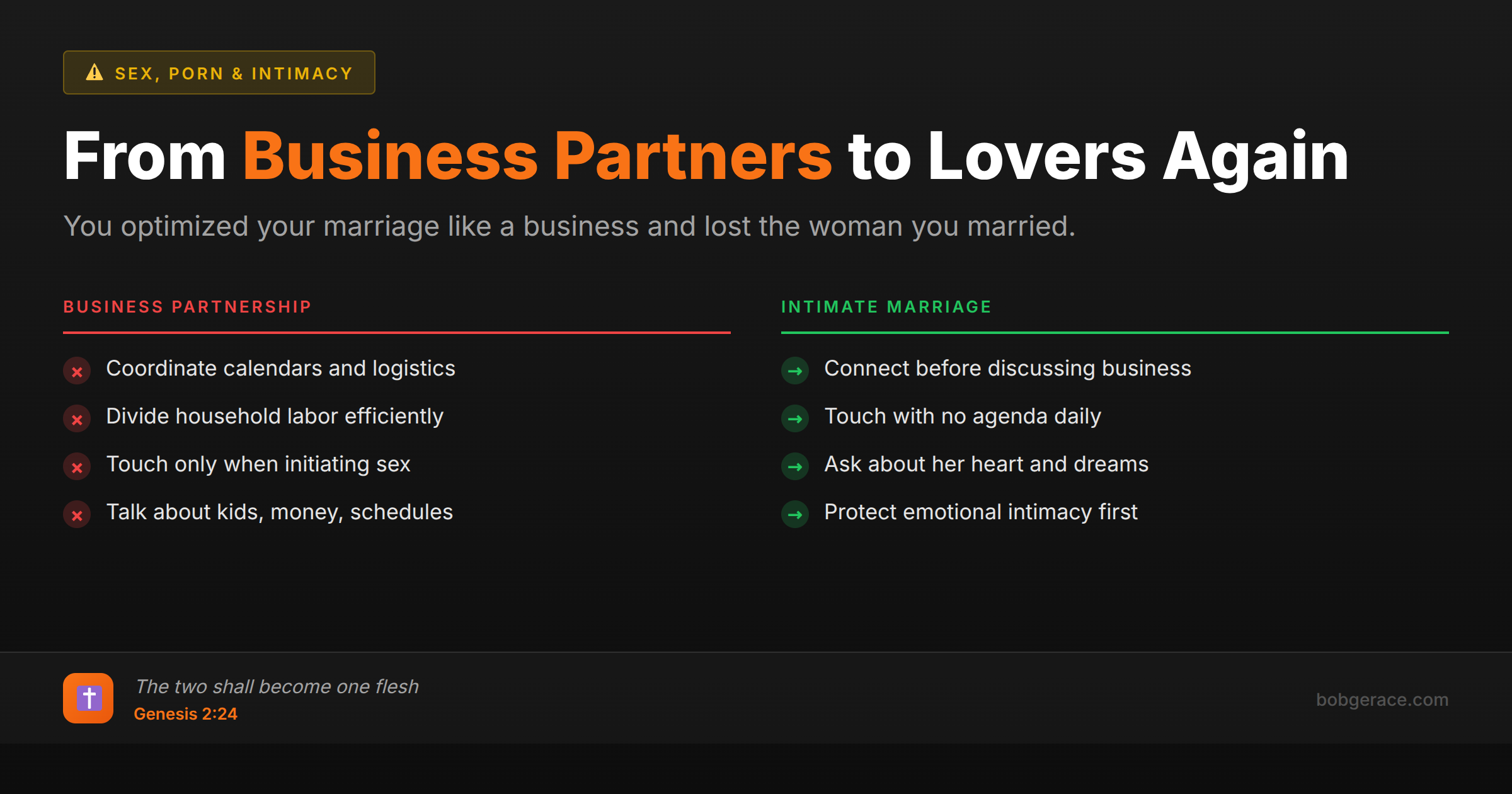
You became business partners instead of lovers because you optimized for efficiency and forgot to protect intimacy. High-performing men excel at systems, delegation, and execution—so marriage becomes another operation to manage. You coordinate calendars, divide household labor, discuss finances, and parent in shifts. It works. The machine runs. But somewhere in the optimization, you stopped being her man and became her co-manager. This didn't happen in one moment. It accumulated through a thousand small choices: checking your phone during dinner, talking only about logistics, touching her only when initiating sex, prioritizing work over presence, treating emotional conversations as inefficient. She adapted by becoming more independent, less vulnerable, more transactional. Now you're two competent adults running a household—but the desire, playfulness, and emotional intimacy are gone.
The Drift from Desire to Delegation
Most men don't choose roommate marriage. They drift into it while building something else—a business, a career, financial security, a reputation. You're crushing it at work. You provide well. You're responsible. You show up for the kids. On paper, you're doing everything right. But your wife doesn't feel chosen, pursued, or desired. She feels managed.
The pattern usually starts with good intentions. You're working hard to build a life together. She's managing the home, the kids, the emotional labor. You both get busy. Conversations become transactional: "Did you pay the HOA?" "Can you pick up from practice?" "We need to talk about the budget." Sex becomes another task on the list—initiated with the same energy you bring to scheduling a meeting. She starts saying no more often, not because she doesn't want intimacy, but because being touched only when you want sex makes her feel like a service provider, not a wife.
You notice the distance but don't know how to close it. Emotional conversations feel inefficient or uncomfortable, so you avoid them. She stops trying to connect and focuses on what she can control—kids, friends, her own life. You both become excellent at parallel play: living in the same house, sleeping in the same bed, raising the same kids, but emotionally alone. The marriage functions, but it doesn't feel like a marriage anymore. It feels like a well-run LLC with shared assets and divided responsibilities.
Meanwhile, resentment builds on both sides. She resents doing all the emotional labor while you're "checked out." You resent feeling like nothing you do is enough, that she's never satisfied, that sex has become a negotiation. Neither of you is wrong—you're both responding to a system that prioritized function over connection. The business partnership works. The love story doesn't.
Why High-Performers Default to Transactional Marriage
Your nervous system is wired for performance, problem-solving, and achievement. That's why you're successful. But intimacy doesn't respond to the same strategies that built your career. Intimacy requires presence, vulnerability, attunement, and emotional availability—skills that feel inefficient or even threatening to men trained to stay in control and produce results.
When you approach marriage like a business, you're operating from your sympathetic nervous system—the part designed for doing, fixing, and executing. Your wife needs you in your ventral vagal state—calm, present, emotionally regulated, attuned. She doesn't need you to solve her day; she needs you to be with her in it. She doesn't need another transaction; she needs to feel felt. But if you've spent years in performance mode, dropping into relational presence feels foreign, even uncomfortable.
Attachment theory explains the drift. Many high-performing men have avoidant attachment patterns—you learned early that emotions are inconvenient, that self-reliance is strength, that vulnerability is weakness. So you default to logic, competence, and control. Your wife, often anxiously attached or securely attached turned anxious by your distance, craves emotional connection and reassurance. When she doesn't get it, she protests (criticism, pursuing, emotional bids). You experience her protest as pressure or dissatisfaction, so you withdraw further into work, hobbies, or phone scrolling. She feels abandoned. You feel inadequate. The cycle deepens.
The roommate dynamic is also a defense against deeper pain. If you stay in business-partner mode, you don't have to face the scarier questions: "Does she still want me?" "Am I enough?" "What if I open up and she rejects me?" Keeping things transactional feels safer than risking real intimacy and discovering she's not interested anymore. But safety without connection isn't a marriage—it's a holding pattern before divorce.
The One-Flesh Design vs. the Corporate Model
Genesis 2:24 says a man leaves his father and mother and is united to his wife, and they become one flesh. One flesh isn't a business merger. It's not a partnership agreement with clearly defined roles and KPIs. It's a mysterious, covenant union where two people are knit together physically, emotionally, and spiritually. You can't become one flesh while keeping your wife at arm's length emotionally.
Ephesians 5 tells husbands to love their wives as Christ loved the church—sacrificially, intimately, with full presence and pursuit. Christ didn't manage the church from a distance. He didn't delegate emotional connection. He gave Himself fully, knew His bride deeply, and pursued her relentlessly. That's the model. Not a CEO managing an organization, but a bridegroom cherishing his bride.
Proverbs 5:18-19 celebrates marital intimacy and delight: "May your fountain be blessed, and may you rejoice in the wife of your youth... may you ever be intoxicated with her love." Intoxication isn't transactional. It's not scheduled or optimized. It's presence, desire, playfulness, and pursuit. God designed marriage to include passionate, delighted, life-giving intimacy—not just coordinated logistics.
The business-partner drift happens when you forget you're called to be a husband, not a manager. Your wife doesn't need another project lead. She needs a man who sees her, chooses her, delights in her, and leads the marriage back toward intimacy. That requires you to lay down the clipboard, step out of performance mode, and risk being present—even when it's uncomfortable.
Action Steps
-
1
Stop all logistics talk for the first 20 minutes when you get home. Greet her, ask about her day, and listen without fixing. Let the business wait.
-
2
Touch her with no agenda three times a day—a hand on her back, a kiss on the forehead, holding her hand—just to connect, not to initiate sex.
-
3
Schedule one weekly date where you talk about anything except kids, money, or household tasks. Rediscover who she is beyond her roles.
-
4
Ask her one question this week: 'What's one way I've made you feel more like a business partner than a wife?' Then listen without defending.
-
5
Identify one area where you've been emotionally unavailable (work stress, phone use, avoiding hard conversations) and name it out loud to her. Vulnerability reopens intimacy.
Related Questions
- What if we sleep in the same bed but live separate lives?
- How do I stop treating my wife like a roommate?
- What is the first real move out of a roommate marriage?
- Can I rebuild attraction after years of resentment?
- What if my wife says she does not feel emotionally safe with me?
- Why does she not want me even though I have changed?
Also find Bob on
Subscribe for weekly videos on Christian marriage.
Ready to Stop Managing and Start Leading?
If your marriage feels more like a business than a love story, you don't need another strategy—you need a guide who understands how high-performers drift and how to lead your marriage back to intimacy. Let's talk.
Talk to Bob →