What is the first real move out of a roommate marriage?
5 min read
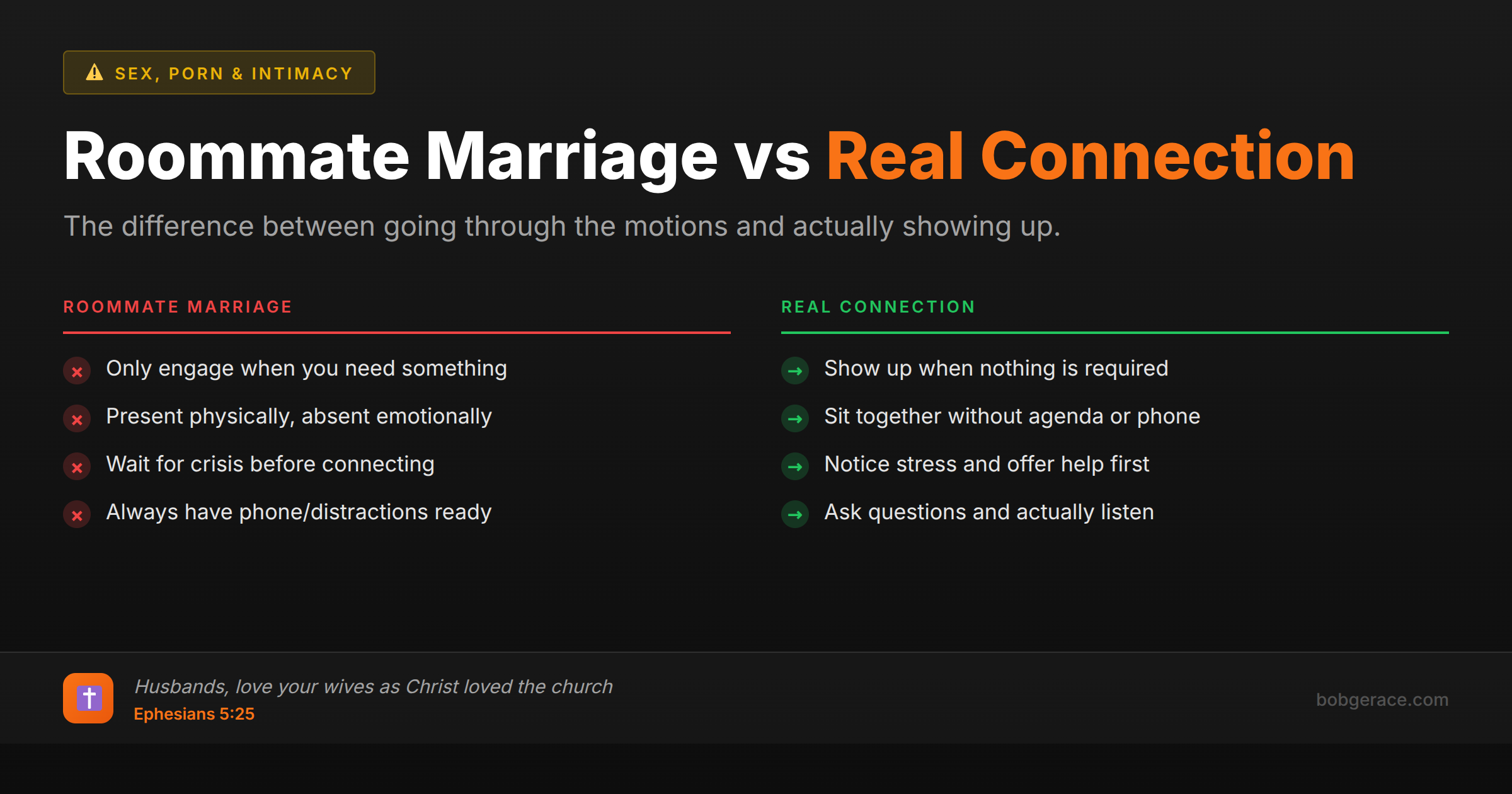
The first real move out of a roommate marriage isn't flowers, date night, or initiating sex. It's showing up emotionally when nothing is required of you. That means sitting with her for ten minutes without your phone, asking how she's doing and actually listening, or noticing her stress and offering help without being asked. You're breaking the transactional pattern—where you only engage when you want something or when logistics demand it. This move feels small, but it rewires the entire system. Your wife has learned that you're only present when it benefits you or when she's in crisis. Consistent, low-stakes presence signals safety. It says, "I'm here because you matter, not because I need something." That's the foundation every other change is built on.
Why Roommate Marriages Feel So Stuck
A roommate marriage doesn't happen overnight. It's the slow accumulation of missed moments, unspoken resentments, and emotional shortcuts. You both got busy—kids, career, ministry, bills. Somewhere along the way, you stopped being curious about each other. Conversations became logistics. Touch became rare or purely functional. Sex, if it happens, feels like a chore or a negotiation.
You're not enemies. You're just... coexisting. And here's the trap: because there's no open conflict, you tell yourself it's fine. But your wife feels it. She feels alone in the same house. She's tired of being the only one who notices when connection is missing. She may have stopped asking for what she needs because asking hasn't worked.
Most men try to fix this with grand gestures—a surprise trip, expensive gift, or suddenly initiating sex after months of distance. But those moves feel hollow when daily presence is missing. Your wife doesn't need a hero moment. She needs to know you see her on a Tuesday afternoon when nothing is broken and no one is watching. She needs evidence that you care about her inner world, not just the exterior of the marriage.
The roommate dynamic is a nervous system issue. Her body has learned that you're not safe to open up to. Every time she reached and you were distracted, dismissive, or only engaged when you wanted sex, her system logged it. Now she's in protective mode. She's not withholding to punish you—she's conserving energy because vulnerability with you has felt costly. The first move is about changing that data.
The Nervous System Shift That Breaks the Pattern
Roommate marriages are maintained by avoidant attachment patterns and chronic nervous system dysregulation. You've both learned to manage discomfort by staying surface-level. Conflict is avoided. Vulnerability is risky. It's easier to stay busy, stay polite, and stay distant.
Here's what's happening under the surface: your wife's nervous system is in a low-grade stress state. She's not in fight-or-flight, but she's not in rest-and-connect either. She's in shutdown—what polyvagal theory calls dorsal vagal collapse. She's given up expecting emotional attunement from you. Her system has decided that hoping for connection costs more than it's worth.
You, meanwhile, are likely in your own avoidant pattern. When emotional needs arise, you default to problem-solving, distraction, or withdrawal. You're not trying to hurt her—you're trying to manage your own discomfort. But the effect is the same: she feels unseen.
The first move works because it targets the nervous system directly. Consistent, non-demanding presence signals safety. You're not asking for anything. You're not fixing anything. You're just there. Over time, her system begins to recalibrate. She starts to believe that you might actually be available.
This is also where most men quit. Because the first move doesn't produce immediate results. She might not respond warmly at first. She might even be suspicious or cold. That's her system testing whether this is real or another short-lived effort. Your job is to stay consistent anyway. You're not performing for a reaction—you're rebuilding trust at the neurological level.
Presence as a Reflection of Christ's Love
Ephesians 5 tells husbands to love their wives as Christ loved the church. Most men read that and think sacrifice—and yes, that's part of it. But the deeper pattern is presence. Jesus didn't love the church from a distance. He entered in. He sat with people. He noticed. He asked questions. He was emotionally available even when it was inconvenient.
A roommate marriage is the opposite of incarnational love. You're physically present but emotionally absent. You're in the same house but not in the same story. That's not the model Christ gave us. He didn't show up only when the crisis was big enough. He was attentive to the woman at the well, to the grieving sisters, to the disciples' fears. He made space for people to be seen.
Proverbs 20:5 says, "The purposes of a person's heart are deep waters, but one who has insight draws them out." Your wife's heart is deep water. She has thoughts, fears, dreams, and wounds you know nothing about—not because she's hiding them, but because you haven't created space for them to surface. Drawing them out requires curiosity, patience, and presence.
This isn't about being perfect. It's about being present. It's about showing up in the small moments and saying, through your attention, "You matter to me." That's how you love like Christ. Not through grand gestures, but through faithful, daily, unglamorous presence.
Action Steps
-
1
Sit with your wife for 10 minutes today with no phone, no agenda, and ask her one question about her day—then listen without fixing or offering advice.
-
2
Notice one thing she's stressed about this week and offer specific help without being asked: "I'll handle bedtime tonight" or "I'll pick that up on my way home."
-
3
Stop initiating sex for two weeks and focus only on non-sexual touch and presence—hand on her back, sitting close, eye contact during conversation.
-
4
Ask her one question about her inner world once this week: "What's been on your mind lately?" or "What's something you've been feeling that I might not know about?"
-
5
Identify one daily moment where you're usually distracted (dinner, bedtime, morning coffee) and commit to being fully present during that time for the next 30 days.
Related Questions
- How did we become business partners instead of lovers?
- What if we sleep in the same bed but live separate lives?
- How do I stop treating my wife like a roommate?
- What if porn has trained me to avoid real vulnerability?
- Why does porn make me less patient with my wife?
- How do I tell the truth about porn without dumping pain on her?
Also find Bob on
Subscribe for weekly videos on Christian marriage.
Ready to Rebuild Real Connection?
If your marriage feels more like logistics than love, you don't have to figure this out alone. I help men move from roommate dynamics to emotional and physical intimacy that lasts.
Talk to Bob →