How do I stop treating my wife like a roommate?
6 min read
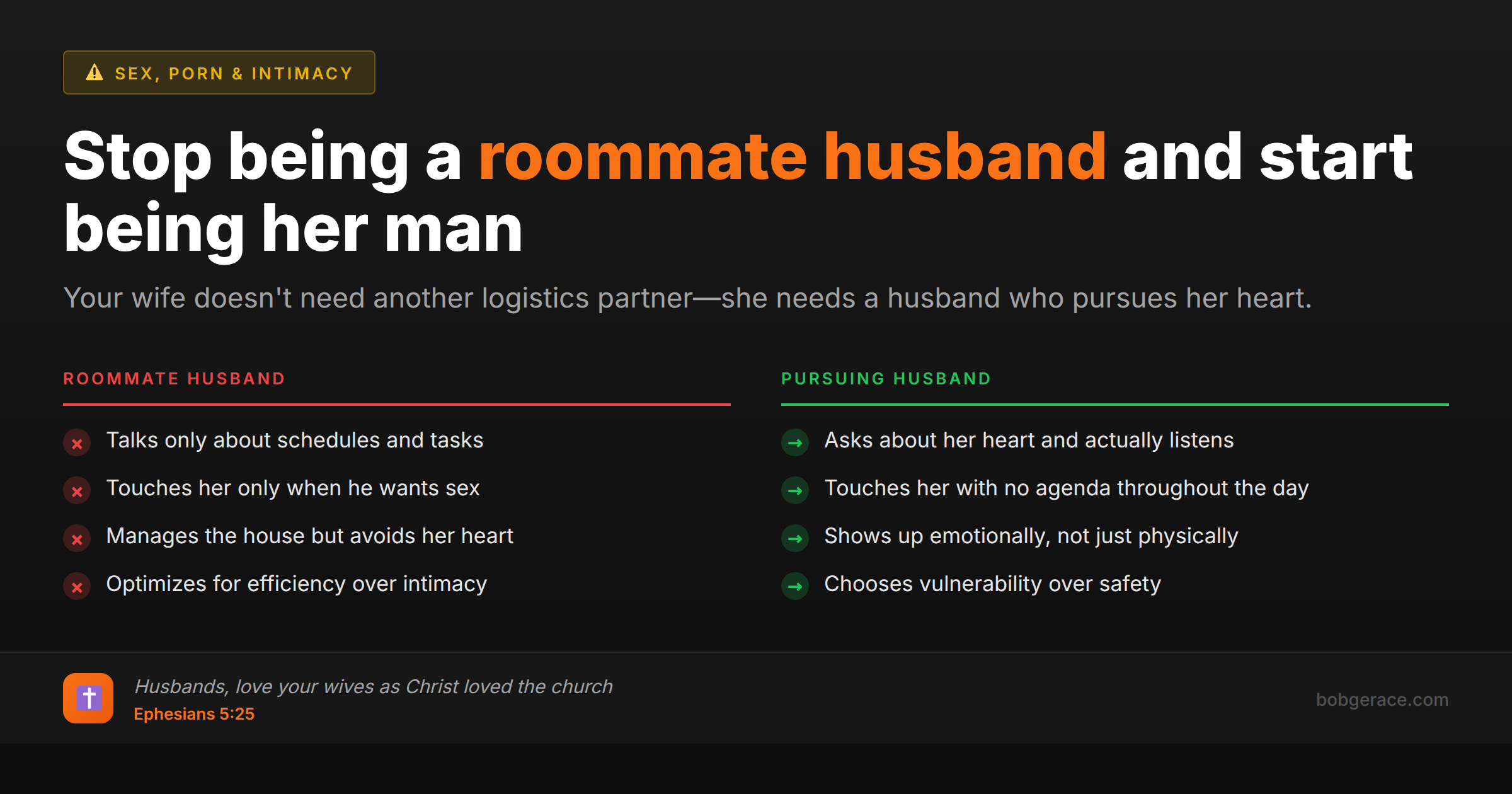
You stop treating your wife like a roommate by shifting from transactional coexistence to intentional pursuit. That means touching her without agenda, talking about more than logistics, being emotionally present instead of just physically around, and choosing vulnerability over efficiency. Roommate marriage happens when you optimize for function and forget to protect intimacy. Reversing it requires you to lead differently—not by doing more tasks, but by showing up emotionally, relationally, and spiritually. This isn't about grand gestures or trying harder at the same things. It's about changing how you see her and how you show up. She's not your co-manager, your logistics partner, or your housemate. She's your wife—the woman you chose, the one you're called to know deeply, pursue consistently, and cherish sacrificially. Treating her like a wife instead of a roommate starts with small, daily choices that rebuild presence, safety, and connection.
What Roommate Mode Actually Looks Like
Roommate marriage is polite, functional, and emotionally flat. You divide responsibilities, coordinate schedules, and keep the household running—but there's no passion, no playfulness, no deep connection. You talk about the kids, the budget, and what needs to get done. You don't talk about your fears, your dreams, or what's really going on inside. Sex, if it happens, feels like another chore—initiated without emotional buildup, completed without real intimacy, followed by rolling over and checking your phone.
You're not fighting, which feels like success. But you're not connecting either. She's living her life—friends, work, kids, hobbies. You're living yours—work, phone, projects, maybe some porn or fantasy to fill the void. You coexist peacefully, but you're not building anything together. You're not teammates in a shared mission; you're two people managing separate lives under the same roof.
The shift into roommate mode usually happens slowly. You got busy. She got tired. Conversations became transactional because emotional ones felt risky or led to conflict. You stopped pursuing her because rejection hurt, and she stopped reaching for you because being touched only when you wanted sex made her feel used. Over time, you both adapted to the distance. It became normal. Comfortable, even. But underneath the calm, resentment, loneliness, and quiet desperation are building.
You know something's wrong because the marriage doesn't feel like a marriage anymore. It feels like a business arrangement with shared assets and divided labor. You're competent co-parents and efficient household managers, but you're not lovers, not best friends, not spiritually connected. You're roommates. And if you don't change course, this is the slow road to divorce—or decades of stable misery.
Why You Default to Roommate Mode (And How to Shift)
Roommate marriage is a nervous system defense. When emotional connection feels unsafe, inefficient, or consistently unmet, your brain defaults to transactional relating. You stay in your sympathetic nervous system—doing, managing, executing—because it's familiar and controllable. Intimacy requires dropping into your ventral vagal state—calm, present, emotionally available—which feels vulnerable and risky, especially if you've been rejected or criticized before.
High-performing men are especially prone to this. You've built success by optimizing systems, solving problems, and staying in control. But intimacy doesn't respond to those strategies. Your wife doesn't need you to manage her or fix her day. She needs you to be with her—emotionally present, attuned, curious, and safe. That requires a different operating system than the one that built your career.
Attachment patterns also play a role. If you're avoidantly attached—learned early that emotions are inconvenient, that self-reliance is strength—then roommate mode feels safer than vulnerability. You keep things surface-level to avoid the discomfort of deeper connection. If your wife is anxiously attached, she's been protesting the distance (criticism, pursuing, emotional bids), but after years of unmet attempts, she may have shifted into avoidance herself—giving up, building her own life, emotionally detaching. Now you're both defended, both distant, both waiting for the other to make the first move.
Shifting out of roommate mode requires you to lead—not by doing more tasks, but by changing how you show up. You have to risk being present even when it's uncomfortable, initiate emotional connection even when you don't know how, and choose vulnerability over self-protection. That's scary, especially if you've been living in transactional mode for years. But it's the only way back to intimacy.
From Manager to Husband: The Biblical Shift
Ephesians 5:25 tells husbands to love their wives as Christ loved the church—sacrificially, intimately, with full presence and pursuit. Christ didn't manage the church from a distance. He didn't keep things transactional or emotionally safe. He gave Himself fully, pursued relentlessly, and laid down His life. That's the model for husbands. Not a roommate who splits chores, but a man who leads his wife into deeper intimacy, safety, and connection.
Genesis 2:24 describes marriage as becoming one flesh—a mysterious, covenant union where two people are knit together physically, emotionally, and spiritually. You can't become one flesh while treating your wife like a business partner. One flesh requires vulnerability, presence, and the willingness to be fully known. It's risky, costly, and uncomfortable—but it's God's design.
Proverbs 5:18-19 celebrates marital intimacy: "May you rejoice in the wife of your youth... may you ever be intoxicated with her love." Intoxication isn't transactional. It's not scheduled between meetings or squeezed in after the kids are asleep. It's delight, desire, playfulness, and presence. God designed marriage to include passionate, life-giving intimacy—not just coordinated logistics.
1 Peter 3:7 calls husbands to live with their wives in an understanding way, honoring them as co-heirs of grace. Understanding requires attention, curiosity, and emotional presence. You can't understand your wife from across the room, behind your phone, or through transactional conversations. You have to engage her heart, ask real questions, and be willing to hear her answers—even when they're hard.
Action Steps
-
1
Stop talking logistics for the first 20 minutes when you get home. Greet her, ask how she's doing, and listen without fixing or problem-solving.
-
2
Touch her three times a day with no sexual agenda—a hand on her shoulder, a kiss on the forehead, holding her hand while watching TV. Rebuild non-sexual physical connection.
-
3
Ask her one question this week: 'What's one thing I do that makes you feel more like a roommate than a wife?' Listen without defending or explaining.
-
4
Schedule one weekly date where you don't talk about kids, money, or household tasks. Rediscover who she is, what she cares about, what she dreams about.
-
5
Share one thing you're struggling with or feeling this week—not a work problem to solve, but something real. Practice being emotionally present and vulnerable, not just competent and in control.
Related Questions
- How did we become business partners instead of lovers?
- What if we sleep in the same bed but live separate lives?
- What is the first real move out of a roommate marriage?
- Why does she not want me even though I have changed?
- What if porn has trained me to avoid real vulnerability?
- Why does porn make me less patient with my wife?
Also find Bob on
Subscribe for weekly videos on Christian marriage.
Ready to Lead Your Marriage Out of Roommate Mode?
You can't fix this alone, and you can't think your way out of it. You need a guide who understands how high-performers drift—and how to lead your marriage back to intimacy. Let's talk.
Talk to Bob →