What if we sleep in the same bed but live separate lives?
6 min read
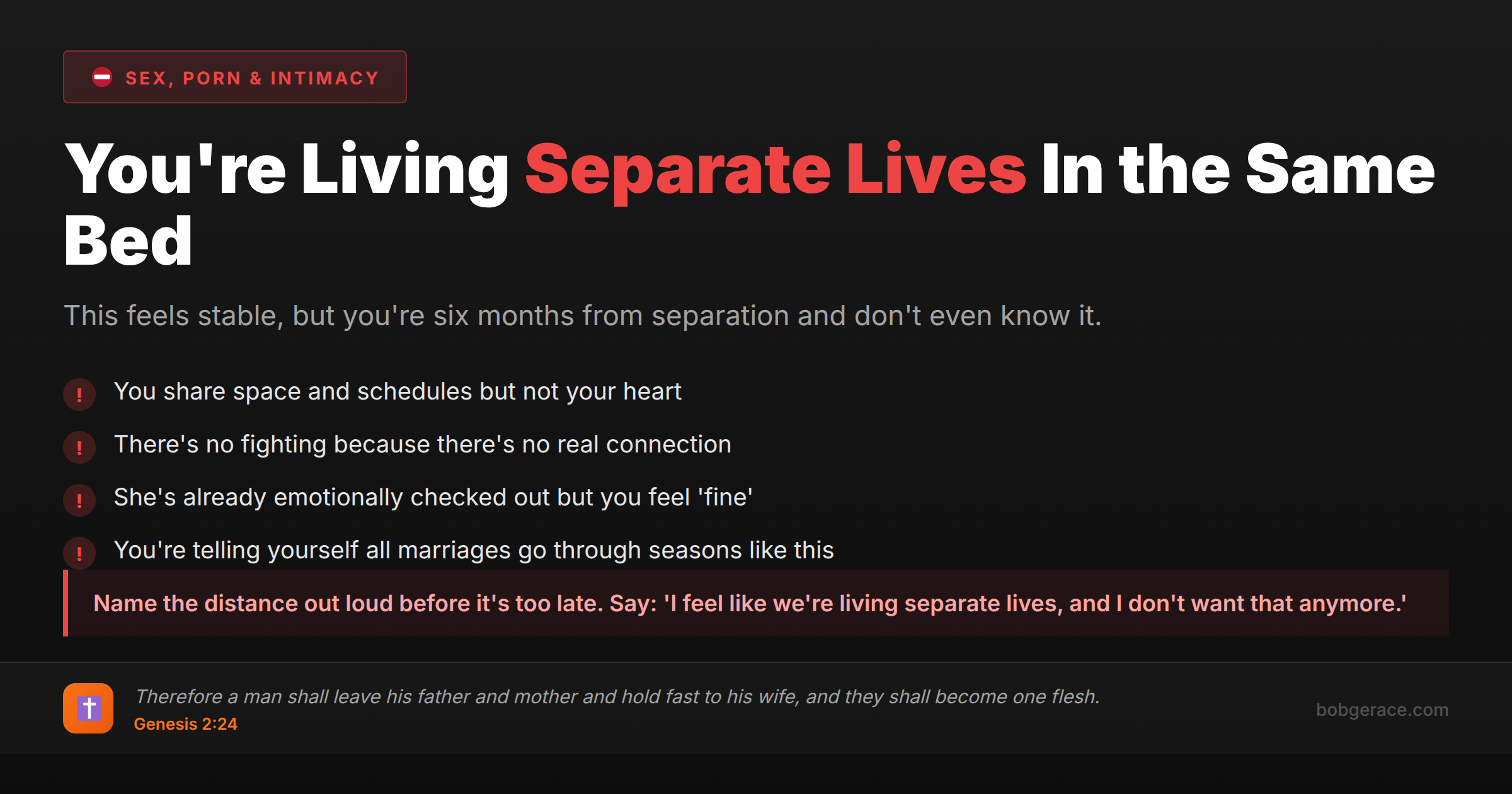
Sleeping in the same bed but living separate lives means you've normalized emotional distance. You coexist without connecting. You share space, schedules, and maybe even some responsibilities—but not your inner world, your struggles, your desires, or your heart. She's living her life. You're living yours. You happen to sleep in the same room. This is one of the most dangerous stages of marriage because it feels stable. There's no fighting, no drama, no crisis—just quiet, polite distance. You tell yourself it's fine, that all marriages go through seasons, that you're both just busy. But underneath the calm surface, resentment, loneliness, and disconnection are building. Your wife may already be emotionally checked out. You may be six months from separation and not even know it.
The Slow Fade into Parallel Lives
You didn't plan to become strangers. It happened gradually, through a thousand small withdrawals. You stopped asking about her day and really listening. She stopped sharing what's on her heart because you seemed distracted or dismissive. You both got busy—work, kids, obligations—and let the busyness fill the space where intimacy used to be. Now you operate like polite housemates: coordinating logistics, dividing labor, avoiding conflict, keeping things smooth.
Sex, if it happens at all, feels mechanical. You initiate out of physical need, not emotional connection. She complies or declines, but either way, it doesn't bring you closer. There's no playfulness, no vulnerability, no shared desire—just another item on the list. Afterward, you roll over and scroll your phone. She does the same. You're inches apart but miles away.
Conversations are surface-level. You talk about the kids' schedules, the budget, what needs fixing around the house. You don't talk about your fears, your dreams, what's weighing on you, or what lights you up. You don't ask her what she's feeling, what she's struggling with, or what she needs from you. Not because you don't care, but because you've both learned that going deeper is uncomfortable, risky, or leads to conflict. So you stay shallow and call it peace.
Meanwhile, she's building a life that doesn't include you emotionally. She confides in friends, finds fulfillment in work or hobbies, pours herself into the kids. You do the same—work becomes your identity, your phone becomes your escape, your emotional world stays locked inside. You're both protecting yourselves from the pain of disconnection by creating separate lives. It works—until it doesn't. Until she says she's done, or you realize you've been living like divorced people under the same roof for years.
Why Parallel Lives Feel Safe (But Aren't)
Living separate lives is a nervous system adaptation to chronic disconnection. When emotional bids are repeatedly ignored, when vulnerability is met with dismissiveness, when conflict feels unsafe or unresolvable, both partners learn to self-regulate independently. You stop reaching for each other and start managing your own emotional world. It reduces immediate pain—no more rejection, no more disappointment—but it kills intimacy.
This is called "stable misery." Your nervous systems have settled into a low-conflict, low-connection equilibrium. There's no fighting because there's no engagement. You've both gone into a dorsal vagal shutdown around the relationship—not fully collapsed, but emotionally numb, resigned, detached. You're functioning, but you're not alive to each other. The marriage is on life support, and you're both pretending it's just sleeping.
Attachment wounds drive this pattern. If you grew up learning that emotions are inconvenient, that self-reliance is strength, that asking for connection is weak, then parallel lives feel normal. You don't know how to be vulnerable, so you stay independent. If she grew up anxiously attached but has now moved into avoidance after years of unmet bids, she's protecting herself by no longer expecting anything from you. You're both defended, both alone, both waiting for the other to make the first move—but neither of you knows how.
The danger is that this stage feels deceptively stable. There's no crisis, so you assume there's no urgency. But emotional distance doesn't stay static—it grows. Resentment accumulates. She starts imagining life without you. You start wondering if this is all there is. An affair, a breakdown, or a blindside divorce announcement is often just months away. The bed you share is the last physical symbol of a marriage that's already emotionally over.
God's Design: Union, Not Coexistence
Genesis 2:24 describes marriage as leaving, cleaving, and becoming one flesh. One flesh means deep, intimate, vulnerable union—not two people living parallel lives under the same roof. You can't become one flesh while emotionally divorced. God's design for marriage is costly, risky, all-in connection, not safe, distant coexistence.
Ecclesiastes 4:9-12 says two are better than one, that they can lift each other up, keep each other warm, and defend together. But that only works if you're actually together—not just physically proximate but emotionally present, mutually invested, and relationally engaged. Separate lives mean you've lost the core benefit of marriage: partnership, intimacy, and shared strength.
1 Corinthians 7:3-5 speaks to the sexual and relational intimacy that should mark marriage—mutual giving, mutual presence, mutual delight. Paul warns against depriving one another except by mutual consent for prayer. But deprivation isn't just sexual—it's emotional, relational, spiritual. When you live separate lives, you're depriving each other of the intimacy God designed marriage to provide.
Jesus calls us to love sacrificially, to lay down our lives, to pursue and cherish (Ephesians 5:25-28). That doesn't mean managing a household together while emotionally checked out. It means knowing your wife, being known by her, fighting for connection even when it's hard, and refusing to settle for polite distance. God didn't design marriage to be a comfortable arrangement. He designed it to be a covenant of deep, risky, life-giving intimacy.
Action Steps
-
1
Name the distance out loud. Say to her: 'I feel like we're living separate lives, and I don't want that anymore.' Don't wait for her to bring it up.
-
2
Put your phone away for the first hour you're home. Be fully present—no email, no scrolling, no half-attention. Show her she matters more than your screen.
-
3
Ask her one vulnerable question this week: 'Do you feel close to me right now?' or 'What's one thing I do that makes you feel alone?' Then listen without defending.
-
4
Initiate one non-sexual touch every day—hold her hand, hug her for 20 seconds, sit close on the couch. Rebuild physical connection without agenda.
-
5
Schedule a weekly check-in where you each share one thing you're struggling with and one thing you're grateful for. Practice being emotionally present, not just logistically coordinated.
Related Questions
- How did we become business partners instead of lovers?
- How do I stop treating my wife like a roommate?
- What is the first real move out of a roommate marriage?
- What if my wife says she does not feel emotionally safe with me?
- Why does she not want me even though I have changed?
- What if porn has trained me to avoid real vulnerability?
Also find Bob on
Subscribe for weekly videos on Christian marriage.
Don't Wait Until She's Done
If you're living separate lives, the clock is ticking. You need a guide who can help you close the gap before it's too late. Let's talk about what's really happening—and how to lead your marriage back to life.
Talk to Bob →