What if porn has trained me to avoid real vulnerability?
5 min read
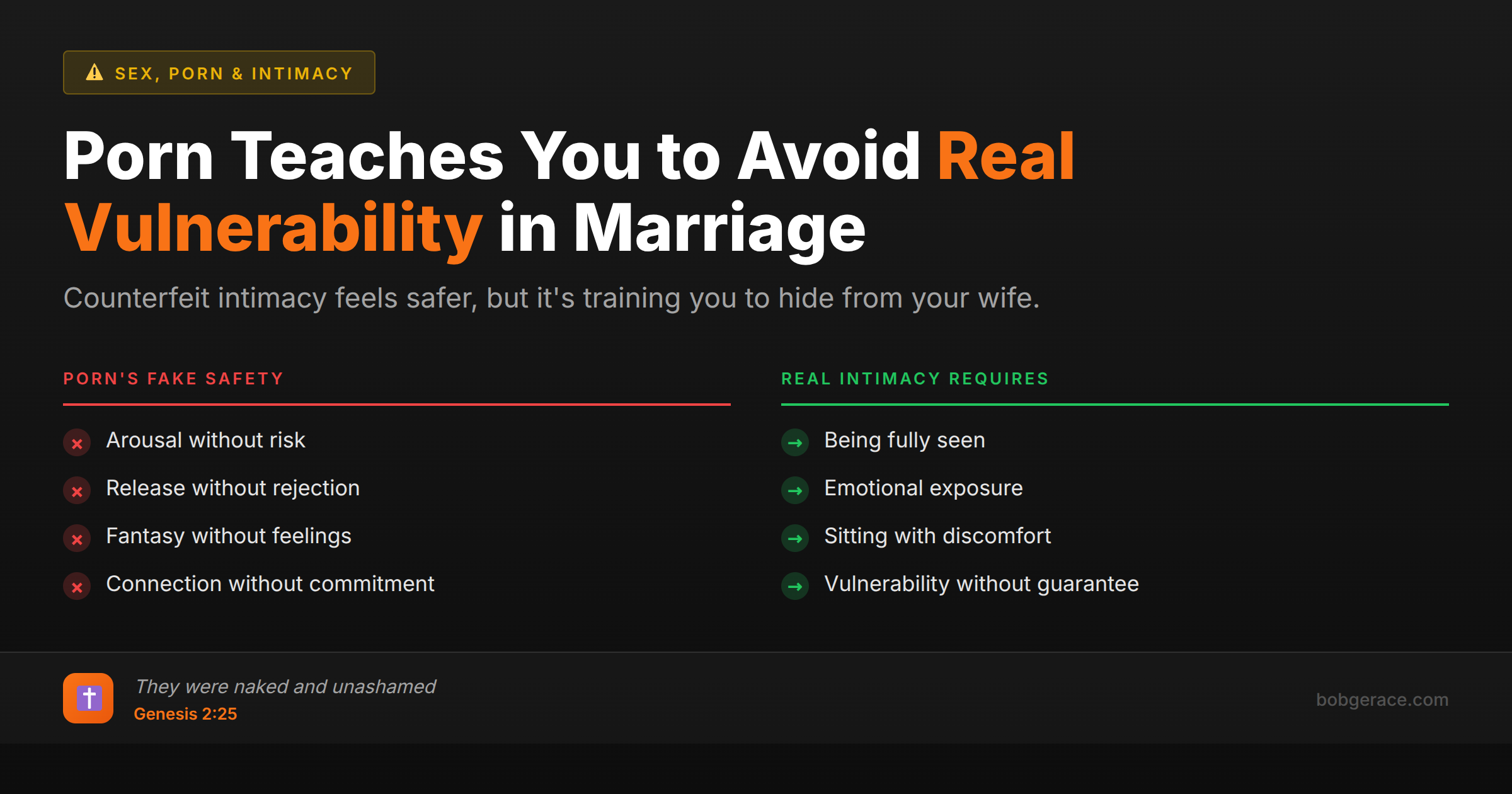
Yes. Porn trains you to avoid vulnerability by offering a counterfeit intimacy that requires nothing of you. It gives you arousal, release, and fantasy connection without risk, rejection, or emotional exposure. Over time, your brain learns to prefer that safety. Real intimacy—where you have to be seen, where your wife has needs and emotions you can't control—feels harder, messier, and less rewarding. This isn't just about sex. Porn teaches you to manage discomfort with a quick hit of dopamine instead of sitting with hard feelings or having hard conversations. It becomes your go-to when you're stressed, lonely, or disconnected. The result: you're emotionally unavailable in your marriage, not because you don't care, but because you've trained yourself to avoid the very thing intimacy requires—being fully present and undefended.
How Porn Replaces Vulnerability with Control
Porn isn't just a sexual issue—it's an intimacy issue. It offers a version of connection that's completely one-sided. You get arousal, validation, and release without having to be known. There's no risk of rejection, no emotional complexity, no need to attune to another person's needs or feelings. It's intimacy without vulnerability, and your brain loves it.
Real intimacy is the opposite. It requires you to be seen—your fears, your failures, your needs. It requires you to see your wife—her hurt, her disappointment, her longing. It's slow, unpredictable, and often uncomfortable. You can't control her response. You can't skip to the good part. And if you've been using porn for years, that discomfort feels unbearable.
So you avoid it. Not consciously, but functionally. When your wife wants to talk about something hard, you shut down or deflect. When she's upset, you problem-solve instead of sitting with her. When she wants emotional closeness, you offer logistics or physical touch that leads to sex. You've learned to manage relational discomfort the same way you manage stress—by reaching for something that makes you feel better without requiring vulnerability.
Your wife feels this. She knows something is off, even if she doesn't know about the porn. She feels your emotional absence. She feels like you're only present when you want something. And over time, she stops reaching for you. Not because she doesn't love you, but because reaching for someone who isn't really there is exhausting.
The longer porn is in the picture, the deeper this pattern runs. It's not just about quitting porn—it's about relearning how to be emotionally present, how to tolerate discomfort, and how to let yourself be known.
The Neurological Trade You've Made
Porn hijacks your brain's reward system. It floods your dopamine pathways with supernormal stimuli—images and scenarios more intense than anything real life offers. Over time, your brain recalibrates. Real intimacy—which involves slower dopamine release, emotional complexity, and relational risk—feels less rewarding. You've trained your brain to prefer the shortcut.
This is compounded by the avoidance pattern porn reinforces. Every time you feel stress, loneliness, or disconnection and turn to porn instead of your wife, you're strengthening a neural pathway that says, "Discomfort = escape, not connection." You're teaching your nervous system that vulnerability is a threat, not a path to intimacy.
There's also a shame cycle at play. Porn use creates secrecy. Secrecy creates distance. Distance makes real intimacy harder. So you feel more alone, which increases the pull toward porn. The cycle deepens. And the longer it runs, the more your capacity for vulnerability atrophies. You're not just avoiding your wife—you're avoiding yourself.
Breaking this pattern requires more than willpower. It requires rebuilding your tolerance for emotional discomfort. It means sitting with loneliness instead of medicating it. It means letting your wife see you—your struggle, your shame, your need—without a script or a guarantee that she'll respond the way you want. That's terrifying if you've spent years avoiding exactly that.
The good news: neuroplasticity is real. Your brain can rewire. But it requires consistent practice of the thing you've been avoiding—vulnerability, presence, and emotional honesty. You have to choose the harder path enough times that it becomes the familiar path.
The Call to Be Known, Not Hidden
Genesis 2:25 says Adam and Eve were "naked and unashamed." That's the design for intimacy—full exposure, no hiding, no fear. Sin broke that. Genesis 3 shows the immediate response: shame, hiding, fig leaves. We've been hiding ever since.
Porn is a modern fig leaf. It lets you experience a shadow of intimacy without being fully known. It's the same pattern as Adam in the garden—choosing self-protection over vulnerability. But God's call has always been the opposite. He calls us out of hiding. "Where are you?" isn't a question of location—it's an invitation to be seen.
James 5:16 says, "Confess your sins to one another and pray for one another, that you may be healed." Healing doesn't happen in secrecy. It happens in the light. Porn keeps you in the dark—literally and spiritually. It trains you to manage your struggles alone, to hide your weaknesses, to avoid the very confession and connection that bring healing.
Your wife isn't your enemy. She's your partner in sanctification. God gave her to you not just for companionship, but for the hard, holy work of being known and learning to love. That work requires vulnerability. It requires you to bring your struggles, your temptations, your failures into the light—not to be condemned, but to be loved and transformed.
This doesn't mean dumping everything on your wife without wisdom or support. But it does mean you can't heal in isolation. You need community, accountability, and the courage to let yourself be seen. That's the path out of hiding and into the intimacy God designed.
Action Steps
-
1
Identify the last three times you turned to porn and write down what you were feeling right before—stress, loneliness, anger, boredom—then share that list with one trusted man or counselor this week.
-
2
Install accountability software (Covenant Eyes, Truple, or similar) and give access to someone who will actually follow up, not just receive reports.
-
3
Practice sitting with discomfort for 10 minutes without escape—no phone, no porn, no distraction—and notice what feelings come up; do this daily for two weeks.
-
4
Tell your wife one true thing about your inner world this week that you'd normally hide—a fear, a struggle, or something you're ashamed of—without expecting her to fix it or affirm you.
-
5
Replace one porn trigger moment with a real connection attempt—text your wife something vulnerable, call a friend, or pray out loud about what you're feeling instead of clicking.
Related Questions
Also find Bob on
Subscribe for weekly videos on Christian marriage.
You Don't Have to Fight This Alone
If porn has you stuck in secrecy and your marriage is paying the price, it's time to get real help. I work with men who are ready to break the cycle and rebuild intimacy that's actually real.
Talk to Bob →