Should I move out if she asks?
6 min read
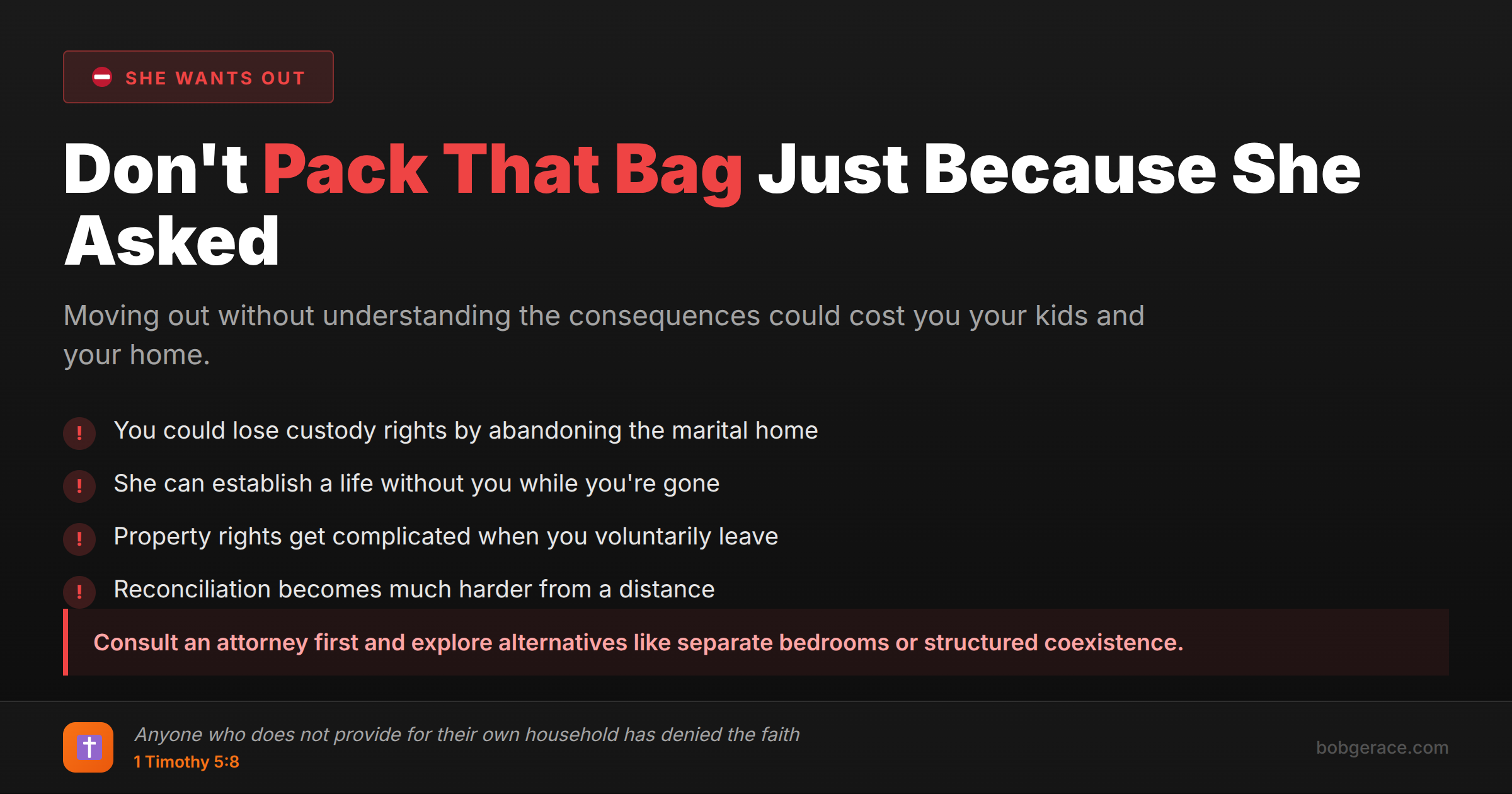
When your wife asks you to move out, don't make this decision in the heat of the moment. This isn't just about giving her space—it's a pivotal choice that could determine whether your marriage survives or dies. Moving out often makes reconciliation harder, not easier, despite what feels intuitive. The brutal truth? Most men who move out when asked never move back in as husband and wife. You're not just changing your address; you're potentially changing the entire trajectory of your marriage. Before you pack a single bag, you need to understand what's really driving her request and whether there are better ways to create the breathing room your marriage needs while keeping the door open for healing.
The Full Picture
When your wife asks you to move out, she's essentially asking you to make the separation feel more real and permanent. While her conscious intention might be to create space for healing, the practical effect is often the opposite.
Why moving out usually backfires: • It removes daily opportunities for positive interactions that could slowly rebuild connection • It makes the separation feel like a trial divorce rather than a time for working on issues • It often accelerates her emotional detachment as she gets used to life without you • It can create financial strain that adds pressure to make the separation permanent • It signals to others (including lawyers) that the marriage is over
The exceptions where moving out might make sense: • There's been physical violence or credible threats • Substance abuse is actively putting the family at risk • Police or court orders require it • A very short-term cooling off period (days, not weeks) has been mutually agreed upon
What's really happening when she asks: She's overwhelmed by conflict and sees your physical presence as a constant reminder of pain. But proximity isn't the problem—it's how you've been showing up in that proximity. Instead of removing yourself, focus on changing how you engage. Create emotional space through better boundaries, reduced conflict, and more intentional interactions.
Consider alternatives: Separate bedrooms, structured communication times, temporary stays with friends during high-conflict periods, or intensive counseling. These options maintain the household while addressing her need for breathing room.
What's Really Happening
From a therapeutic standpoint, the request to move out typically emerges from emotional overwhelm and a perceived need for psychological safety. When a spouse feels constantly triggered or activated by their partner's presence, physical distance can seem like the obvious solution. However, research consistently shows that physical separation often accelerates emotional detachment rather than facilitating healing.
The neuroscience perspective: When couples are in chronic conflict, the brain's threat detection system (amygdala) becomes hyperactive around the partner. The brain literally perceives the spouse as a source of danger. While temporary distance might calm this system, it doesn't rewire the neural pathways—only new, positive experiences together can do that.
Attachment theory implications: Moving out often activates abandonment fears and protest behaviors, even when it was requested. The pursuing partner (typically the husband) experiences increased anxiety and desperate attempts to reconnect, while the distancing partner (typically the wife) may initially feel relief but then begin to adapt to independence.
The therapeutic challenge: Real healing requires controlled exposure to the relationship triggers while building new skills and neural pathways. Moving out eliminates the opportunity for this crucial rewiring process. Instead, I recommend what I call "emotional separation within physical proximity"—maintaining household connection while creating clear boundaries around interaction patterns, communication styles, and personal space.
Statistical reality: Studies show that couples who separate physically have significantly lower reconciliation rates compared to those who work on issues while cohabitating, even when controlling for relationship satisfaction levels.
What Scripture Says
Scripture provides clear guidance about marriage commitment and the importance of not abandoning our covenant relationships lightly. 1 Corinthians 7:10-11 states: "To the married I give this command (not I, but the Lord): A wife must not separate from her husband. But if she does, she must remain unmarried or else be reconciled to her husband. And a husband must not divorce his wife."
This passage acknowledges that separation sometimes happens, but emphasizes that the goal should always be reconciliation, not permanent separation. Moving out often makes reconciliation more difficult.
Ephesians 5:25 calls husbands to "love your wives, just as Christ loved the church and gave himself up for her." This sacrificial love doesn't mean enabling unhealthy patterns, but it does mean fighting for your marriage rather than taking the path of least resistance. Sometimes the most loving thing is to stay and do the hard work of change.
Matthew 5:23-24 teaches: "If you are offering your gift at the altar and there remember that your brother or sister has something against you, leave your gift there in front of the altar. First go and be reconciled to them; then come and offer your gift." This suggests that reconciliation requires intentional proximity and engagement, not distance.
1 Peter 3:7 reminds husbands to "be considerate as you live with your wives, and treat them with respect." The phrase "live with" assumes physical presence. The solution to marital problems isn't separation but learning to live together with honor and respect.
Practical application: Scripture supports creating space for healing through changed behavior and attitudes, not changed addresses. Fight for your marriage by becoming the husband God calls you to be, right where you are.
What To Do Right Now
-
1
Tell her you understand she needs space and ask what specific changes would help her feel safer and more peaceful at home
-
2
Propose alternative solutions like separate bedrooms, structured communication times, or temporary cooling-off periods instead of moving out
-
3
Set clear boundaries around your interactions—no pursuing, arguing, or trying to "fix" things in the moment
-
4
Focus intensively on changing your own behavior patterns that contributed to her overwhelm rather than changing your location
-
5
Consult with a family law attorney to understand the legal implications of moving out before making any decisions
-
6
Give her a specific timeline for your behavior changes and ask for 30-60 days to demonstrate your commitment to being different at home
Related Questions
- She wants separation — should I agree?
- If I move out, will I ever come back?
- Who should stay in the house?
- How does moving out affect my legal position?
- Is trial separation ever a good idea?
- What are the rules of separation?
- What boundaries should I set?
- How do I protect myself legally without being adversarial?
- How do I tell the kids?
- What does self-care look like in this season?
Also find Bob on
Subscribe for weekly videos on Christian marriage.
This Decision Needs a Coach
Moving out isn't just logistics—it's a fork in the road. Before you make a call you can't walk back, talk to someone who knows your specific situation and has seen how this plays out.
Talk to Bob →