Who should stay in the house?
6 min read
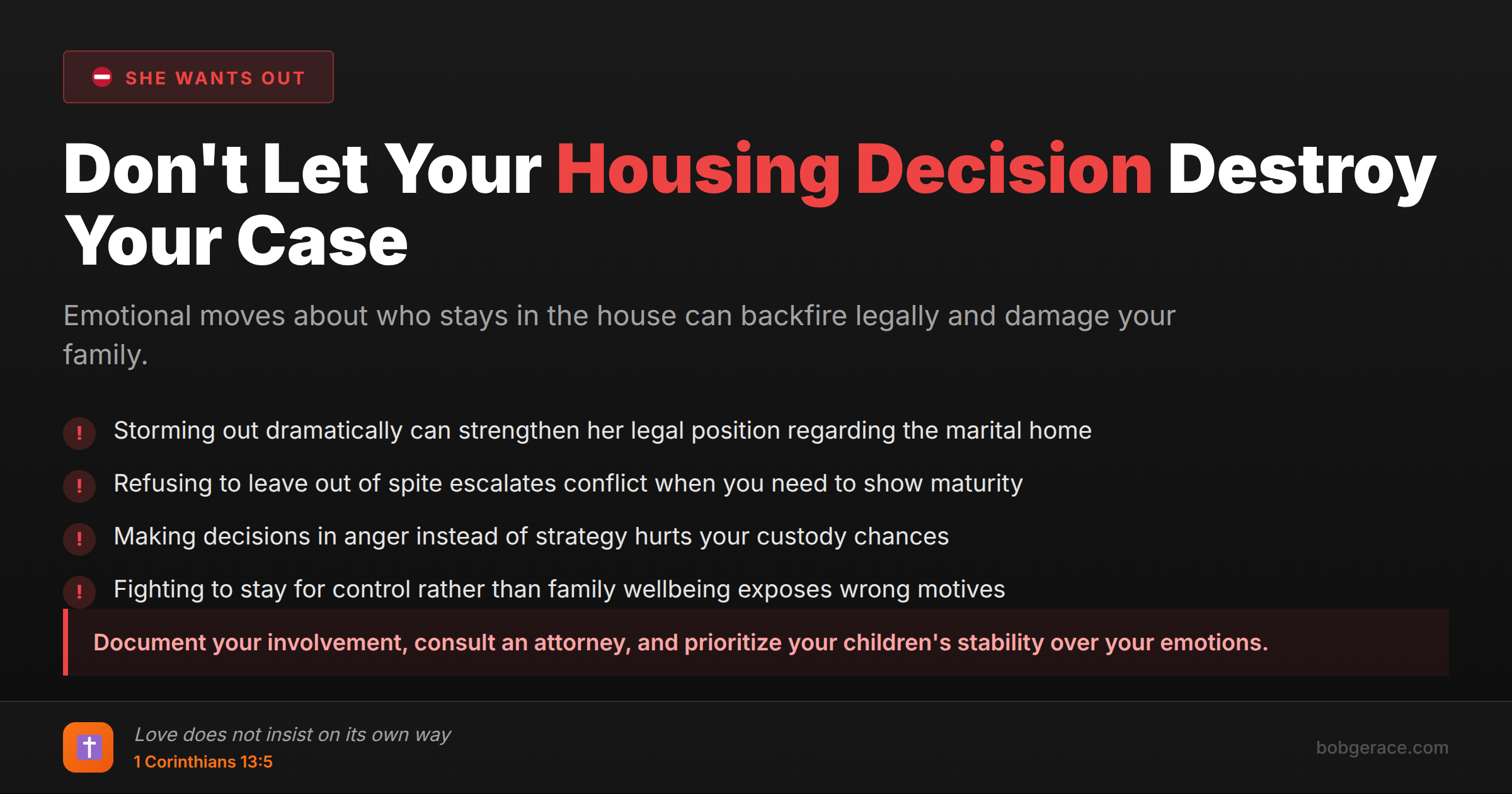
The decision of who stays in the house during separation isn't just about preference - it's about strategy, stability, and what serves your family best. Generally, the primary caregiver of children should remain in the home to maintain their stability, but this isn't always possible or practical. Your decision should consider legal implications, financial capacity, and the potential impact on reconciliation efforts. Don't make this choice in the heat of emotion or as a power play. If your wife initiated the separation and you storm out dramatically, you might be inadvertently strengthening her legal position regarding the marital home. Conversely, refusing to leave out of spite can escalate conflict when you need to be demonstrating maturity and leadership. This decision will echo through custody arrangements, divorce proceedings, and your children's emotional well-being.
The Full Picture
The question of who stays in the house is rarely about the house itself - it's about control, security, and the children's stability. Most men's instinct is either to leave immediately (to avoid conflict) or to dig in their heels (to maintain their ground). Both approaches can backfire.
Legal considerations matter more than you think. In many states, voluntarily leaving the marital home can be viewed as abandonment and may affect your claim to the property later. If you leave, document that it's temporary and maintain financial responsibility for the home. Keep paying the mortgage, utilities, and maintenance regardless of where you're sleeping.
The children's needs should drive this decision. Whoever has been their primary caregiver typically has the stronger argument for remaining. If that's your wife, fighting her on this might harm your custody prospects. If you've been actively involved in their daily routines - school pickup, homework, bedtime - you have standing to argue for remaining.
Financial reality often decides everything. Can either of you afford to maintain two households? If money is tight, the person who stays inherits all the home expenses. Sometimes the "winner" of this battle actually loses financially. Consider whether staying puts you in a better or worse position to provide for your family's future needs.
Your separation goals matter. If you're hoping for reconciliation, how does this decision support or hinder that outcome? Sometimes creating space by leaving demonstrates respect for her wishes while maintaining your commitment to the family. Other times, leaving reinforces her narrative that you're unreliable or abandoning your responsibilities.
What's Really Happening
The housing decision during separation often becomes a proxy war for deeper issues of power, security, and attachment. From a psychological perspective, the family home represents safety, identity, and continuity - which explains why this decision feels so emotionally charged for everyone involved.
Research on separation outcomes shows that maintaining stability for children significantly impacts their adjustment. The parent who remains in the home often gains a psychological advantage in terms of routine maintenance and the children's sense of normalcy. However, this advantage can become a disadvantage if that parent becomes overwhelmed by the full responsibility of home management during an already stressful time.
Attachment theory helps us understand the deeper dynamics. For many men, being asked to leave the home triggers abandonment fears and can activate anxious attachment behaviors - pleading, controlling, or angry responses. For women initiating separation, having their spouse remain can feel suffocating and prevent the emotional space needed for healing or decision-making.
Clinically, I observe that couples who can negotiate this decision collaboratively, focusing on practical needs rather than emotional wounds, tend to have better long-term outcomes regardless of whether they reconcile or divorce. The process of making this decision reveals each person's capacity for putting children's needs first and working together despite personal pain - skills essential for successful co-parenting or marriage repair.
What Scripture Says
Scripture provides wisdom for navigating this difficult decision through principles of sacrificial love, wise stewardship, and protecting the vulnerable.
1 Corinthians 13:5 reminds us that love "does not insist on its own way." This doesn't mean becoming a doormat, but it calls us to examine our motives. Are you fighting to stay out of genuine concern for your family's wellbeing, or are you asserting control?
Philippians 2:3-4 instructs us to "do nothing from selfish ambition or conceit, but in humility count others more significant than yourselves. Let each of you look not only to his own interests, but also to the interests of others." This perspective can guide your decision-making process, considering what truly serves your wife and children best.
Nehemiah 4:14 shows us to "remember the Lord, who is great and awesome, and fight for your brothers, your sons, your daughters, your wives, and your homes." Sometimes fighting for your home means staying and taking responsibility. Sometimes it means leaving to create space for healing.
1 Timothy 5:8 declares that "anyone who does not provide for their relatives, and especially for their own household, has denied the faith and is worse than an unbeliever." Regardless of who stays in the house, your responsibility to provide and protect continues.
Matthew 18:4 calls us to "humble ourselves like children." Pride often drives housing decisions during separation. Biblical manhood means setting aside ego and making choices based on wisdom, sacrifice, and long-term family wellbeing rather than immediate emotional reactions.
What To Do Right Now
-
1
Document your current involvement in household management and children's daily routines before making any decisions
-
2
Consult with a family law attorney to understand the legal implications of staying versus leaving in your state
-
3
Calculate the realistic financial costs of maintaining two households and determine what's sustainable
-
4
Have an honest conversation with your wife about what arrangement would best serve the children's stability
-
5
Create a written agreement about household expenses, maintenance responsibilities, and access regardless of who stays
-
6
Establish clear boundaries and communication protocols if you'll be sharing the space during transition
Related Questions
- She wants separation — should I agree?
- Should I move out if she asks?
- If I move out, will I ever come back?
- How does moving out affect my legal position?
- What are the rules of separation?
- Is trial separation ever a good idea?
- What do I do about finances immediately?
- What evidence should I secure?
- How do I tell the kids?
- What boundaries should I set?
Also find Bob on
Subscribe for weekly videos on Christian marriage.
This Decision Has Long Legs
Housing choices during separation affect custody, finances, and your shot at reconciliation. A coach who knows your specific situation helps you see what you can't see from inside it.
Talk to Bob →