How does separation affect custody later?
6 min read
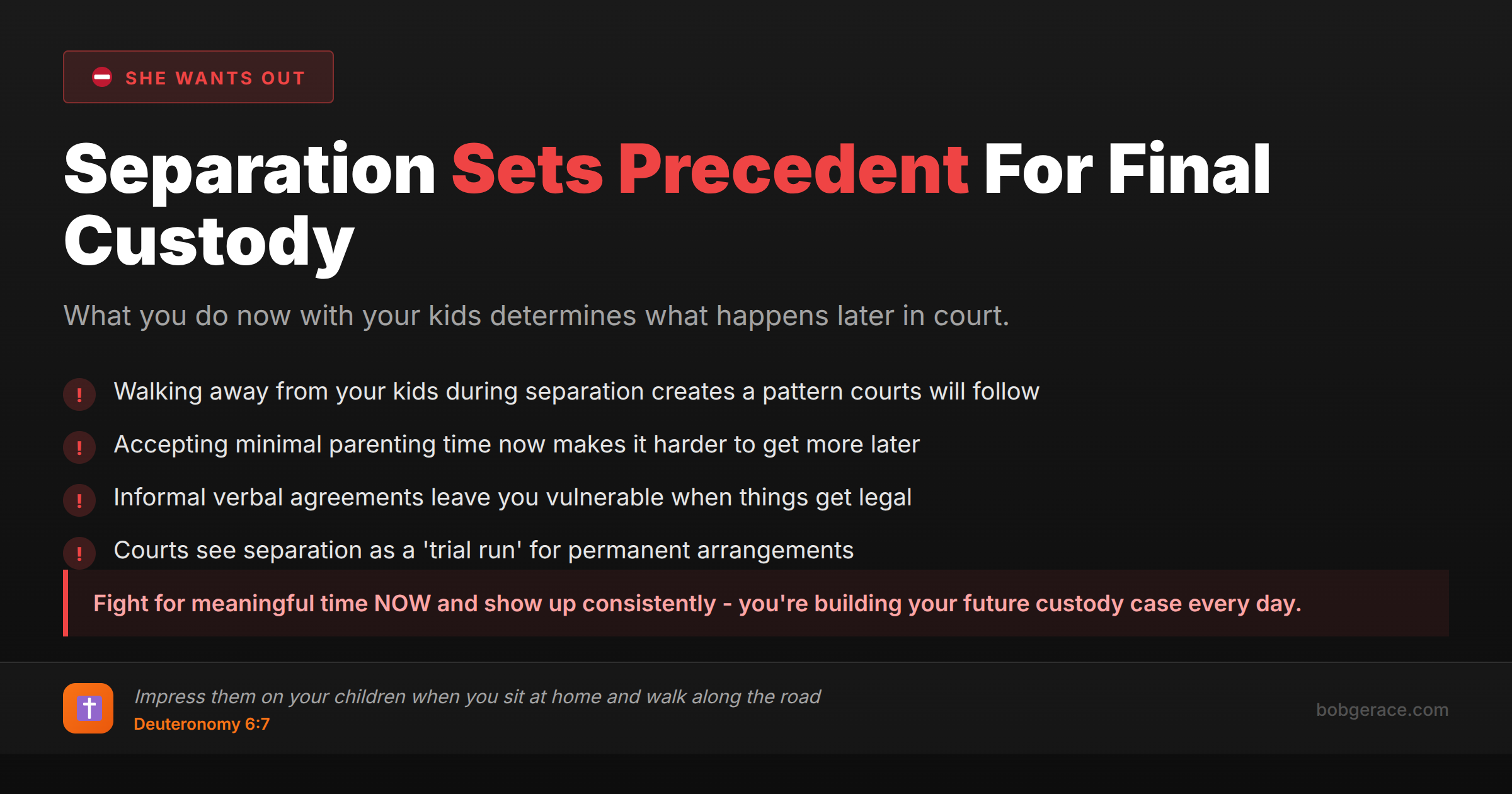
Separation doesn't automatically determine your final custody arrangement, but it absolutely influences it. Courts pay close attention to how custody and parenting time work during separation - they see it as a "trial run" for what might become permanent. Here's the hard truth: if you walk away from your kids during separation or accept minimal time with them, you're setting a precedent that's tough to overcome later. Courts look at what's been working and what's in the children's "established routine." But here's the good news - if you fight for meaningful time with your kids now and show up consistently, you're building a strong foundation for the future. The key is being intentional about your role as a father from day one of separation, not waiting until divorce proceedings to suddenly become engaged.
The Full Picture
Separation creates the template for your future custody arrangement. Family courts don't operate in a vacuum - they look at what's been happening during your separation as evidence of what works best for the children. If you've had the kids every other weekend for eight months, the court assumes that arrangement is working. If your wife has been handling 90% of the parenting decisions, they'll likely formalize that pattern.
The "status quo" principle drives most custody decisions. Judges are conservative by nature - they don't like disrupting children's established routines unless there's compelling evidence for change. This means every week of separation is essentially a "custody audition" whether you realize it or not.
Common mistakes men make during separation: • Agreeing to minimal parenting time "temporarily" to keep peace • Focusing on work or dating instead of consistent parenting • Letting their wife make all school and medical decisions without involvement • Moving out without establishing a formal parenting schedule • Assuming they can "fix" custody issues later in divorce court
What courts actually evaluate: • Consistency - Do you show up when you're supposed to? • Engagement - Are you involved in homework, activities, and daily care? • Communication - How do you coordinate with your wife about the kids? • Stability - Can you provide a safe, nurturing environment?
The good news: Separation also gives you opportunity to demonstrate your value as a father. Men who step up during separation - who fight for 50/50 time, stay involved in school decisions, and create stability in their own homes - often achieve better custody outcomes than they feared possible. The key is treating separation as the beginning of your custody case, not a temporary inconvenience.
What's Really Happening
From a psychological standpoint, children's adjustment during separation becomes a critical factor in long-term custody decisions. Research consistently shows that children benefit most from consistent, predictable contact with both parents during family transitions, yet many fathers unknowingly sabotage this by accepting irregular or minimal contact.
Attachment theory plays a significant role here. Children who maintain secure attachments with both parents during separation show better emotional regulation and fewer behavioral problems. Courts increasingly recognize this research, which is why we're seeing more emphasis on maintaining strong father-child relationships even in high-conflict separations.
The "primary caretaker" bias is shifting but still exists. Historically, courts favored whoever had been the primary caretaker before separation, which often disadvantaged fathers. However, modern family psychology recognizes that children need different things from each parent, and fathers often provide unique contributions to child development - particularly in areas of risk assessment, independence building, and emotional resilience.
Parental alienation concerns are on courts' radar. When one parent attempts to undermine the child's relationship with the other parent during separation, family court professionals are trained to identify these patterns. However, the alienated parent must document these behaviors and respond appropriately - not by withdrawing from the children, but by maintaining consistent, loving contact despite the challenges.
Children's developmental needs change over time. What works for a 4-year-old during separation may not work when that child is 8. Courts are looking for parents who can adapt and prioritize the children's evolving needs over their own convenience or emotional wounds from the marriage.
What Scripture Says
Scripture places tremendous value on fathers' roles in their children's lives, and this calling doesn't diminish during separation. Deuteronomy 6:6-7 reminds us: "These commandments that I give you today are to be on your hearts. Impress them on your children. Talk about them when you sit at home and when you walk along the road, when you lie down and when you get up." This isn't just about religious instruction - it's about being present and engaged in your children's daily lives.
Psalm 127:3 declares that "Children are a heritage from the Lord, offspring a reward from him." Your children aren't just part of your marriage - they're a direct gift from God to you personally. Separation from your wife doesn't change your God-given responsibility to steward that gift well.
Malachi 4:6 speaks of God's heart "to turn the hearts of the parents to their children and the hearts of the children to their parents." Even in broken family situations, God's desire is for strong parent-child bonds. Fighting for meaningful time with your kids isn't selfish - it's biblical.
1 Corinthians 13:4-7 gives us the blueprint for love that "is patient, kind... keeps no record of wrongs... always protects, always trusts, always hopes, always perseveres." This applies directly to how you navigate custody during separation. Your love for your children should transcend any bitterness toward your wife.
Ephesians 6:4 instructs fathers: "Do not exasperate your children; instead, bring them up in the training and instruction of the Lord." During separation, children are already dealing with family instability. Your job is to provide security, consistency, and godly guidance - not to add to their burden with anger or inconsistency.
God calls fathers to be actively involved in raising their children, and no earthly court decision should prevent you from pursuing that calling with wisdom and perseverance.
What To Do Right Now
-
1
Document your current parenting schedule and involvement in writing - track every interaction, school event, and decision you're part of
-
2
Push for a formal written parenting plan immediately, even during separation - don't rely on informal verbal agreements
-
3
Stay actively involved in your children's education, medical care, and extracurricular activities - communicate directly with teachers and coaches
-
4
Create a stable, child-friendly environment in your new living space with proper bedrooms, supplies, and routines for your kids
-
5
Maintain consistent, reliable contact with your children - if you're supposed to have them Tuesday nights, be there every Tuesday night
-
6
Communicate professionally with your wife about parenting matters - use email or co-parenting apps to keep records of all discussions
Related Questions
Don't Let Separation Determine Your Future as a Father
Every decision you make during separation impacts your long-term relationship with your children. Get strategic guidance to protect what matters most.
Protect Your Kids →