What does 'I love you but I'm not in love with you' really mean?
6 min read
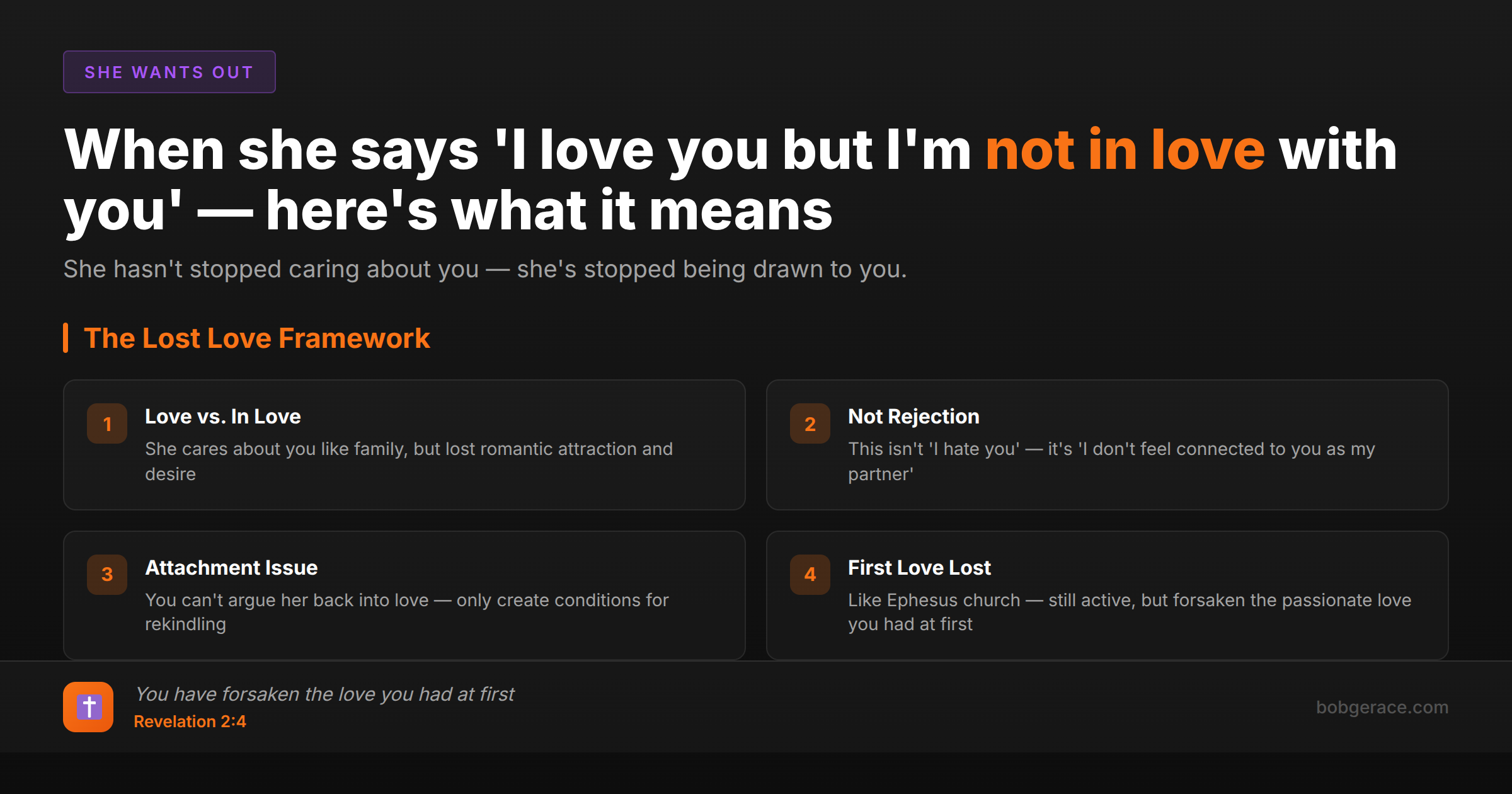
It means: 'I care about you as a person, but I'm no longer romantically attracted to you or emotionally attached to you as a partner.' The 'love' she still has is the kind you might have for a friend or family member — affection, history, well-wishing. The 'in love' she's lost is passion, desire, emotional connection, and the feeling that you're her person. She hasn't stopped valuing you. She's stopped being drawn to you.
The Full Picture
This phrase is devastating precisely because it sounds like it should be a compliment. She still loves you! That's good, right?
No. It's worse than if she said she hated you.
Hate means there's still emotional charge. Where there's hate, there's often still attachment — just negative attachment. Strong emotion means the connection is still alive, even if it's painful.
'I love you but I'm not in love with you' means the attachment has deactivated. The emotional charge is gone. You've moved from 'husband' to 'roommate' to 'someone she used to be married to.'
Let's decode it:
'I love you' = I care about your wellbeing. I have history with you. I don't wish you harm. I recognize your value as a human being. This is familial or friendly love — like what you might feel for a sibling or longtime friend.
'But I'm not in love with you' = I no longer feel romantic passion for you. I don't //blog.bobgerace.com/sexual-pressure-christian-marriage-destroying-desire/:desire you. I don't feel emotionally safe with you. When I imagine my future, you're not in it. My heart doesn't respond to you the way it once did — or the way it should to stay married.
Why this happens:
Romantic love requires fuel. It requires consistent deposits of emotional connection, presence, affection, admiration, and safety. When those deposits stop — when connection becomes transaction, when presence becomes proximity, when safety becomes predictability without passion — the romantic love starves.
She probably didn't choose to stop being in love with you. She woke up one day and realized it was already gone. The death of romantic love is often discovered, not decided.
What this means for you:
You cannot argue her back into love. Love is not a logical conclusion she reached; it's a felt experience that faded. The path to rekindling it (if it's possible) runs through months of demonstrated change, not days of desperate pleading.
What's Really Happening
From an attachment perspective, 'I love you but I'm not in love with you' translates to: 'My attachment system has deactivated toward you.'
Attachment systems can be in three states:
1. Secure and active: She feels bonded to you, seeks closeness, is emotionally invested. This is 'in love.'
2. Anxious and hyperactivated: She's worried about the relationship, seeks reassurance, may be clingy or demanding. This is still attached — just insecurely.
3. Avoidant/deactivated: Her attachment system has shut down. She no longer seeks closeness. She feels indifferent to your presence or absence. This is 'not in love.'
Deactivation is a protective mechanism. When attachment needs are chronically unmet, the system eventually gives up seeking. It stops registering the partner as an attachment figure. This is what's happened.
Neurologically, the brain pathways associated with romantic love — dopamine-driven reward, oxytocin-based bonding — have weakened or redirected. The 'love' she still feels is processed in different brain regions: more cognitive, less emotional.
Can deactivated attachment be reactivated? Yes — but not through the same mechanisms that created it originally. Early romantic love is effortless. Rekindled love requires consistent, visible evidence of safety and change over extended time. The brain needs to unlearn its protective response.
This is why quick fixes fail. Her brain has literally rewired to protect itself from you. Rewiring takes time.
What Scripture Says
Revelation 2:4: 'Yet I hold this against you: You have forsaken the love you had at first.'
This is Christ's rebuke to the church at Ephesus. They were doctrinally correct. They were active. They were persevering. But they had lost their first love.
Your wife has forsaken the love she had at first. Not intentionally — but functionally. And if you're honest, you probably did too. First love — passionate, attentive, sacrificial — requires cultivation. It dies without intentional fuel.
What's Christ's prescription? Revelation 2:5: 'Consider how far you have fallen! Repent and do the things you did at first.'
Consider. Repent. Return to first works.
What did you do when you were courting her? When you were 'in love'? When she was the most important person in your world? You pursued. You studied her. You sacrificed. You prioritized. You were present.
The path to rekindling love is the same: return to first works. Not as manipulation. Not as performance. But as genuine repentance — a turning back to what you once knew how to do and stopped doing.
1 Corinthians 13:4-7 describes love: patient, kind, not envious, not proud, not self-seeking. Have you loved her this way consistently? If not, there's your roadmap.
What To Do Right Now
-
1
Hear what she's actually saying: Not 'I hate you' or 'You're worthless' — but 'I've lost the feeling of being in love with you.' This is painful, but it's different from rejection.
-
2
Don't argue semantics. Debating whether 'love' and 'in love' are different is beside the point. The felt experience is what matters.
-
3
Understand this is about attachment, not logic. You cannot persuade her back into love. You can only create conditions where love might rekindle — over time.
-
4
Ask yourself honestly: When did you stop doing the things that made her fall in love with you? Those first works need to return.
-
5
Don't expect quick results. Reactivating attachment takes consistent, visible change over months — not days. Pace yourself for a long journey.
-
6
Grieve the loss while working toward possible restoration. You can mourn what's been lost and still hope for what might be rebuilt.
Related Questions
- What is 'negative sentiment override' and does she have it?
- What does 'emotional starvation' look like in a wife?
- Why does she remember everything differently than I do?
- What are the Four Horsemen and which ones killed us?
- What is 'deactivation' and has she done it?
- When does a wife's attachment system shut off completely?
- She says she's never felt this way before
- What is limerence?
- She says she loves me but isn't 'in love'
- What does 'in love' even mean?
Also find Bob on
Subscribe for weekly videos on Christian marriage.
Ready to Apply This to Your Marriage?
You understand the words now. A coach helps you figure out what they mean in your specific situation — and what to do next.
Talk to Bob →