Why didn't I see this coming?
6 min read
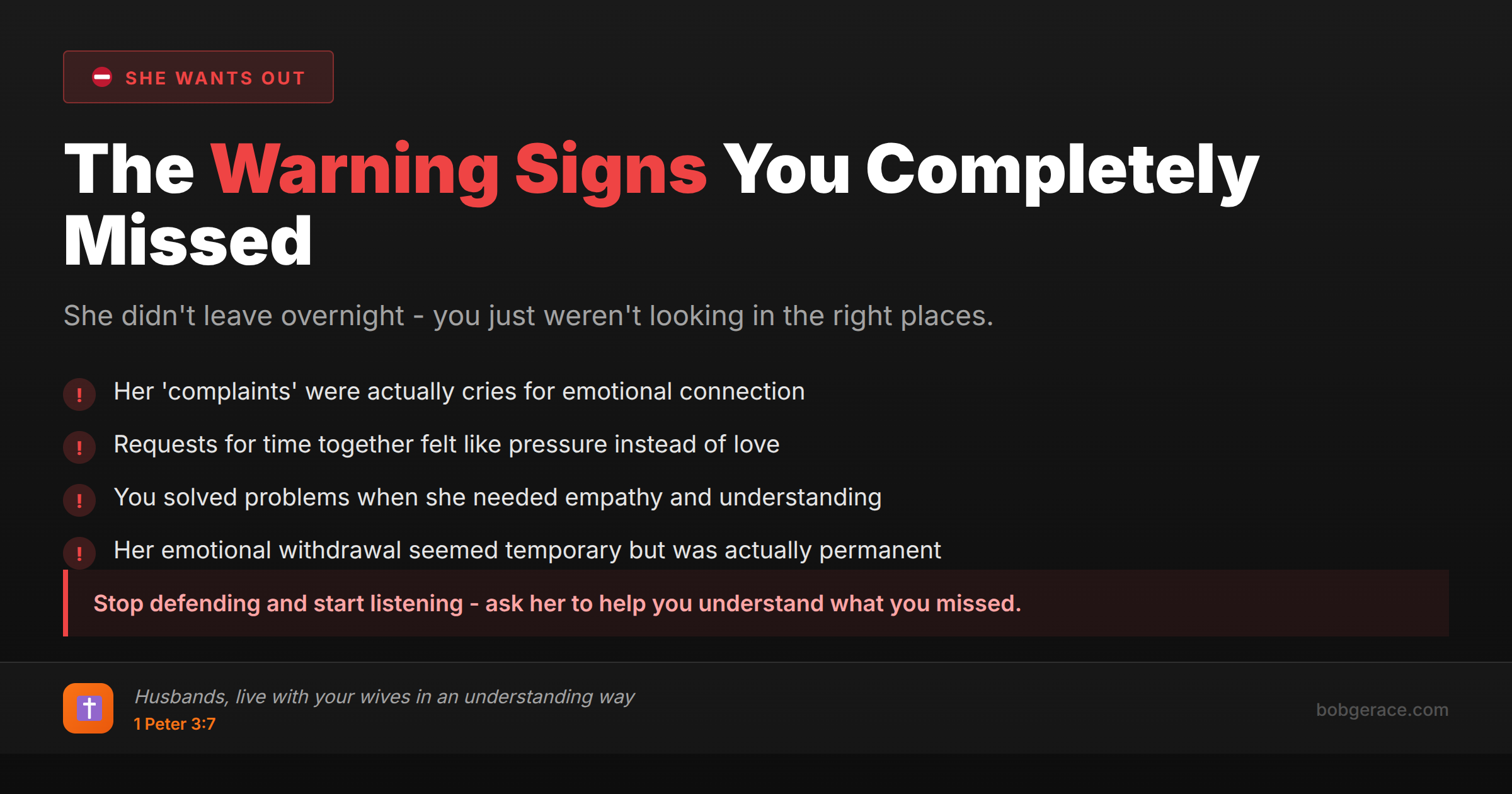
You didn't see it because you weren't looking. Not maliciously — but because things seemed fine to you. Her silence felt like peace. Her withdrawal felt like independence. Her complaints felt like nagging. You interpreted her internal crisis through the lens of your own comfort. She was drowning, and you thought she was waving.
The Full Picture
You're asking the question every blindsided husband asks: How did I miss this?
Here's the uncomfortable answer: the signs were there. You didn't see them because you didn't want to — or because you didn't know how.
Common reasons men miss the signs:
1. You conflated peace with health. When she stopped fighting, you thought things were better. Actually, she'd given up. Her silence wasn't contentment — it was resignation. The most dangerous phase in a dying marriage often feels like the calmest.
2. You heard complaints as nagging. Every time she raised an issue, you heard criticism, not a cry for connection. You got defensive or dismissive. Eventually she stopped raising issues — not because they were resolved, but because she'd learned you wouldn't listen.
3. You assumed your experience was shared. You were reasonably happy. You assumed she was too. This is a fundamental error of perspective — your satisfaction doesn't indicate hers. You were experiencing two different marriages.
4. You weren't attuned to emotional signals. She may have been communicating distress in ways you didn't recognize. Withdrawal. Sadness. Decreased affection. You noticed something was different but didn't investigate.
5. You prioritized work, kids, hobbies over the marriage. You had good reasons. Providing matters. Kids matter. But somewhere along the way, she stopped mattering at the same level — at least in terms of active attention. The marriage ran on autopilot while you focused elsewhere.
6. You believed your own narrative. You told yourself a story: we're solid. She'd tell me if something was wrong. We've been through harder times. The story protected you from seeing what contradicted it.
The hardest truth: You missed it because, at some level, you didn't want to see it. Seeing it would have required change. It's easier to believe everything's fine than to face the work of addressing what isn't.
What's Really Happening
This phenomenon is well-documented in relationship research. Studies show that men consistently rate their marital satisfaction higher than women in the same marriage — and are more surprised when their wives initiate divorce.
Several psychological factors contribute:
1. Threshold differences. Research suggests women have lower thresholds for detecting relationship distress. They notice problems earlier and weight them more heavily. By the time a man notices, the woman has often been suffering for years.
2. Confirmation bias. Once you believe your marriage is fine, you unconsciously filter out contradicting evidence. Her sadness gets attributed to work stress. Her withdrawal gets labeled as 'needing space.' The narrative stays intact.
3. Emotional labor blindness. Women typically do more emotional labor in relationships — monitoring the relationship's health, raising issues, attempting repairs. Men often don't see this labor happening, so when it stops, they don't notice its absence.
4. The 'quiet' danger zone. Gottman's research shows that couples who stop fighting aren't necessarily healthier — they may have simply given up. The cessation of conflict can be a warning sign, not a positive indicator.
5. Self-protective denial. The brain protects us from painful truths. If acknowledging marital distress feels threatening, the brain will literally filter out evidence of it.
This isn't about blame. It's about understanding why your subjective experience differed so dramatically from hers. That understanding is essential for real change.
What Scripture Says
Proverbs 16:2: 'All a person's ways seem pure to them, but motives are weighed by the LORD.'
You thought things were fine because from your perspective, they were. But God weighs motives and sees hearts — including the parts we hide from ourselves.
Jeremiah 17:9: 'The heart is deceitful above all things and beyond cure. Who can understand it?'
Your heart deceived you. Not maliciously — but self-protectively. It told you everything was fine because confronting the alternative was too costly.
1 Peter 3:7 commands husbands to 'live with your wives in an understanding way.' Understanding requires attention. Study. Awareness. If you were understanding her, you would have seen the signs.
This isn't condemnation — it's invitation. The same text says to show her honor 'as the weaker vessel.' 'Weaker' here doesn't mean inferior — it means more vulnerable, more easily hurt, requiring more careful handling.
She was hurt. You didn't see it. Now you do.
Psalm 139:23-24: 'Search me, God, and know my heart; test me and know my anxious thoughts. See if there is any offensive way in me.'
This is your prayer now. Not 'God, show me why she's wrong' — but 'God, show me what I've been unable or unwilling to see.'
What To Do Right Now
-
1
Stop telling yourself 'this came out of nowhere.' It came out of somewhere. Your job is to understand where.
-
2
Review the last 2-5 years with fresh eyes. When did she complain? What did she ask for? When did she go quiet? Those are the signs you missed.
-
3
Ask yourself honestly: What did I not want to see? What would I have had to change if I'd acknowledged there were problems?
-
4
Don't ask her to explain what you should have seen. She's exhausted from trying to show you. Do this work yourself — through reflection, journaling, therapy, coaching.
-
5
Forgive yourself for missing it. You're human. But don't excuse yourself from learning how you missed it. Those patterns need to change.
-
6
Commit to developing relational awareness going forward. Learn to read emotional signals. Learn what 'bids for connection' look like. This is learnable — but it requires intentionality.
Related Questions
- What signs did I miss?
- Why do wives suddenly want out?
- How long has she been thinking about this?
- Did she plan this or is it impulsive?
- What pushed her over the edge?
- Is she testing me or serious?
- She won't talk about our problems
- She shuts down when I try to connect
- What is 'emotional disengagement'?
- How did we get here without me noticing?
Also find Bob on
Subscribe for weekly videos on Christian marriage.
Ready to Apply This to Your Marriage?
Understanding the pattern is step one. Changing what happens next in your specific situation — that's where coaching comes in.
Talk to Bob →