Am I using work to avoid my marriage?
6 min read
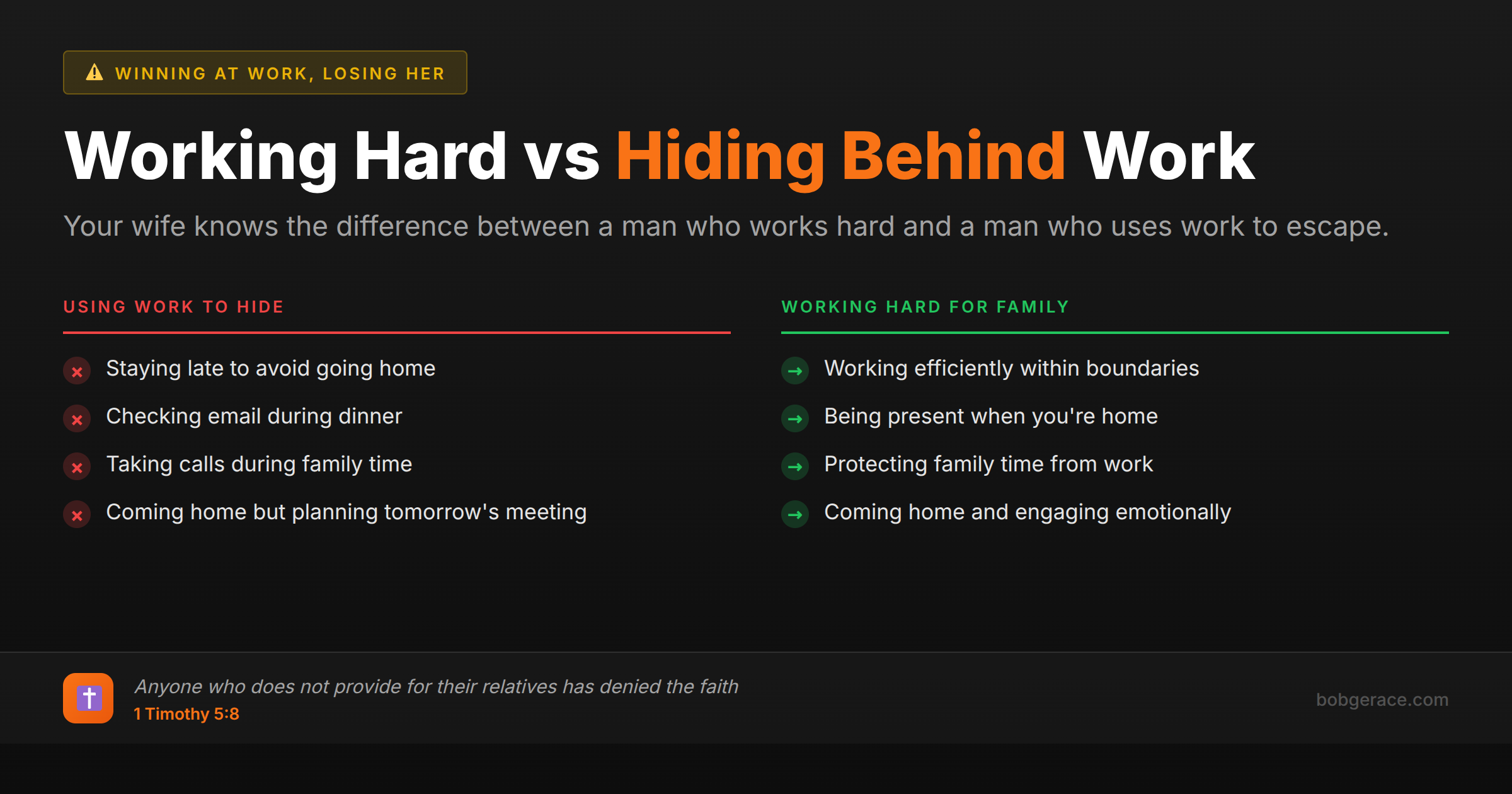
Yes, probably. If you are reading this question, some part of you already knows the answer. Work is not just your job. It is where you feel competent, in control, and successful. It is where you do not have to deal with your wife's disappointment, your own shame, or the emotional complexity of a struggling marriage. So you stay late. You check email at dinner. You take the call during family time. And you tell yourself it is sacrifice, when it is actually avoidance. Your wife is not asking you to quit your job. She is asking you to stop hiding behind it. She knows the difference between a man who works hard and a man who uses work to escape. The first comes home and is present. The second comes home and is already planning tomorrow's meeting. If she says you care more about work than her, she is not being dramatic. She is describing her lived experience of you.
When Provision Becomes a Shield
You built something. You provide well. Your family has financial security, opportunities, and a lifestyle that many envy. From your perspective, you are doing exactly what a man is supposed to do. You are sacrificing, grinding, and carrying the weight. So when your wife says you are never really home, it feels like betrayal. You are doing all of this for her, and she does not even see it.
But here is what you may not see: work is also your refuge. It is the place where you know the rules, where effort equals results, where you do not have to be vulnerable. At work, you are respected. You are competent. You are in control. At home, your wife is hurt, your kids want your attention, and you feel like you are failing no matter what you do. So you go back to work. You stay late. You check your phone at the dinner table. You take the Saturday call. And you call it responsibility.
Your wife is not stupid. She knows the difference between a season of hard work and a pattern of emotional avoidance. She knows when you are working because you have to and when you are working because you do not want to come home. She feels it in the way you sigh when she asks about your day, the way you are irritated when she needs you during work hours, the way you are more animated talking about a client than you have been talking to her in months.
This is not about working less. It is about being honest. Are you working hard, or are you hiding? Are you providing for your family, or are you avoiding the emotional labor your marriage requires? Because if work is your escape, your wife already knows. And she is deciding how much longer she will tolerate being the thing you avoid.
The Dopamine Hit of Achievement vs. the Discomfort of Intimacy
Work gives you something your marriage does not: immediate feedback, clear wins, and a sense of control. You close a deal, you get a promotion, you solve a problem, and you feel the dopamine hit of achievement. Your nervous system loves it. It is predictable, measurable, and safe. Marriage is none of those things. Marriage requires vulnerability, emotional attunement, and sitting with discomfort you cannot fix. So your nervous system does what it is wired to do: it moves toward the reward and away from the threat.
Many high-performing men are operating in a chronic low-grade state of hyperarousal. You are always on, always scanning for the next problem, always optimizing. That state makes you excellent at work. It makes you terrible at intimacy. Because intimacy requires you to slow down, to be present, to tolerate not knowing, and to let someone else see you when you are not performing. That feels dangerous. So you stay busy. You stay in work mode. You stay safe.
Your wife experiences this as rejection. She is not asking you to stop achieving. She is asking you to stop using achievement as a substitute for connection. She wants you to be able to sit with her without your phone, to have a conversation without pivoting to logistics, to be emotionally present without needing to fix or solve. But you cannot do that if work is your primary source of regulation. You have trained your nervous system to find safety in productivity, and now you cannot turn it off.
The pattern becomes self-reinforcing. The more you avoid emotional intimacy, the more your wife pulls away or pursues you with frustration. The more she does that, the less safe home feels. So you go back to work, where you are appreciated and competent. And the cycle deepens. Breaking it requires you to see work not just as provision, but as avoidance. And to get honest about what you are running from.
The Idol of Productivity and the Call to Presence
Scripture honors work. Proverbs praises the diligent man. Paul says if you do not provide for your family, you are worse than an unbeliever. But nowhere does Scripture say that provision excuses emotional absence. Nowhere does it say that your career success justifies neglecting your wife. In fact, Jesus consistently confronted men who used religious duty and external achievement to avoid the harder work of the heart.
Work can become an idol. Not because you worship your job, but because you use it to find your identity, your worth, and your safety. You feel like a man when you are winning at work. You feel like a failure when you are struggling at home. So you pour yourself into the place where you feel competent, and you avoid the place where you feel exposed. That is not provision. That is self-protection.
Ephesians 5 calls you to love your wife as Christ loved the church. Christ did not love from a distance. He did not outsource intimacy. He was present, engaged, and emotionally available even when it cost Him everything. He did not hide behind His mission. He brought His disciples into it. That is the model. Your work matters, but it cannot be the thing that keeps you from your wife.
God calls you to steward your work, not to be enslaved by it. If your career is the thing that makes you feel alive and your marriage is the thing you endure, you have it backward. Your wife is not a distraction from your mission. She is part of it. And if you cannot be present with her, all your success is just noise.
Action Steps
-
1
Ask yourself honestly: 'Do I feel more alive at work than at home?' Write down your answer and what it reveals about where you are finding your identity.
-
2
Set a hard boundary on work hours for one week. No email after 7 PM, no calls during dinner, no working on Saturday. Notice what feelings come up when you cannot escape into work.
-
3
Ask your wife: 'Do you feel like I use work to avoid you?' Do not defend or explain. Just listen to her answer and sit with it.
-
4
Identify one recurring emotional conversation you have been avoiding with your wife. Schedule time this week to have it without your phone, without an agenda, and without trying to fix it.
-
5
Track your phone screen time for one week, specifically how much time you spend on work apps outside of work hours. Show your wife the data and ask her how it makes her feel.
Related Questions
- I make six figures, so why is my wife still unhappy?
- Am I a workaholic husband or just a responsible provider?
- Can a good provider still be an emotionally unavailable husband?
- Why do successful men miss the warning signs at home?
- What if my lifestyle is comfortable but my marriage is starving?
- What if the part of me that wins at work loses at home?
Also find Bob on
Subscribe for weekly videos on Christian marriage.
Stop Hiding Behind Your Success
If work is your escape, your marriage will not survive on autopilot. I help successful men learn to be present at home without losing their edge at work.
Talk to Bob →