How do I become a husband again, not just a provider?
6 min read
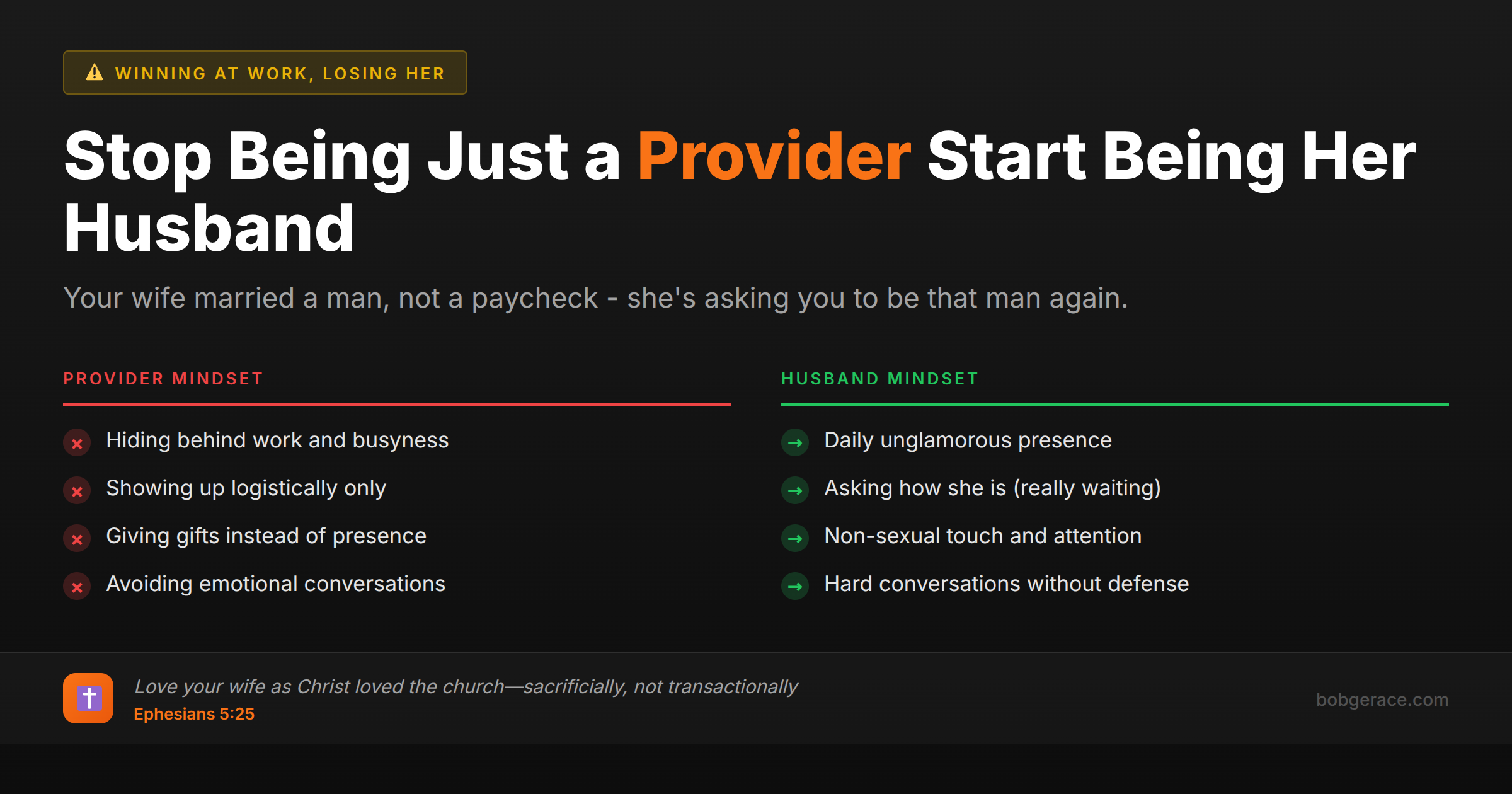
You become a husband again by doing the things that provision cannot buy: presence, attention, emotional availability, and non-transactional love. Your wife does not need you to provide more. She needs you to see her, know her, and choose her even when it is uncomfortable. That means you stop hiding behind your work, your competence, and your busyness. You start showing up emotionally, not just logistically. This is not about grand gestures or expensive gifts. It is about daily, unglamorous presence. It is about asking how she is and waiting for the real answer. It is about initiating non-sexual touch. It is about having hard conversations without defensiveness. It is about letting her see you, not just your performance. Your wife married a man, not a paycheck. She is asking you to be that man again.
The Slow Shift from Partner to Transaction
It did not happen overnight. Early in your marriage, you were present. You asked questions. You were curious about her world. You initiated connection. You made her feel seen. But somewhere along the way, the marriage became a project to manage instead of a relationship to nurture. You started optimizing instead of connecting. You started providing instead of being present. And now your wife feels like a line item in your life, not the center of it.
You still do things for her. You handle the finances, fix what breaks, plan the vacations, and make sure the family is taken care of. From your perspective, you are being a good husband. But she is telling you something different. She says she feels alone. She says you do not really see her. She says she misses the man she married. And when you list everything you do for her, it only proves her point: you still think provision is the same as love.
Your wife does not need you to do more. She needs you to be more. She needs you to be emotionally available, not just logistically helpful. She needs you to ask about her day and actually care about the answer. She needs you to touch her without it leading to sex. She needs you to share what you are struggling with instead of pretending you have it all together. She needs you to be a partner, not a manager.
The shift from provider to husband is not about working less or earning less. It is about reordering your priorities and your presence. It is about recognizing that your wife does not experience your sacrifice at work as love if you come home and are emotionally unavailable. She experiences it as abandonment. You are building a life she does not want to live in because the man she married is not in it anymore.
Rewiring from Transactional to Relational Presence
Most high-performing men operate in a transactional mode. You solve problems, close loops, and move to the next task. That mode makes you successful at work. It makes you a terrible husband. Because marriage is not transactional. It is relational. Your wife does not need you to fix her or optimize her life. She needs you to be with her, to attune to her, and to co-regulate with her nervous system.
When you are stuck in provider mode, you are operating from your prefrontal cortex—logic, strategy, problem-solving. But intimacy happens in the limbic system—emotion, connection, attunement. Your wife is reaching for you emotionally, and you are responding logically. She says she feels alone, and you list everything you have done for her. She shares a struggle, and you immediately offer solutions. She wants presence, and you give her productivity. The mismatch is killing your marriage.
Becoming a husband again requires you to slow down and drop into relational presence. That means you learn to tolerate emotional discomfort without fixing it. You learn to ask questions without an agenda. You learn to listen without planning your response. You learn to be curious about her inner world instead of just managing the external logistics of your shared life. This is not soft. It is hard. It requires more emotional strength than closing a deal or hitting a revenue target.
Your nervous system will resist this. It will tell you that emotions are inefficient, that vulnerability is weak, that you do not have time for this. That resistance is the problem. You have trained yourself to find safety in control and competence. But your wife does not need you to be in control. She needs you to be present. And that requires you to rewire how you show up, not just what you do.
From Duty to Delight: The Biblical Vision of Husband
Scripture does call you to provide. But it calls you to much more. Ephesians 5 says to love your wife as Christ loved the church—not transactionally, but sacrificially. Christ did not just provide for the church from a distance. He gave Himself fully. He was present, engaged, and emotionally invested. He knew His people. He wept with them. He celebrated with them. He did not outsource intimacy. That is the model.
Proverbs 5:18-19 tells you to rejoice in the wife of your youth, to be intoxicated with her love. That is not the language of duty or transaction. That is the language of delight, presence, and emotional engagement. God is not calling you to be a stoic provider who shows up physically but is emotionally absent. He is calling you to be a man who is fully alive in his marriage, who knows his wife deeply, and who lets himself be known.
Genesis 2 says that a man leaves his father and mother and holds fast to his wife, and they become one flesh. One flesh is not just sexual. It is emotional, spiritual, and relational unity. It is the opposite of the divided life where you are one person at work and another person at home. It is the call to be fully present, fully engaged, and fully yourself with your wife. That is what it means to be a husband.
God does not need you to be perfect. He needs you to be present. To show up not just with your wallet, but with your heart. To lead not just with your competence, but with your vulnerability. To love your wife not because she earns it, but because you chose her. That is the kind of husband your marriage needs.
Action Steps
-
1
Ask your wife this week: 'What is one way I act more like a provider than a husband?' Listen without defending. Write down what she says and reflect on it.
-
2
Commit to 15 minutes of undistracted time with your wife every day for the next week. No phones, no logistics, no problem-solving. Just presence.
-
3
Initiate non-sexual physical touch three times this week: a long hug, holding her hand during a walk, sitting close on the couch. Let her feel you without an agenda.
-
4
Share one thing you are struggling with emotionally that you would normally keep to yourself. Let her see you, not just your competence.
-
5
Ask your wife one question about her inner world that you do not already know the answer to: 'What has been hard for you lately?' or 'What do you need from me that you are not getting?' Then listen.
Related Questions
- I make six figures, so why is my wife still unhappy?
- Am I a workaholic husband or just a responsible provider?
- Can a good provider still be an emotionally unavailable husband?
- Why do successful men miss the warning signs at home?
- What if the part of me that wins at work loses at home?
- What if I am physically present but emotionally gone?
Also find Bob on
Subscribe for weekly videos on Christian marriage.
Learn to Be Present, Not Just Productive
Your wife does not need you to provide more. She needs you to be more. I help men move from transactional provision to relational presence before it is too late.
Talk to Bob →