What does my wife need from me after a long workday?
5 min read
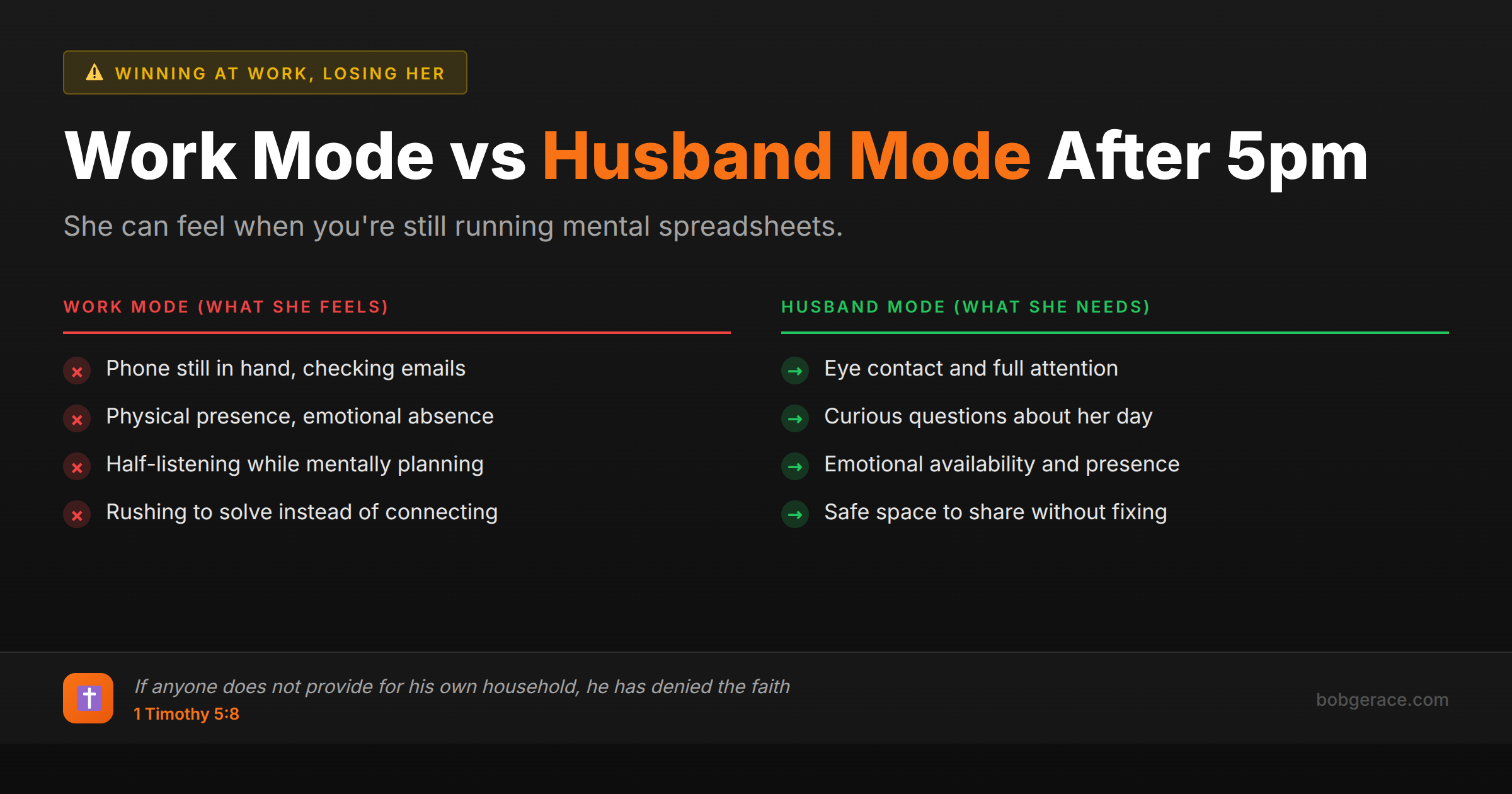
Your wife needs you to transition from work mode to husband mode. That means putting down the phone, making eye contact, asking real questions, and being emotionally present—not just physically in the room. She doesn't need you to solve her day or manage her feelings. She needs you to be curious, engaged, and safe. Most high-performing men walk through the door still running mental spreadsheets. You're still in execution mode. She feels it. What she's asking for is simple but costly: your attention, your emotional availability, and your interest in her inner world. Not later. Not after you decompress. Now.
The Provider Trap: Sacrifice Without Connection
You work hard. You provide well. You sacrifice daily so your family has security, opportunity, and comfort. That matters. But here's the gap most men miss: provision is not the same as presence. Your wife doesn't doubt your work ethic. She doubts whether you still see her.
When you walk through the door, you're often still mentally at the office—emails queued, problems unsolved, adrenaline still running. You think you need 20 minutes to decompress. She's been waiting all day for connection. The gap between those two realities creates distance. Over time, she stops expecting you to engage. She learns to manage her emotional world without you. That's when loneliness sets in.
Many successful men confuse sacrifice at work with intimacy at home. You think, 'I'm doing this for her.' She thinks, 'He's married to his work, not me.' Both can be true. The issue isn't that you work hard. It's that you haven't learned to shift gears when you come home. You're still in operator mode—efficient, task-focused, solution-oriented. She doesn't need a manager. She needs a husband.
This pattern accelerates when kids arrive. You double down at work to provide more. She doubles down at home to manage more. You drift into parallel lives. By the time you notice, she's been alone for years. The house is full. The marriage is empty.
Nervous System Mismatch and Emotional Bids
When you come home in sympathetic activation—stress hormones elevated, mind racing, body tense—you're not available for connection. Your nervous system is still in threat-response mode. Your wife can feel it. She makes what Dr. John Gottman calls an 'emotional bid'—a question, a comment, a look. If you turn toward her, connection builds. If you turn away or turn against, resentment builds.
Most men turn away without realizing it. You grunt a response. You scroll your phone. You say 'uh-huh' while thinking about tomorrow's meeting. She registers each moment as rejection. Over months and years, those micro-rejections compound into a belief: 'He doesn't care about my world. I'm alone.'
Attachment research shows that emotional availability matters more than time quantity. A distracted hour together creates more distance than no time at all. Your wife's nervous system is scanning for safety: 'Does he see me? Does he care? Am I important to him?' If the answer feels like 'no,' her system moves toward self-protection. She stops reaching. She stops sharing. She builds a life that doesn't require you emotionally.
This isn't about working less. It's about transitioning better. High performers are good at compartmentalizing—until it costs them their marriage. You can't compartmentalize intimacy. Your wife needs to know she's not another item on your task list.
Provision and Presence: Both Matter
Scripture calls men to provide. 'If anyone does not provide for his relatives, and especially for his own household, he has denied the faith' (1 Timothy 5:8). That's real. But provision without presence is not biblical manhood. It's half the assignment.
Jesus modeled both strength and tenderness. He worked. He also withdrew to pray, engaged deeply with people, and prioritized relationship over productivity. He didn't confuse busyness with faithfulness. When the disciples tried to manage the crowd, Jesus said, 'Let the children come to me.' He made space. He was present.
Ephesians 5 tells husbands to love their wives as Christ loved the church. That love is sacrificial, yes—but it's also intimate, attentive, and nurturing. Christ doesn't provide for the church from a distance. He's present. He knows. He engages. Your wife needs the same.
Many Christian men use provision as a shield against emotional risk. It's easier to work than to connect. Easier to solve than to listen. Easier to be respected than to be known. But God calls you to both. Provide well and be present fully. Your work matters. So does your marriage. One doesn't replace the other.
Action Steps
-
1
Create a 10-minute transition ritual before you walk in the door—park in the driveway, take five deep breaths, pray, and mentally shift from work mode to husband mode.
-
2
Greet your wife first, before kids, phone, or tasks—make eye contact, ask one real question, and listen to the full answer without solving.
-
3
Set a daily 20-minute no-phone window after you get home where you're fully present—sit together, ask about her day, and stay curious.
-
4
Notice when you're still in operator mode—if you're problem-solving, managing, or multitasking during conversation, pause and reset.
-
5
Ask her directly: 'What do you need from me when I get home?'—then honor her answer even if it feels inconvenient.
Related Questions
- I make six figures, so why is my wife still unhappy?
- Am I a workaholic husband or just a responsible provider?
- Can a good provider still be an emotionally unavailable husband?
- Why do successful men miss the warning signs at home?
- What are the signs my marriage is falling apart?
- What signs do successful men miss before separation?
Also find Bob on
Subscribe for weekly videos on Christian marriage.
You Can't Fix This Alone
Most men don't realize how far the distance has grown until it's almost too late. If your wife has been saying she feels alone, don't wait until she stops saying it. Let's talk about what's actually happening in your marriage and what you can do now.
Talk to Bob →