What if the part of me that wins at work loses at home?
6 min read
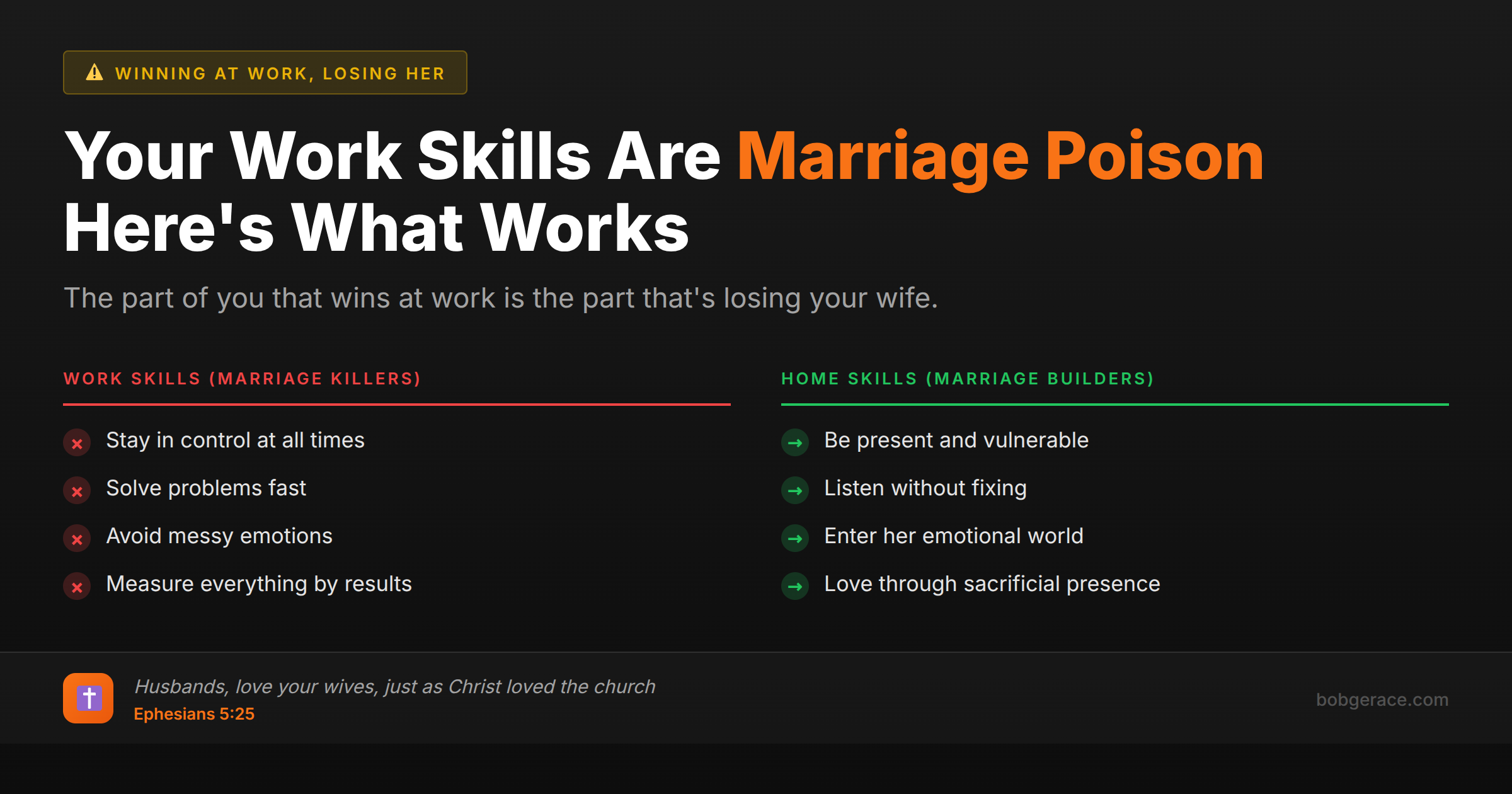
The part of you that wins at work is the part that stays in control, solves problems fast, avoids emotions, and measures everything by results. That part is an asset in business. It is poison in marriage. Your wife does not need a manager, a consultant, or a performance review. She needs a husband who can be present, vulnerable, and emotionally available. And that requires a completely different operating system. You are not failing at home because you are weak. You are failing because you are using the wrong tools. The skills that make you successful at work—efficiency, control, emotional distance, task focus—are the same skills that make your wife feel unseen, unheard, and unloved. Until you learn to lead differently at home, you will keep winning at work and losing the woman you married.
The High-Performer's Intimacy Problem
You are good at what you do. You solve problems, you lead teams, you close deals, you execute under pressure. You have built a career on being competent, decisive, and emotionally controlled. Those traits make you valuable at work. They make you unavailable at home.
Here is what happens. You walk in the door after a day of high-stakes decisions, and your wife wants to talk about her day, her feelings, or something that feels small compared to what you just handled. Your brain is still in work mode: assess, solve, move on. So you half-listen, offer a solution, and wonder why she gets frustrated. She does not want a solution. She wants connection. But connection requires presence, and presence requires you to turn off the part of you that has been running all day.
You are not trying to hurt her. You are just operating in the only mode you know. At work, efficiency is rewarded. At home, efficiency is experienced as dismissiveness. At work, emotional control is leadership. At home, emotional control is distance. At work, results matter. At home, process matters. Your wife does not care how fast you solve the problem. She cares whether you are with her while she talks about it.
The part of you that wins at work is the part that stays above the mess, stays focused on outcomes, and does not get distracted by feelings. The part of you that wins at home is the part that enters the mess, sits with the feelings, and prioritizes connection over efficiency. Most high-performers never learn to toggle between these modes. So they bring the boardroom home, and their wife feels like an employee who can never meet expectations.
Why Your Work Brain Kills Intimacy
Your work brain operates in what neuroscience calls task-positive mode. It is focused, goal-oriented, and emotionally detached. This mode is necessary for performance, but it shuts down the default mode network, the part of your brain responsible for empathy, self-reflection, and relational attunement. You cannot be in both modes at once. When you are in work mode, you are neurologically unavailable for intimacy.
High-performers also tend to have avoidant attachment patterns. You learned early that emotions are distractions, that vulnerability is weakness, and that love is earned through achievement. So you achieve, and you expect your wife to appreciate the results. But she does not experience your achievement as love. She experiences it as absence. She does not want your success. She wants your presence. And presence requires you to drop the armor that makes you successful.
This is why your wife says things like, 'You are not listening,' or 'You do not care how I feel.' You hear those as attacks. They are actually bids for connection. She is telling you that the mode you are in is not the mode she needs. But because you have spent your whole life being rewarded for that mode, you double down. You get defensive, you explain how hard you work, and you prove her point: you care more about being right than being close.
The part of you that wins at work is also the part that avoids conflict, controls outcomes, and stays emotionally regulated. Those are survival skills in a high-pressure career. They are intimacy killers in marriage. Your wife does not need you to stay calm and solve her problems. She needs you to feel with her, even when it is uncomfortable. Until you learn that, you will keep winning deals and losing her.
Leadership at Home Is Not Leadership at Work
Scripture calls you to lead your home, but it does not call you to lead it like a business. Ephesians 5:25 says, "Husbands, love your wives, just as Christ loved the church and gave himself up for her." Christ did not lead the church with efficiency and emotional distance. He led with sacrificial presence. He washed feet. He wept. He entered the mess.
You are called to be the head of your home (Ephesians 5:23), but headship in Scripture is not about control or competence. It is about laying down your life. That means laying down your need to be right, your need to fix everything, and your need to stay in control. It means being present even when presence feels inefficient. It means listening even when you do not have a solution.
James 1:19 says, "Everyone should be quick to listen, slow to speak and slow to become angry." That is the opposite of how you operate at work. At work, you are quick to speak, quick to decide, and quick to move on. At home, that approach makes your wife feel steamrolled. She does not need you to be quick. She needs you to be present. She does not need your competence. She needs your heart.
Jesus was fully God and fully man. He had all power, but He chose vulnerability. He had all authority, but He chose service. You have competence, success, and control. But if you want to lead your wife well, you have to choose presence over performance. You have to learn to lead with your heart, not just your head. That is what Christ did. That is what your marriage needs.
Action Steps
-
1
Create a transition ritual when you get home: sit in your car for five minutes, breathe, and pray, 'God, help me be present, not productive.'
-
2
This week, when your wife shares something, do not offer a solution. Just say, 'Tell me more,' and listen for five minutes without fixing.
-
3
Identify one work skill you rely on—control, efficiency, problem-solving—and notice when you use it at home. Confess it to your wife when you catch yourself.
-
4
Ask your wife: 'What is one way I make you feel like a project instead of a person?' Then listen without defending.
-
5
Schedule one hour this week where you are fully present with your wife: no phone, no problem-solving, just connection.
Related Questions
- I make six figures, so why is my wife still unhappy?
- Am I a workaholic husband or just a responsible provider?
- Can a good provider still be an emotionally unavailable husband?
- Why do successful men miss the warning signs at home?
- What does it mean to leave my wife alone emotionally?
- What if I have time for clients but not for my wife?
Also find Bob on
Subscribe for weekly videos on Christian marriage.
You Can Win at Work and at Home.
If the skills that make you successful are killing your marriage, you need a different playbook. Bob helps high-performers learn to lead at home without losing what makes them great at work.
Talk to Bob →