What marriage mistakes do high-achieving men make?
6 min read
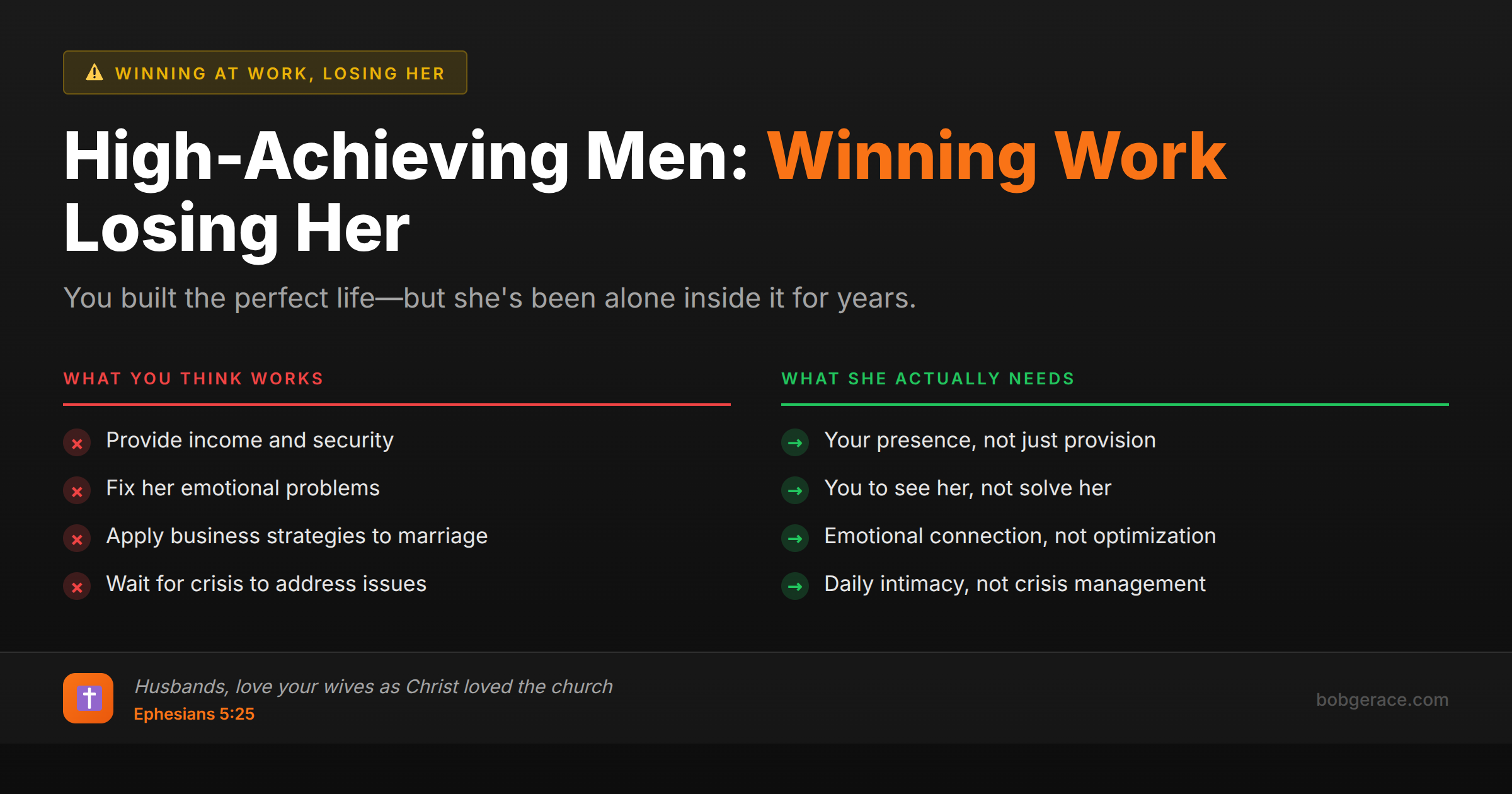
High-achieving men make three core mistakes: they confuse provision with presence, they apply work strategies to intimacy problems, and they wait until crisis to address emotional distance. You built the income, the house, the security—but your wife has been alone inside that life for years. She doesn't need you to solve her. She needs you to see her, stay present when she's hurt, and stop treating emotional conversations like problems to close. The second mistake is optimization thinking. You approach marriage like a business problem: identify the issue, implement the solution, expect results. But intimacy doesn't work that way. Your wife doesn't want a performance plan. She wants a husband who can sit in discomfort without fixing, who notices her before she has to ask, and who shows up emotionally even when there's no crisis to solve.
The Provider Trap: When Success Becomes Distance
You crushed it at work. Six figures. Maybe seven. You provided everything you said you would. The house. The vacations. The security. You sacrificed time, energy, and presence to build a life most men only dream about. And now your wife says she feels alone. It doesn't make sense. You gave her everything.
Except you didn't. You gave her provision. You didn't give her presence. There's a difference, and that difference is killing your marriage.
Here's what happens: You learn early that performance equals value. You win at work by outworking everyone, by solving problems faster, by delivering results. That same engine that built your career becomes the thing that hollows out your marriage. You come home depleted. You've already given your best energy to clients, employees, deals. Your wife gets what's left—which is usually nothing.
She doesn't feel like a priority. She feels like a dependent. You touch her when you want sex. You listen when she's crying, but you're already thinking about how to fix it so the conversation ends. You're present in the house, but absent in the relationship. She's not ungrateful. She's lonely. And loneliness inside a marriage is worse than loneliness alone.
The brutal truth: your success may have bought comfort, but it also bought distance. You optimized for income and lost intimacy. You built a life she can't leave, but also can't stay in. That's the provider trap. You think you're winning. She thinks you're gone.
Why High Performers Fail at Intimacy
High-achieving men often operate from an avoidant attachment system under stress. At work, that's an advantage. You stay calm under pressure. You don't get emotional. You solve problems and move on. But at home, that same system reads as coldness. Your wife reaches for connection, and you reach for control. She wants to be felt. You want to fix and finish.
This creates a pursue-withdraw cycle. She pursues emotionally—trying to get you to engage, to feel something, to stay in the conversation. You withdraw—not because you don't care, but because you're dysregulated. Her emotion feels like chaos. Your nervous system says: solve this or exit. So you do both. You offer solutions, then leave the room. She feels abandoned. You feel attacked. The loop tightens.
Here's the clinical piece most men miss: your wife's nervous system is tracking your presence, not your productivity. She's not measuring how much you provide. She's measuring how safe she feels with you. And right now, she doesn't. You're reliable at work and unreachable at home. That inconsistency creates insecure attachment. She stops reaching. She stops asking. She stops expecting you to show up. That's not peace. That's resignation.
The other mistake is applying performance logic to intimacy. You think: if I do X, she'll feel Y. But intimacy isn't transactional. She doesn't want you to perform. She wants you to stay. To not fix. To not flee. To be present in discomfort without making it about you. That's the skill you never built. And it's the skill your marriage is dying without.
Provision Without Presence Is Not Biblical Leadership
Scripture is clear: husbands are called to love their wives as Christ loved the church (Ephesians 5:25). That's not a call to provide. It's a call to sacrifice, presence, and intimacy. Jesus didn't send checks. He showed up. He washed feet. He stayed present in suffering. He gave His life, not His résumé.
You're called to lead, but leadership isn't about control or productivity. It's about laying down your life daily. That means laying down your phone. Your work stress. Your need to be right. Your impulse to fix her instead of feel with her. Provision matters, but it's not the same as love. You can provide everything and love nothing. Your wife doesn't need a better benefits package. She needs a husband who sees her, stays with her, and doesn't disappear into work every time intimacy gets uncomfortable.
Proverbs 31 celebrates the capable wife, but it also assumes a husband who is present, known at the gates, engaged in the home. You can't lead from a distance. You can't shepherd a wife you never see. And you can't build a one-flesh marriage when you're emotionally checked out six days a week.
God didn't design you to win at work and lose at home. He designed you to steward both. That requires presence, not just performance. It requires intimacy, not just income. If your marriage is falling apart while your career is thriving, you're not winning. You're just busy.
Action Steps
-
1
Audit your energy: track one week and note when you give your best energy to work vs. your wife. Be honest about what she actually gets.
-
2
Stop fixing her feelings: next time she's upset, say 'I'm here' and stay in the room for five minutes without offering a solution.
-
3
Schedule presence, not tasks: put 30 minutes on your calendar three times this week where you're home, phone off, just available to her.
-
4
Ask her one question: 'What's one way I've been absent that I don't see?' Then listen without defending.
-
5
Confess the gap to God: pray specifically about the distance between your work success and your marriage presence, and ask Him to reorder your priorities.
Related Questions
- I make six figures, so why is my wife still unhappy?
- Am I a workaholic husband or just a responsible provider?
- Can a good provider still be an emotionally unavailable husband?
- Why do successful men miss the warning signs at home?
- What if I am physically present but emotionally gone?
- Am I using work to avoid my marriage?
Also find Bob on
Subscribe for weekly videos on Christian marriage.
You Don't Have to Lose Her to Learn This
Most high-achieving men wait until she's done to get help. You don't have to. If you're winning at work but losing her, let's talk about what presence actually looks like before it's too late.
Talk to Bob →