What should I do if my wife says she needs space?
6 min read
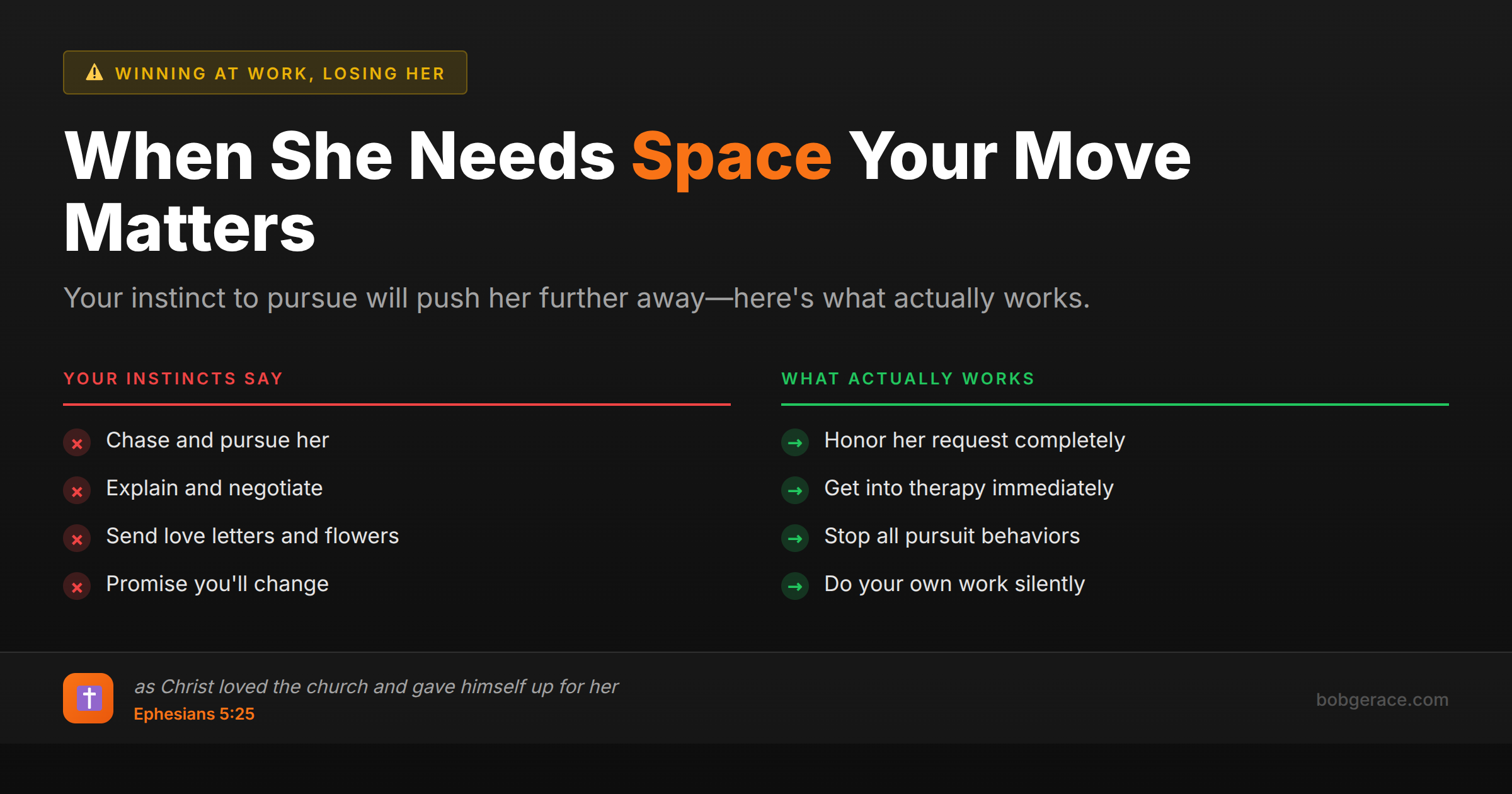
Stop trying to fix it with words. When your wife says she needs space, she's telling you that your presence—as you've been showing up—feels unsafe, draining, or empty. Your instinct will be to pursue, explain, promise, or negotiate. That instinct is wrong. It will push her further away because it proves you still don't hear her. Your job right now is to give her the space she asked for while becoming a different man in that space. Not different as a performance. Different because you've done the hard work of looking at how you've contributed to her exhaustion, loneliness, or distrust. She needs space from the man who has been emotionally unavailable, defensive, or only present when he wants something. She doesn't need space from a man who is grounded, honest, and doing his own work without needing her approval.
What 'I Need Space' Really Means
When a successful man's wife asks for space, it's rarely the first signal. It's usually the tenth or twentieth. She's been trying to tell you she feels alone, unseen, or used for months or years. She's asked you to listen, to be present, to care about her inner world. You've been too busy, too defensive, or too focused on solving her feelings instead of sitting with them.
Now she's protecting herself. Space is her nervous system's way of saying, 'I can't keep giving to someone who doesn't see me.' It's not necessarily about another man, an affair, or a decision to divorce. It's about survival. She's depleted. She's tired of being touched only when you want sex. She's exhausted by your work obsession, your phone addiction, your porn habit, or your emotional unavailability. She's done being the only one trying.
You'll want to panic. You'll want to send flowers, write letters, promise change, or double down on pursuit. That's your fear talking. It's also the same pattern that got you here: you trying to control her feelings instead of owning your behavior. She doesn't need your promises. She needs evidence that you're capable of looking at yourself without her having to manage your emotions about it.
This moment is a test. Not of whether you can win her back with the right words, but whether you can become the kind of man who doesn't need her validation to do what's right. If you chase her, you'll confirm her fears. If you ignore her request and pretend everything's fine, you'll prove you still don't listen. If you give her space while doing nothing to change, you'll waste the opportunity. The only path forward is to honor her request while becoming someone worth coming back to.
The Nervous System Behind the Request
When your wife asks for space, her nervous system is in a protective state. She's likely oscillating between hyperarousal—anxiety, anger, vigilance—and hypoarousal—shutdown, numbness, disconnection. Both are survival responses. She doesn't feel safe with you, not because you're physically dangerous, but because emotionally, you've been unpredictable, dismissive, or absent.
Attachment research shows that when a partner repeatedly fails to attune—when you don't notice her bids for connection, when you minimize her concerns, when you prioritize work or screens over her presence—she moves from protest (fighting for your attention) to despair (giving up) to detachment (protecting herself). Space is often the detachment phase. She's no longer fighting for you to see her. She's conserving energy and protecting what's left of herself.
Your nervous system, meanwhile, is likely in panic mode. You're used to solving problems, closing deals, and controlling outcomes. Her withdrawal triggers your fear of failure, rejection, or loss. That fear will drive you to pursue, fix, or perform. But pursuit when she's asked for space activates her threat response even more. It tells her you're still not listening, still prioritizing your need for relief over her need for safety.
The clinical reality is this: you can't regulate her nervous system from the outside. You can only regulate your own. When you stop chasing, stop defending, and start doing your own emotional work—therapy, coaching, honest self-inventory—you create the conditions for her to feel safe again. Not because you've manipulated her feelings, but because you've become predictable, grounded, and trustworthy. That's what her nervous system needs to move from protection back to connection.
Stewarding the Space She Needs
Scripture is clear about how a husband is called to love his wife: 'as Christ loved the church and gave himself up for her' (Ephesians 5:25). That doesn't mean pursuing her when she's asked for distance. It means laying down your need to control her response and doing the hard work of becoming who God has called you to be, whether she ever comes back or not.
Christ didn't chase. He didn't manipulate. He didn't perform to earn love. He was steady, truthful, and willing to bear the weight of rejection without retaliating or collapsing. When your wife asks for space, you're being invited into that same posture: to love her by respecting her boundary, to serve her by becoming healthier yourself, and to lead by example rather than by force.
Proverbs 25:28 says, 'A man without self-control is like a city broken into and left without walls.' If you can't honor her request for space without falling apart, blaming her, or trying to manipulate her back, you're proving you don't have the self-control required to lead a marriage. Your job is to rebuild those walls—not around her, but within yourself. To become a man who can sit with discomfort, own his failures, and trust God with outcomes he can't control.
This is also where repentance becomes real. Not the kind where you say sorry to get her back, but the kind where you turn from the patterns that hurt her—workaholism, emotional laziness, porn, defensiveness—and walk a different path whether she's watching or not. That's the love that reflects Christ. That's the love that creates space for her to heal and for God to work.
Action Steps
-
1
Honor her request for space without negotiating, explaining, or asking how long it will last.
-
2
Get into individual coaching or therapy immediately to work on your own patterns, not to fix her.
-
3
Stop all pursuit behaviors: no love letters, no flowers, no grand gestures designed to change her mind.
-
4
Identify the specific ways you've been emotionally unavailable, defensive, or self-focused, and write them down honestly.
-
5
Commit to a daily practice—prayer, journaling, 12-step work, or therapy homework—that builds your capacity to self-regulate without needing her approval.
Related Questions
- Can I rebuild trust before she makes a final decision?
- How do I become trustworthy after years of not showing up?
- What if my wife says she is done but has not filed?
- What if my wife says she loves me but is not in love?
- What should I change before my wife leaves?
- What should I do in the six months before she leaves?
Also find Bob on
Subscribe for weekly videos on Christian marriage.
Before the Space Becomes Permanent
If your wife has asked for space, you're in the window where your response will determine the trajectory of your marriage. I work with men in exactly this moment to help them become grounded, honest, and emotionally available before fear turns them into someone she can't trust.
Talk to Bob →