Why does achievement not protect my marriage?
6 min read
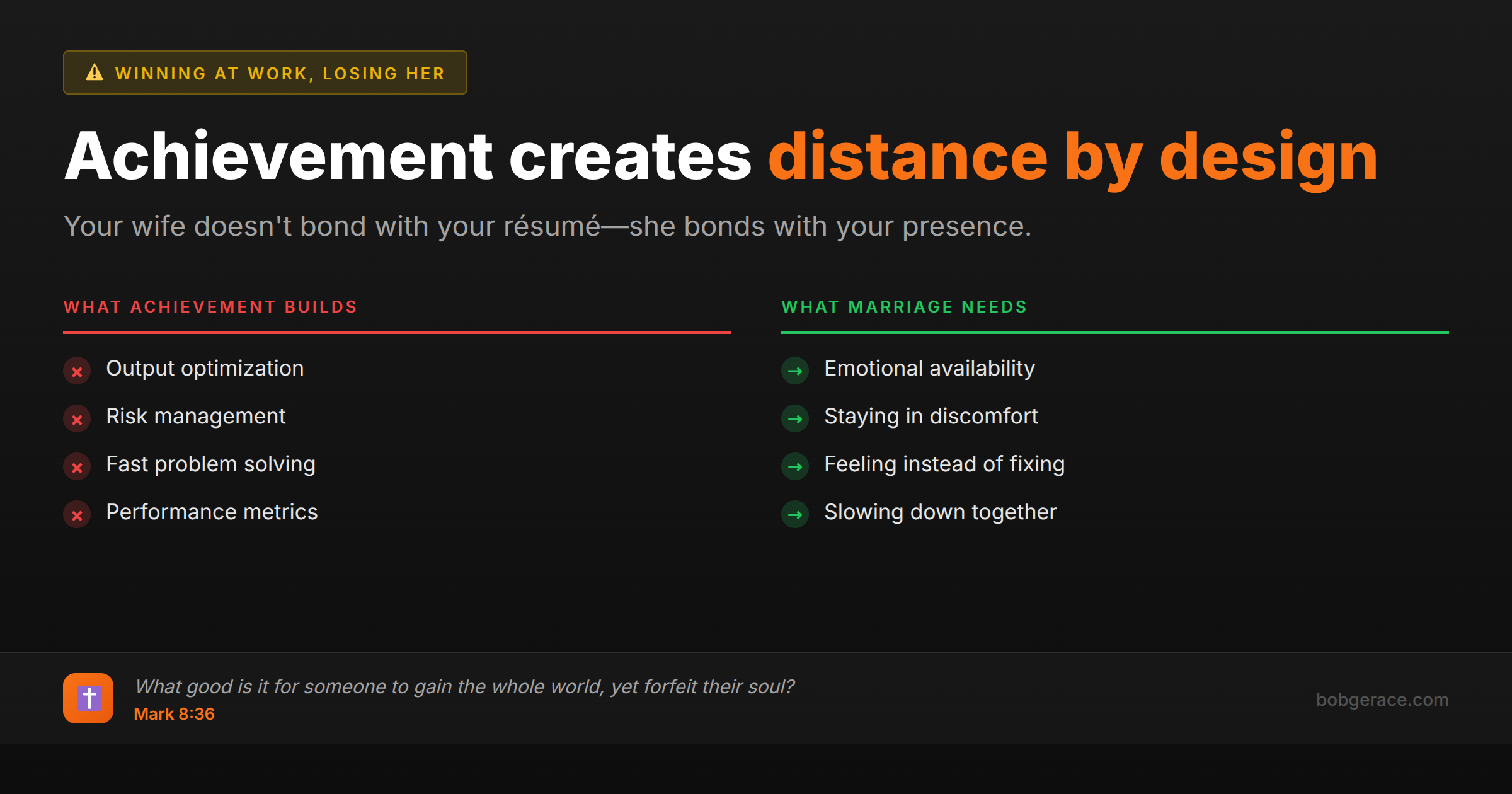
Achievement doesn't protect your marriage because intimacy isn't built on performance—it's built on presence. Your wife doesn't bond with your résumé. She bonds with your attention, your emotional availability, and your willingness to stay present when things are hard. You can close every deal and still lose her, because the skills that make you successful at work often make you unavailable at home. The second reason: achievement creates distance by design. You're optimizing for output. You're managing risk. You're solving problems fast and moving on. But marriage requires you to slow down, to feel instead of fix, to stay in discomfort without an exit strategy. The same drive that built your career is the thing that's hollowing out your marriage. Success didn't protect you. It distracted you.
The Illusion That Success Equals Security
You thought if you built enough, she'd feel secure. If you earned enough, she'd feel valued. If you provided enough, she'd feel loved. So you worked. You sacrificed. You delayed gratification, missed dinners, skipped vacations, and told yourself it was all for her. For the family. For the future.
And now she's telling you she's been alone for years. It doesn't compute. You gave everything. How is that not enough?
Here's the truth: you gave everything except yourself. You provided security, but you didn't provide presence. You built a life she can live in, but you're not actually living in it with her. She doesn't feel like your partner. She feels like your dependent. You're the landlord of a life she's lonely inside.
Achievement protects against financial collapse. It doesn't protect against emotional collapse. Your wife isn't leaving because you didn't provide. She's leaving because you didn't stay. You didn't notice her. You didn't prioritize her. You didn't choose her when work demanded more. And after years of coming in second to your career, she stopped competing for first place.
The brutal part: you thought success was the answer. You thought if you just worked harder, earned more, built bigger, she'd see your love. But she didn't see love. She saw absence. She saw a man who could show up for clients but not for her. A man who could stay late for a deal but couldn't stay present for a conversation. Achievement didn't protect your marriage. It became the rival.
Why Performance Thinking Kills Intimacy
High achievers operate in a performance-reward loop. You set a goal, execute, get rewarded, repeat. That loop works in business. It fails in marriage. Because intimacy isn't a performance metric. Your wife doesn't want you to earn her. She wants you to see her. She doesn't want optimization. She wants your attention.
Here's what happens neurologically: when you're in high-performance mode, your prefrontal cortex is running the show. You're strategic, logical, efficient. But intimacy requires your limbic system—the part of your brain that feels, connects, attaches. When you come home still in work mode, you're literally using the wrong part of your brain. She's trying to connect emotionally, and you're trying to solve logically. It's a mismatch. She feels unheard. You feel unappreciated.
This creates a dynamic where your wife starts to see your success as the problem, not the solution. Every promotion is another layer of distance. Every business trip is another week she's alone. Every late night is another signal that work matters more than she does. She's not being unreasonable. She's responding to a pattern. You're married to your career. She's the mistress.
The other clinical piece: achievement often masks avoidant attachment. You stay busy so you don't have to feel. You solve problems so you don't have to sit in discomfort. You optimize your schedule so there's no space for emotional unpredictability. But marriage is unpredictable. Your wife has needs you can't schedule. Feelings you can't fix. Hurt you can't solve with a strategy. And when you try, she doesn't feel helped. She feels managed. That's not intimacy. That's control.
Success Is Not the Same as Faithfulness
Jesus didn't call you to be successful. He called you to be faithful. There's a difference. Success is about outcomes. Faithfulness is about obedience. You can succeed at work and fail at home. You can build a kingdom and lose your family. The rich young ruler had everything. Jesus told him to give it up. Not because wealth is bad, but because it had become his god.
Your career isn't your god—yet. But it's close. You've organized your life around it. You've sacrificed your marriage for it. You've told yourself it's for her, but really, it's for you. It's for the validation. The status. The sense of control. Work is where you feel competent. Home is where you feel inadequate. So you stay at work.
Scripture is clear: 'What does it profit a man to gain the whole world and forfeit his soul?' (Mark 8:36). You're gaining the world. You're forfeiting your marriage. That's not wisdom. That's idolatry. God didn't design you to win at work and lose at home. He designed you to steward both. And right now, you're failing at stewardship because you're succeeding at everything else.
Ephesians 5 doesn't say 'Husbands, provide for your wives.' It says 'Husbands, love your wives, as Christ loved the church.' Christ didn't send resources. He gave Himself. Fully. Sacrificially. Present. That's the standard. Not your income. Not your title. Your presence. Your attention. Your heart. If you're too busy to love her, you're too busy.
Action Steps
-
1
Name the rival: write down how many hours you gave to work this week vs. how many you gave to your wife. Let the gap speak.
-
2
Ask her directly: 'Do you feel like you come second to my career?' Don't defend. Just listen.
-
3
Block one evening this week: no work, no phone, no agenda. Just be home and available. See what happens.
-
4
Identify one work habit that creates distance: late emails, weekend calls, mental absence at dinner. Cut it for two weeks.
-
5
Pray for reordering: ask God to show you where success has become your functional savior and where your marriage has become your functional mission field.
Related Questions
- I make six figures, so why is my wife still unhappy?
- Am I a workaholic husband or just a responsible provider?
- Can a good provider still be an emotionally unavailable husband?
- Why do successful men miss the warning signs at home?
- Am I using work to avoid my marriage?
- How do I become a husband again, not just a provider?
Also find Bob on
Subscribe for weekly videos on Christian marriage.
Success Won't Save Your Marriage
You've built everything except intimacy. If your achievement isn't protecting your marriage, it's time to learn what actually does. Let's talk before she stops asking you to stay.
Talk to Bob →